
What does warmth cost per shift? Disposable warmers vs battery vs heat-reflective
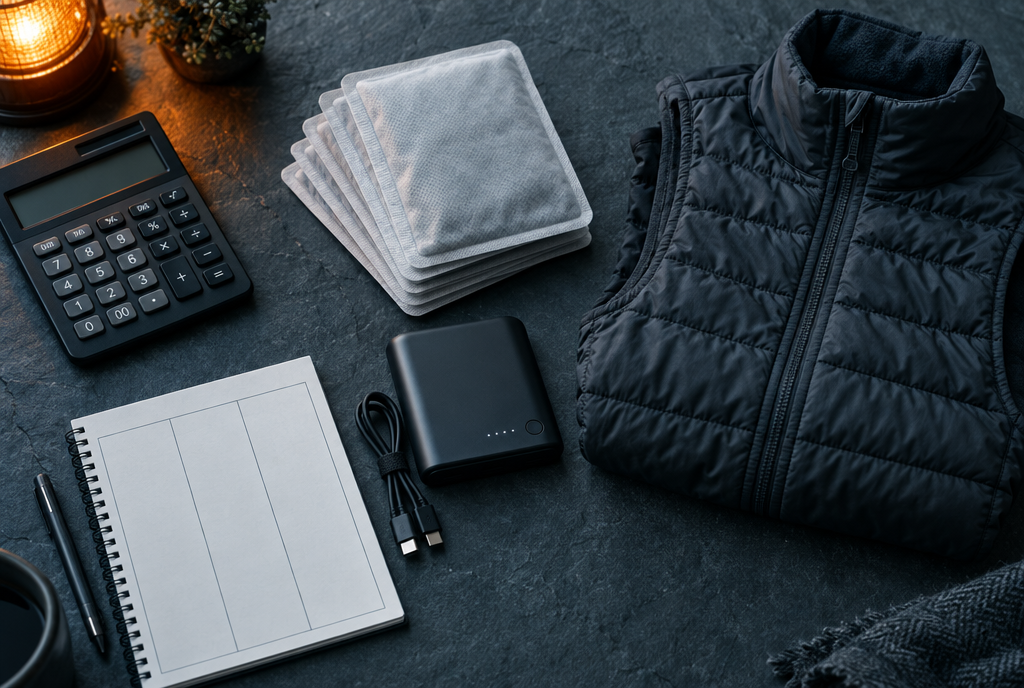
Over a season, disposable warmers cost little per shift but add up with every shift, while a battery-heated vest costs more up front and very little to run. Using listed prices and a 100-shift illustrative season, one pair of warmers a shift runs about $69 to $149 per worker, and a $180 heated vest pays back in about two to three seasons.
Warmth runtime and season cost calculator
Enter your own numbers. Defaults are illustrative, based on listings checked in September 2026; they are not quotes.
| Option | Runtime check | Season 1 per person | Average per season | Season 1 for the group |
|---|
How it works: warmer pairs per shift = hours needed ÷ label hours, rounded up. Battery runtime = watt-hours ÷ heater draw, reduced for cold as a rough planning estimate (lithium-ion packs can deliver about half their capacity near 0°F). Extra packs are added when one charge cannot cover the shift. Warmers and a heated vest are not identical warmth: warmers heat hands or one spot, a vest heats the core. Anyone with diabetes, neuropathy or reduced sensation should talk to a clinician before relying on heated gear or warmers.
How is this different from comparing cost per hour?
Our comparison of battery heat and hand warmers looks at cost and runtime per hour of heat. This page takes the budget view: what one worker, and a team of 20, spends across a whole cold season, including the up-front purchase.
The figures below are illustrative. The prices are real listings checked in September 2026, but the season length, usage and product life are assumptions. Replace them with your own.
What is the formula for season cost?
Each option reduces to a few inputs you can look up. Use the same number of cold shifts for every option so the comparison is fair.
Disposable warmers: shifts × pairs per shift × price per pair
Battery-heated vest, first season: vest price + spare packs + charging energy
Battery-heated vest, per season over its life: (vest price + spare packs) ÷ seasons of use + charging energy
Charging energy: pack watt-hours × charges ÷ 1,000 × electricity price per kWh
Passive vest with warmers on the coldest shifts: vest price ÷ seasons + (cold shifts × price per pair)
Payback in seasons: battery up-front cost ÷ (disposable season cost minus battery running cost)
What assumptions does the example use?
Prices come from listings; everything else is a stated assumption. HotHands lists its hand warmers, rated up to 10 hours, at $14.90 for 10 pairs, $39.35 for 40 pairs and $165.00 for a 240-pair case, or about $1.49, $0.98 and $0.69 a pair. Another retailer lists a 40-pair pack at $32.99.
For the battery option, Venustas lists a women's heated vest with a 74 Wh pack at $179.99, rated up to 20 hours on low, with a 3-year limited warranty on heating elements and 1 year on the battery. EIA's September 2026 outlook puts the 2026 average US residential electricity price at 18.2 cents per kWh.
Assumption: 100 cold shifts per season
Assumption: one pair of hand warmers per shift for the disposable option
Assumption: one full charge of the 74 Wh pack per shift
Assumption: the heated vest lasts three seasons
Assumption: the passive option uses warmers on half of shifts
What does a season cost per worker and for a team of 20?
Charging is almost free: 74 Wh a shift for 100 shifts is 7.4 kWh, about $1.35 at 18.2 cents. Team figures are pro rata; buying whole cases rounds them up slightly. The passive vest's price is left as V so you can enter your own.
| Option | Up front per worker | Season 1 per worker | Season 1, team of 20 |
|---|---|---|---|
| Warmers, 240-pair case | $0 | $68.75 | $1,375.00 |
| Warmers, 40-pair box | $0 | $98.38 | $1,967.50 |
| Warmers, 10-pair pack | $0 | $149.00 | $2,980.00 |
| Heated vest, 74 Wh | $179.99 | $181.34 | $3,626.80 |
| Heated vest, spread over 3 seasons | $179.99 | $61.35 per season | $1,227 per season |
| Passive vest, warmers on half of shifts | V | V + $34.38 | 20V + $687.50 |
When does a battery vest pay for itself?
Using the payback formula, a $179.99 vest against case-price warmers breaks even after about 2.7 seasons ($179.99 ÷ $67.40). Against 40-pair boxes it breaks even in about 1.9 seasons ($179.99 ÷ $97.03). Pay more per pair, or use two pairs a shift, and payback comes sooner.
Cycle life is rarely the limit. ororo lists one 35 Wh pack as rechargeable up to 800 times and prices it at $59.99, so 100 charges a season leaves room; age, damage and warranty length matter more. Add a spare pack if your shifts outlast one charge.
What costs does the simple formula miss?
The options are not identical warmth. Hand warmers heat hands; a vest heats the core. Many crews combine them, so model the mix you will actually use.
Usage moves the result more than price. If your crew uses two pairs a shift, or hand and toe warmers together, double the disposable rows. If shifts outlast one charge, add a spare pack to the battery row. If cold days are few, disposables may stay cheaper for years.
Lost, damaged or unreturned vests and packs
Charging space, chargers and safe battery storage for a team
Laundering, and who does it
Battery replacement after the warranty period
Battery recycling and warmer disposal
Staff time to issue, track and replace gear
Where HEATJAC fits
HEATJAC REFLECT belongs in the passive row: a lightweight heat-reflective vest with integrated warming pockets for compatible warming elements (sold separately) and no built-in battery. Enter its price as V, and count warmers only on the shifts you expect to need them.
Key takeaways
Compare options over a full season, not a single shift.
Disposable cost scales with every shift; battery cost is mostly up front.
In the example, a $180 heated vest pays back in about two to three seasons against warmers.
Charging costs are negligible; loss, damage, storage and replacements are not.
Use the formula with your own prices, shifts and usage.
Frequently asked questions
Are rechargeable warmers cheaper than disposable ones?
Over several seasons they usually are, if they last and you use them often. With few cold days, disposables can cost less because there is no up-front purchase.
How much do hand warmers cost per shift?
At listed prices, one pair costs about $0.69 in a 240-pair case, about $0.98 in a 40-pair box and about $1.49 in a 10-pair pack. Multiply by pairs per shift.
How much does it cost to charge a heated vest?
Very little. A 74 Wh pack charged once a shift for 100 shifts uses about 7.4 kWh, roughly $1.35 at 18.2 cents per kWh, before charger losses.
How should an employer budget for a team of 20?
Multiply per-worker costs by 20, then add spares, loss, charging and storage, and administration. Buying warmers by the case lowers the per-pair price but ties up storage.
Is a passive vest cheaper than a heated vest?
It depends on its price and how many warmers you add. A passive vest has no charging or battery replacement, so its season cost is its price spread over its life plus any warmers.
Related reading
Sources
HotHands 2-Hand Warmers (10 pair, 40 pair and 240 pair case), HotHands Direct
HotHands Air Activated Hand Warmers, 40 Pair Value Pack, Warmers.com
Women's Heated Vest 7.4V (Up to 20 heating hours), W2118 Max, Venustas
Short-Term Energy Outlook, Table 7c: U.S. Regional Electricity Prices, US Energy Information Administration
About HEATJAC. HEATJAC is a thermal architecture company founded by an anesthesiologist. We design patented garment systems that capture, conduct and broaden warmth across the body, and we publish this knowledge hub because the science of staying warm should be public. HEATJAC products are not medical devices and are not intended to diagnose, treat, cure or prevent any disease.