
Heated and thermal gear: the buying, safety and care guide
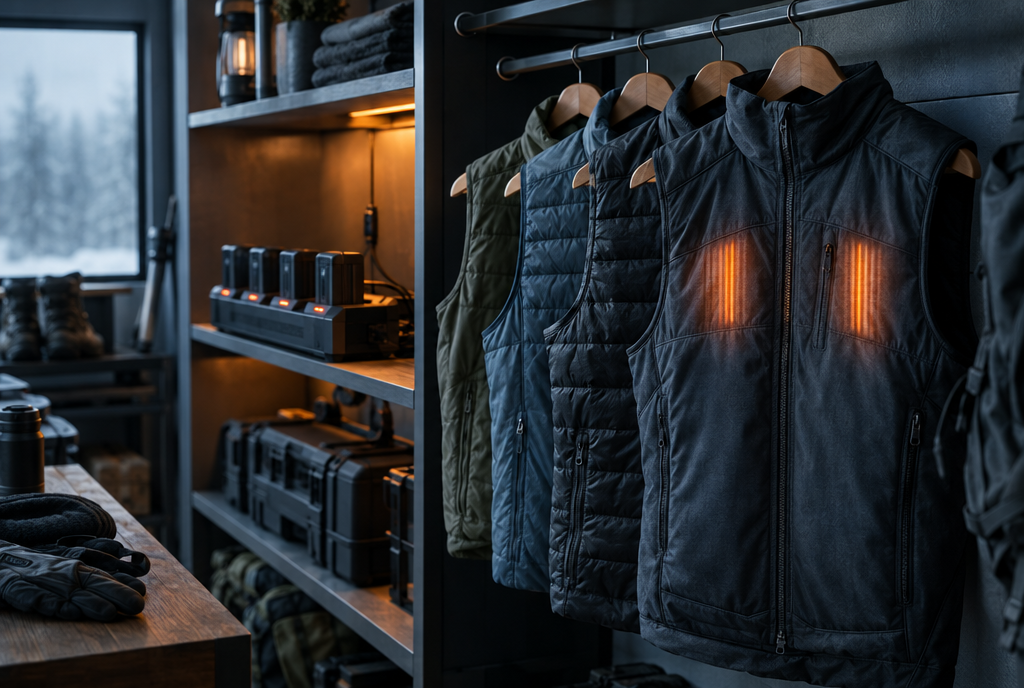
A heated vest is a battery-powered garment with thin heating panels, usually over the back and chest, that adds warmth to your core on demand. Choosing well means matching the format to your use, sizing for your layers, comparing batteries in watt-hours, checking safety testing and recalls, and knowing when battery-free warmth from insulation, heat-reflective linings or air-activated warmers is the better tool.
Which warmth setup is right for you?
Five quick questions. You get a starting approach and the guides that go deeper. No personal data is collected.
What kinds of heated and thermal gear are there?
Wearable warmth comes in two families. Active gear adds heat: battery-heated vests, jackets, socks and insoles, and air-activated warmers that release heat through iron oxidation. Passive gear reduces heat loss: insulation that traps still air, and reflective linings that return part of the body's radiant heat. A StatPearls overview estimates that radiation accounts for about 60% of total body heat loss, which is why reflective layers can matter more than their thickness suggests.
Neither family is universally better. Added heat runs out; reduced heat loss does not, but it cannot help a body producing little heat. Hybrid designs combine the two, pairing an insulating or reflective garment with pockets for heat sources. HEATJAC, for example, designs pocketed garments that accept air-activated warmers, battery heating inserts or cold packs. Our guide to battery-heated vs battery-free warmth compares every approach on heat, runtime, safety and travel.
| Approach | Adds or keeps heat | Needs charging | Best for |
|---|---|---|---|
| Battery-heated clothing | Adds | Yes | Long, still exposure to cold |
| Air-activated warmers | Adds | No, single use | Hours of heat away from power |
| Insulation | Keeps | No | Movement, reliability, all-day use |
| Reflective linings | Keeps | No | Low-bulk warmth under other layers |
| Hybrid pocketed garments | Both | Only with battery inserts | Switching between conditions |
Are heated vests safe?
For most healthy adults, a well-made heated vest used as directed is low risk. The two real hazards are contact burns and lithium-ion battery faults. A review of burns from body heating devices places the lowest burn-causing temperature at about 44°C (111°F) and found that older adults, people with reduced sensation such as from diabetes, and people who were asleep were overrepresented among the injured.
People with pacemakers or ICDs should know that the American Heart Association flags magnets, headphones and phones, advising a distance of at least 6 inches from the device, while most household appliances rarely cause problems. There is no specific guidance on heated vests, so check the vest for magnetic closures and battery placement, and ask your cardiologist. Pregnancy, diabetes, neuropathy and childhood each call for extra care, covered in are heated vests safe. Talk to a clinician about any symptoms or conditions before relying on heated clothing.
Heated vest, heated jacket or heated hoodie?
A vest warms the torso, layers under almost anything and leaves the arms free, which makes it the most versatile format. A jacket combines heat with an outer shell for people who want one garment. A hoodie is a casual mid layer for mild cold. OSHA's cold-stress guidance recommends several loose layers, and a thin heated vest slots into the middle of that system without replacing anything you already own. See heated vest vs heated jacket vs heated hoodie for the full comparison.
How do heated vest batteries work, and how long do they last?
Compare batteries in watt-hours, not milliamp-hours. The FAA's formula is volts multiplied by amp-hours, so a 7.4 V, 5,000 mAh pack stores 37 Wh. Runtime is roughly watt-hours divided by the heater's wattage on a given setting, which is why low settings last several times longer than high.
Cold matters. Battery University notes that a lithium-ion battery delivering full capacity at 27°C (80°F) typically delivers about 50% at minus 18°C (0°F), and that lithium-ion should not be charged below freezing. Keep packs in an inner pocket and bring them indoors to warm before charging. Our heated vest battery guide covers compatibility, storage and replacement packs.
Can you fly with heated clothing?
Yes. The garment can go anywhere, but spare lithium-ion batteries must travel in the cabin. Under FAA rules, packs up to 100 Wh need no airline approval, packs from 101 to 160 Wh need airline approval with a limit of two spares, and packs over 160 Wh are forbidden. Unplug the pack, protect its terminals and check your airline, since carriers can set stricter limits than the FAA. Flying with heated clothing walks through packing step by step.
How do you wash and care for heated gear?
Most heated vests are washable once the battery is removed and the connector is secured. Follow the care label first, since it is the only instruction written for your exact garment. Where washing is allowed, use cold water, a gentle cycle and mild detergent, then air dry fully before reconnecting. Avoid tumble drying, ironing, wringing and dry cleaning unless the label allows them. Reflective and pocketed garments need their inserts removed and gentle handling of the lining. The full routine, plus off-season storage, is in can you wash a heated vest.
Are hand warmers safe?
Air-activated warmers are safe for most people when used inside gloves, pockets or over clothing. Their surface can run well above the roughly 44°C (111°F) point where skin injury begins, so the main risk is a low-temperature burn from prolonged bare-skin contact. Never sleep with a warmer, supervise children, and take extra care with diabetes or reduced sensation. See are hand warmers safe for guidance on kids, pets, pregnancy and disposal.
Heated socks or heated insoles?
Heated socks put heat near the toes and work in most footwear; heated insoles keep electronics out of the laundry and suit one pair of roomy boots. Fit comes first, because anything that makes a boot tight can leave feet colder. Recent Consumer Product Safety Commission actions involved burns from heated socks and fires from heated insole batteries, and people with diabetic neuropathy face a higher burn risk on the feet. Heated socks vs heated insoles compares both in detail.
How do you choose a heated or thermal vest?
Work through these points in order; each is covered in how to choose a heated or thermal vest.
Need: decide whether you need added heat, better insulation or both
Fit: close to the body but not tight, sized for your real layers
Zones: back and chest for core warmth; collar and pockets as switchable extras
Battery: watt-hours for your longest day, maker-approved packs, labeled for travel
Safety: batteries tested to UL 2054 or UL 62133-2, garments designed to IEC 60335-2-17, overheat protection, and a clean CPSC recall history
Care: a label that allows washing once the battery is out
Who benefits most from heated gear?
Added heat earns its cost when your own heat production is low and exposure is long. That includes people who sit or stand still outdoors, such as hunters, anglers, spectators and crews on loading docks; people who work in cold rooms or freezers; clinicians and office workers in cold, air-conditioned spaces; and people who simply run cold. People who move constantly, hike for days or fly often usually get more from insulation, reflective layers and chemical warmers, because nothing needs charging and there is less to fail.
How can you use heated gear safely every day?
A short routine covers most of the risk, whatever brand or format you use.
Start on low and turn heat up only if you need it
Keep a base layer between heating panels or warmers and your skin
Switch heat off when you are active, sweating or back indoors
Never sleep in heated clothing or with a warmer against your body
Charge with the supplied charger, at room temperature, where you can see it
Retire any swollen, cracked, wet or overheating battery and recycle it properly
Check skin after use, especially on the feet and for children and older adults
What safety standards apply to heated clothing?
Two layers of standards matter. For the battery, UL 2054 covers household and commercial batteries, and UL 62133-2 covers portable lithium cells and batteries. For the garment, IEC 60335-2-17 sets safety requirements for blankets, pads, clothing and other flexible appliances that heat the body, explicitly including battery-operated ones, with a dedicated annex for clothing.
A certification claim is only as good as the laboratory behind it, so ask which standard and which lab. Then search the CPSC recall database for the exact model, before you buy and occasionally afterward.
Key takeaways
Heated gear adds warmth on demand; insulation and reflective linings keep warmth without power; hybrids do both.
Burns and battery faults are the main risks; reduced sensation, sleep, pregnancy, childhood and implanted cardiac devices call for extra care.
Compare batteries in watt-hours, keep them warm in use, and never charge them below freezing.
Spare lithium batteries fly in the cabin only; 100 Wh and 160 Wh are the key thresholds.
Choose by use case, fit, zones, battery, safety testing, recall history and care label.
Frequently asked questions
Are heated vests worth it?
They are worth it for long, mostly stationary time in the cold, or when bulk is a problem. If you are active or rarely near a charger, good insulation or battery-free warmers may serve you better.
How long does a heated vest stay warm?
It depends on the battery's watt-hours, the heat setting and the temperature. Low settings last several times longer than high, and deep cold can cut delivered capacity roughly in half.
Can you wear a heated vest every day?
Yes, with sensible habits: low settings, a layer between panels and skin, heat off during hard exertion, and never while sleeping. Inspect the battery and connector regularly.
Is a heated vest safe with a pacemaker?
There is no specific guidance on heated vests, but the American Heart Association advises keeping magnets, phones and headphones at least 6 inches from the device. Check the vest for magnets and battery placement, and ask your cardiologist before use.
What is the difference between a heated vest and a thermal vest?
A heated vest uses a battery to add heat. A thermal vest uses insulation or a reflective lining to reduce heat loss, with no power required.
Can I take my heated vest on a plane?
Yes. Pack the vest anywhere, but carry the lithium battery in the cabin with its terminals protected, and confirm it is within watt-hour limits.
From HEATJAC
We design low-profile thermal garments: a heat-reflective vest and a thermal harness with pockets for warmers or cold packs.
Choosing gear? Heated vest vs heat-reflective vest · What warmth costs per shift
Related reading
battery heat vs air-activated warmers: cost and runtime compared
heated gloves vs glove liners vs mittens with warmer pockets
reflective jacket linings compared: dots, full foil and film
how to size a thermal vest to wear under scrubs, uniforms or body armor
how many hours of warmth do you need? Planning heat by shift length
what does warmth cost per shift? Disposable warmers vs battery vs reflective
Sources
Physiology, Temperature Regulation (StatPearls), NCBI Bookshelf, National Library of Medicine
Burns Sustained From Body Heating Devices: An Integrative Review (Kornhaber et al., Wounds, 2020), Wounds / HMP Global
Devices That May Interfere With ICDs and Pacemakers, American Heart Association
PackSafe: Lithium Batteries, Federal Aviation Administration
BU-502: Discharging at High and Low Temperatures, Battery University
Understanding Portable Battery Safety: the UL 62133 family of standards, UL Solutions
IEC 60335-2-17:2022, Particular requirements for blankets, pads, clothing and other flexible heating appliances, International Electrotechnical Commission
Recalls and Product Safety Warnings, US Consumer Product Safety Commission
About HEATJAC. HEATJAC is a thermal architecture company founded by an anesthesiologist. We design patented garment systems that capture, conduct and broaden warmth across the body, and we publish this knowledge hub because the science of staying warm should be public. HEATJAC products are not medical devices and are not intended to diagnose, treat, cure or prevent any disease.