
Heat-reflective jacket linings compared: dots, full foil and film
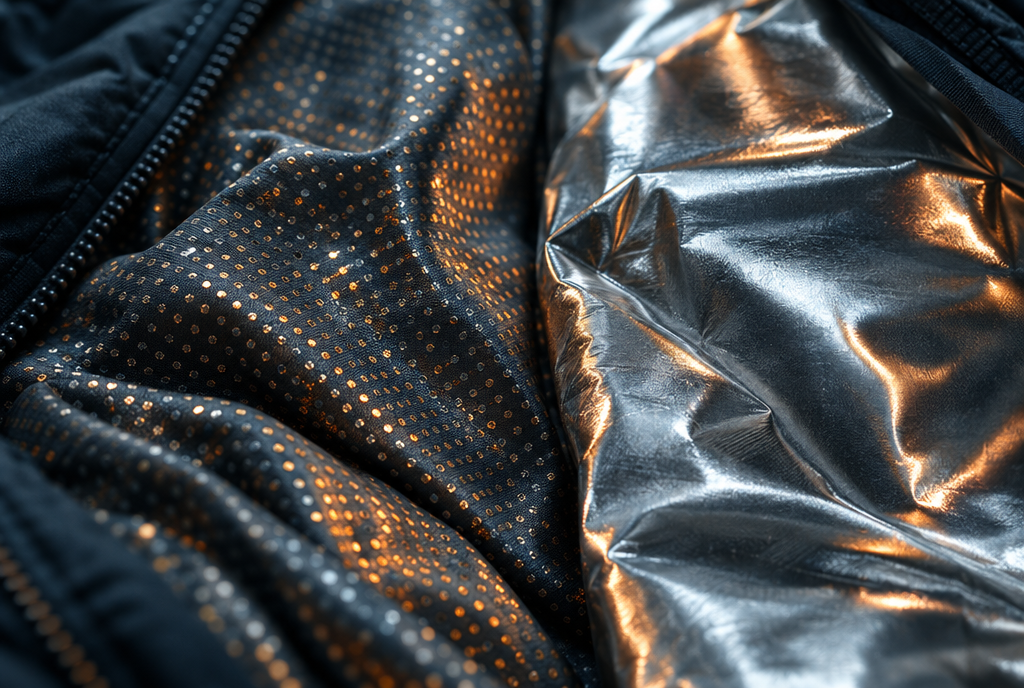
Heat-reflective linings differ mainly in how much of the surface is metal. Dot patterns trade some reflection for breathability, continuous metallized layers reflect more but can trap sweat unless perforated or breathable, and laminated films sit between the two depending on construction. Judge any lining by its metal coverage, a stated emittance measured to a named test method, and how it handles moisture.
What types of heat-reflective lining are there?
Almost every reflective lining uses a thin metal layer, usually aluminum, on a fabric or film. NASA describes aluminum as having an emittance of 0.03, meaning it reflects 97% of radiant heat. The differences between linings come from how much of the fabric carries that metal and how it is attached.
Why reflection helps and why it needs an air gap are covered in our pages on radiant barriers in clothing and on whether reflective linings work. This page compares the constructions.
| Lining type | How it is built | Reflective coverage | Breathability | Best suited to |
|---|---|---|---|---|
| Dot pattern | Metallic dots printed on a breathable liner | Partial; set by dot size and spacing | Good between dots | Active use and all-round jackets |
| Continuous metallized layer | Metal deposited across the whole fabric face | Near full | Low unless perforated or on a breathable base | Low-activity, static cold |
| Laminated film | Metallized film bonded to fabric or insulation | Full on the film area | Depends on perforation or membrane | Durable work and outer layers |
How much does dot coverage matter?
A great deal, because a dot lining only reflects where there is metal. According to Textile World, Columbia's original Omni-Heat Reflective lining had about 30% aluminum coverage, and the newer Omni-Heat Infinity pattern mixes small and large dots for 50% to 60% coverage. Columbia states that Infinity increases radiant body heat reflection by 40%, a manufacturer claim rather than an independent test.
More coverage is not free. A textile researcher quoted in the same Textile World article said breathability changes little until about 65% or more surface coverage, after which moisture vapor transmission drops sharply. That threshold is why most dot linings stop well short of full coverage.
Is a full foil lining warmer than a dot lining?
For radiant heat alone, more metal area generally means more reflection. A continuous metallized layer can approach the reflectance of the metal itself, while a dot lining averages the metal and the fabric between the dots.
The catch is moisture. A solid metal face slows water vapor, so during hard activity sweat can condense on the inside and chill you. Continuous layers work best for low-activity cold such as standing posts, spectating or cold rooms, or when the maker has perforated the layer or put it on a breathable base.
What about laminated heat-reflective films?
Laminated films bond a metallized plastic film to a fabric or insulation. They tend to be durable and wind-resistant, and the film protects the metal, but they can feel stiffer and may rustle.
Protective coatings matter for any metal layer. NASA's spinoff report describes encapsulating each metal particle so the coating prevents oxidation when exposed to moisture. The US Department of Energy notes that dust on a reflective surface reduces its reflective capability, and the same logic applies to body oils and grime in clothing.
Which heat-reflective spec claims should you trust?
Look for a stated emittance or emissivity and the test method behind it. ASTM C1371 measures the emittance of opaque, highly thermally conductive materials near room temperature with a portable emissometer, with a stated precision better than plus or minus 0.02 units. It is a comparative material measurement on a flat sample.
That makes it useful for comparing lining materials, and not a measure of how warm a finished jacket is. Garment warmth depends on insulation, fit, wind and moisture, and is tested with hot plates and thermal manikins. Research supports the principle: a 2023 study in Applied Sciences measured an emissivity of 0.13 for a copper-coated textile and found infrared-reflective textiles the more effective of two methods it simulated for cold-protection garments.
Trust more: a named test method, a stated emittance value, and clarity on whether it describes the metal, the lining or the garment
Trust less: percentage warmth claims with no test conditions, or adjectives with no numbers
For dot linings, ask whether the emittance describes the metal dots or the whole lining surface
What should you ask a seller?
A few direct questions separate a considered design from a shiny liner.
What percentage of the lining surface is metal?
What is the emittance, and what test method and lab produced it?
Is the reflective layer perforated, printed on a breathable liner or a solid film?
Is the metal protected by a coating, and how does it hold up to washing?
Does the reflective side face the body across an air gap?
Which lining fits your use?
Choose the construction that matches your activity and moisture load.
| If you mostly... | Choose |
|---|---|
| Hike, ski or work hard in the cold | Dot pattern with moderate coverage |
| Stand or sit still for long periods | Higher-coverage dots or a continuous layer |
| Need a tough, wind-resistant work layer | Laminated film with perforation |
| Sweat heavily | Dot pattern, plus a wicking base layer |
Where HEATJAC fits
HEATJAC REFLECT is a lightweight heat-reflective vest with a snap front and integrated warming pockets for compatible warming elements (sold separately). Its lining material is rated at about 95% radiant heat reflectance in the supplier's ASTM emittance testing, which is a material property and not a whole-garment or medical claim.
Key takeaways
Linings differ mainly in metal coverage: dot patterns, continuous metallized layers and laminated films.
Dot coverage ranges widely; one researcher reports breathability falling sharply above about 65% coverage.
Continuous metal reflects more but needs perforation or a breathable base for active use.
ASTM C1371 emittance is a material measurement, not a rating of garment warmth.
Ask sellers for metal coverage, emittance with a test method, and how the layer handles moisture.
Frequently asked questions
What is the difference between Omni-Heat and Omni-Heat Infinity?
Both are dot-pattern reflective linings from Columbia. Textile World reports about 30% aluminum coverage for the original and 50% to 60% for Infinity, which uses a mix of small and large gold-colored dots.
Are foil-lined jackets breathable?
A solid foil layer blocks most water vapor unless it is perforated or applied to a breathable base. Dot patterns are designed to leave breathable fabric between the metal.
What emissivity should a heat-reflective lining have?
Lower is more reflective. Aluminum is around 0.03 per NASA; coated textiles in research have measured higher. Ask how the number was measured and whether it applies to the metal or the whole lining.
Do heat-reflective linings wear out?
They can lose some performance if the metal oxidizes, abrades or gets coated with grime. Protective coatings help, so follow the care label and ask the seller about wash durability.
Does a heat-reflective lining replace insulation?
No. It reduces radiant heat loss only, and works alongside insulation and a wind-resistant shell.
Related reading
Sources
Omni-Heat Infinity: Gold Beats Cold, Textile World
Meet Omni-Heat Infinity, Columbia Sportswear
ASTM C1371-15(2022): Determination of Emittance of Materials Near Room Temperature Using Portable Emissometers, ASTM International
Radiant Barriers Save Energy in Buildings, NASA Spinoff
Radiant Barriers, US Department of Energy
Development of Infrared Reflective Textiles and Simulation of Their Effect in Cold-Protection Garments, Applied Sciences (MDPI), 2023
About HEATJAC. HEATJAC is a thermal architecture company founded by an anesthesiologist. We design patented garment systems that capture, conduct and broaden warmth across the body, and we publish this knowledge hub because the science of staying warm should be public. HEATJAC products are not medical devices and are not intended to diagnose, treat, cure or prevent any disease.