
Do heat-reflective linings like Omni-Heat actually work?
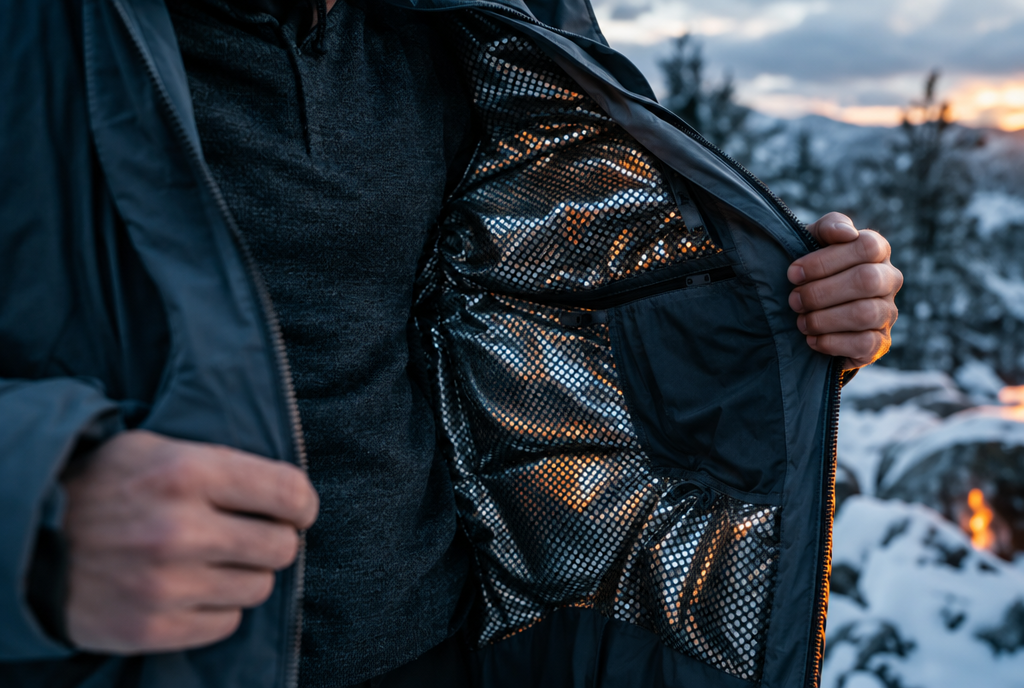
Yes, but modestly and conditionally. A heat-reflective lining such as Omni-Heat reduces the infrared heat your body radiates outward, so less warmth escapes through the jacket. The benefit is real, typically a percentage improvement rather than a dramatic one, and it is largest when radiant loss dominates, when the lining sits over good insulation with an air gap, and when paired with a heat source.
How do heat-reflective linings work?
Your body sheds heat in several ways: radiation, convection, conduction, evaporation and breathing. OpenAnesthesia, describing a person at rest, notes that radiation is the major route and accounts for about 60% of total heat loss, with convection around 25%. Radiation is infrared energy leaving warm skin and clothing toward cooler surroundings.
A metallized lining has low emissivity, which means it absorbs and re-emits little infrared energy and reflects most of it. Facing inward, it bounces part of the radiant heat back toward the body instead of letting the jacket absorb and pass it outward. The concept descends from the vacuum-metallized films NASA developed to manage heat on spacecraft.
Reflection does not create heat. It only changes how quickly heat you already produce, or heat from a warmer, leaves the system.
Does Omni-Heat work? What Columbia claims
Columbia introduced Omni-Heat reflective in 2010 as a silver-dot lining and stated it keeps people 20% warmer than ordinary liners. The dots are spaced so that heat and moisture vapor can escape through the breathable liner between them, a deliberate compromise between reflection and breathability.
The newer Omni-Heat Infinity uses an expanded pattern of gold dots that Columbia says reflects more body heat. Columbia states that Infinity increases radiant body heat reflection by 40 percent, without publishing the test method on that page.
These are manufacturer claims, and the full test protocol behind the 20% figure is not published in the launch release. That does not make the claim false. It means shoppers should read it as a comparison under specific conditions rather than a guarantee in every situation.
What does independent research say about heat-reflective textiles?
Independent work supports the principle and suggests the size of the effect. A 2023 study in Applied Sciences metallized textiles and modeled their use in cold-protection garments. It reported that a nickel coating can reach reflectivity of up to 95%, and that a reflectivity of about 80% to 90% already reflects a substantial share of body heat radiation.
In the same study's simulations, an infrared reflective layer increased the garment's insulation effect by up to 10% at 80% reflectivity, and it was the more effective of the two methods studied, the other being aerogel material. Modeled results depend on assumptions, but they point the same way as the physics: a helpful gain, not a replacement for insulation.
When does a heat-reflective lining help most, and when least?
Because a reflective layer acts only on radiant heat, its value depends on what else is happening.
| Condition | Reflective benefit | Why |
|---|---|---|
| Still air, low activity (standing, sitting, waiting) | Larger | Radiation is a big share of heat loss |
| Lining over insulation with a small air gap | Larger | Reflection needs space to work; insulation handles conduction |
| Paired with a heat source (warmer or heated panel) | Larger | Reflection helps keep added heat near the body |
| Strong wind, no windproof shell | Smaller | Convection dominates and strips heat away |
| Lining compressed tight against skin | Smaller | Contact turns radiation into conduction |
| Sweat or condensation on the lining | Smaller | A water film raises emissivity and adds evaporative loss |
What are the limitations of heat-reflective linings?
Moisture is the first limit. A film of water on a metallized surface behaves much less like a mirror to infrared, and damp layers conduct heat away faster. Reflective linings work best with a wicking base layer and enough ventilation that sweat does not pool on the lining.
Compression is the second. Reflection works across an air space. Where a pack strap or tight cuff presses the lining flat against skin, heat moves by conduction instead and the reflective advantage largely disappears there.
Third, a lining is only one layer. Without insulation and a wind-resistant shell, reflected heat still leaks out through convection. Dot patterns also trade some reflective coverage for breathability.
Is a heat-reflective lining worth it?
For many people, yes: it adds warmth for very little weight or bulk, which is valuable in lighter jackets and for low-activity cold. It is not a substitute for adequate insulation, and it will not make a thin jacket perform like a heavy parka.
The strongest use is as part of a system. HEATJAC's REFLECT vest, for example, pairs a reflective lining with warming pockets; that lining material is rated at about 95% radiant heat reflectance (emittance about 0.05) in the supplier's standardized ASTM emittance testing, which is a material property rather than a whole-garment rating.
If you feel cold far more than people around you, or your fingers change color in the cold, talk to a clinician, since clothing choices cannot answer medical questions.
Key takeaways
Reflective linings reduce radiant heat loss, which is a large share of heat loss at rest.
Columbia claims Omni-Heat is 20% warmer than ordinary liners; independent modeling suggests gains of up to about 10% in insulation.
Benefits are largest in still air, over insulation with an air gap, and alongside a heat source.
Moisture, compression and wind reduce the benefit.
Think of a reflective lining as one layer in a system, not a replacement for insulation.
Frequently asked questions
Is Omni-Heat actually warmer?
Reflective linings do reduce radiant heat loss, and Columbia states Omni-Heat is 20% warmer than ordinary liners. Independent research supports a real but modest gain that depends on conditions, fit and moisture.
What is the difference between Omni-Heat and Omni-Heat Infinity?
Omni-Heat reflective uses a silver-dot lining introduced in 2010. Omni-Heat Infinity uses an expanded gold-dot pattern that Columbia says reflects more body heat.
Do heat-reflective linings work as well as battery heating?
No. A reflective lining only slows the loss of heat you already produce, while a battery heater adds heat. The two work well together, because reflection helps keep added heat near the body.
Do heat-reflective jackets make you sweat more?
They can if the lining blocks vapor. Dot patterns and breathable liners are designed to let moisture escape, but during hard exercise any warm layer can lead to sweating, so vent early.
Does it matter which side of a heat-reflective lining faces the body?
In a jacket the reflective surface faces inward toward the body, where it reflects radiant heat back. The outer fabric and insulation handle wind and conduction.
From HEATJAC
We design low-profile thermal garments: a heat-reflective vest and a thermal harness with pockets for warmers or cold packs.
Choosing gear? Heated vest vs heat-reflective vest · The thermal gear buying, safety and care guide
Related reading
Sources
Normal Thermoregulation, OpenAnesthesia (International Anesthesia Research Society)
Columbia Sportswear Launches New Omni-Heat Warmth Technology with Global Marketing Campaign, Columbia Sportswear Company
Omni-Heat Infinity Thermal Reflective Insulation, Columbia Sportswear
Development of Infrared Reflective Textiles and Simulation of Their Effect in Cold-Protection Garments, Applied Sciences (MDPI), 2023
Reflecting on Space Benefits: A Shining Example, NASA Spinoff
About HEATJAC. HEATJAC is a thermal architecture company founded by an anesthesiologist. We design patented garment systems that capture, conduct and broaden warmth across the body, and we publish this knowledge hub because the science of staying warm should be public. HEATJAC products are not medical devices and are not intended to diagnose, treat, cure or prevent any disease.