
Every way to warm the human body: warming technologies compared
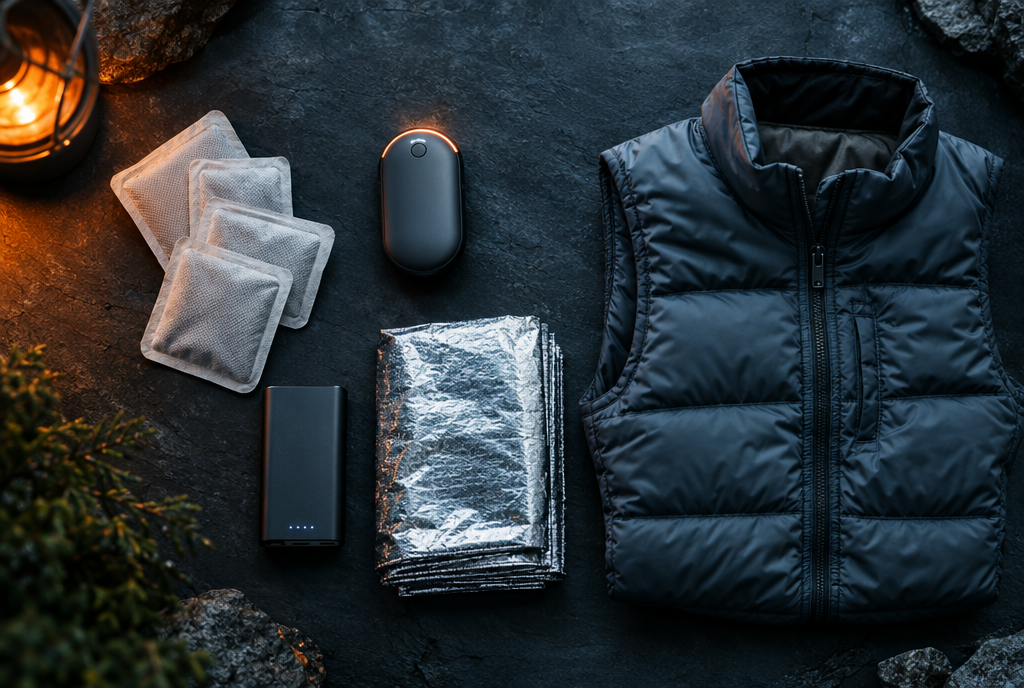
Every warming technology does one of two things: it adds heat to the body or it slows the heat the body loses. Chemical warmers and battery heaters add heat. Insulation, heat-reflective linings, space blankets and aerogel slow loss. Phase-change fabrics only store and return heat briefly, and far-infrared textiles only redirect it. The warmest systems combine a heat source with insulation and reflection.
How does the body lose heat, and what can technology change?
Your body makes heat continuously and sheds it through radiation, convection, conduction, evaporation and breathing. OpenAnesthesia, describing a person at rest, reports that radiation accounts for about 60% of total heat loss, convection about 25%, and breathing typically about 10%, with direct conduction only 1% to 2% unless you touch something cold.
Those shares shift with conditions. Wind raises convective loss, sitting on snow raises conductive loss, and sweat raises evaporative loss. A good warming strategy starts by asking which pathway dominates in your situation, then choosing technology that targets it.
| Technology | Adds heat or slows loss? | Main pathway addressed | Typical duration | Key limitation |
|---|---|---|---|---|
| Air-activated warmers | Adds heat | Local warming | About 7 to 18 hours (rated) | Single use; needs air |
| Battery heated vests | Adds heat | Core warming | About 2 to 8 hours per charge | Battery weight and charging |
| Reflective linings | Slows loss | Radiation | Continuous | Modest gain; weakened by moisture and compression |
| Space blankets | Slows loss | Radiation, wind, evaporation | Continuous | Almost no insulation |
| Aerogel insulation | Slows loss | Conduction | Continuous | Cost and breathability |
| Phase-change materials | Stores and returns heat | Temperature swings | Minutes | Small, temporary effect |
| Far-infrared textiles | Redirects existing heat | Radiation | Continuous | Limited, mixed evidence |
How do hand warmers work?
Disposable warmers are controlled rust. Iron powder, water, salt, activated carbon and an absorbent filler sit in a porous pouch; oxygen entering the pouch oxidizes the iron and releases heat. Chemical & Engineering News reports that they average about 135°F and that some last about seven hours while others last more than 24.
Our guide to how hand warmers work covers the chemistry, including sodium acetate gel warmers that release heat by crystallizing and reset by boiling. For rated runtimes, shelf life and whether expired packs still work, see how long hand warmers last.
Warmers are the simplest active heat source: no charging, no electronics and very little weight. Their drawbacks are waste, a heat output you cannot adjust, and dependence on airflow, which is why a warmer buried in a tight boot often feels weaker than one in an open pocket.
How do heated vests and heated clothing work?
Battery-heated garments use resistive heating. Current flows through carbon fiber strands, metal alloy wire or conductive film, which turn electrical energy into heat. The 7.4-volt lithium battery is the most common system, and most 7.4-volt garments run for roughly 2 to 8 hours depending on heat setting and conditions.
Our explainer on how heated vests work covers elements, voltage, zones and battery sizing. A related design, the PTC self-regulating heater, uses a material whose resistance rises as it warms, so it limits its own output; its strengths and trade-offs are covered separately.
Do heat-reflective linings and space blankets work?
Reflective technologies target radiation, the largest pathway at rest. A metallized surface with low emissivity bounces infrared heat back toward the body. The idea traces to the vacuum-metallized films NASA developed to protect spacecraft, which also became the familiar space blanket.
The effect is real but bounded. In a 2023 modeling study, an infrared reflective layer increased a garment's insulation effect by up to 10% at 80% reflectivity. Our article on whether reflective linings like Omni-Heat work explains when the gain is largest: in still air, over insulation with an air gap, and alongside a heat source. Moisture and compression shrink it.
Space blankets apply the same physics in an emergency, adding wind and vapor blocking but almost no insulation. Our guide to how space blankets work explains why a ground pad and insulating layers still matter.
What about aerogel and other advanced insulation?
Insulation slows conduction and convection by trapping still air. Aerogel pushes the idea to the limit: NASA Spinoff describes it as 99.8% air, and aerogel blankets as providing three times more insulation than the best fiberglass. In clothing, it appears as flexible composites in gloves, boots and slim jackets.
Our article on aerogel in clothing compares it with down and synthetic fills. Aerogel wins on warmth per thickness and resistance to compression; down still wins on warmth per weight, and aerogel's breathability and cost remain trade-offs.
Do phase-change and far-infrared fabrics keep you warm?
Both appear on many labels, and both deserve measured expectations. Phase-change materials absorb heat as they melt and release it as they solidify. In thermal manikin tests by Shim and colleagues, PCMs reduced heat loss by an average of 6.5 to 13.2 watts, and the effect lasted approximately 15 minutes. That buffers transitions, not a long day in the cold.
Far-infrared textiles embed minerals intended to re-emit body heat as infrared energy. A systematic review in PLOS One found only eleven eligible sports studies, with small samples and inconclusive results. Our articles on phase-change materials in clothing and far-infrared clothing and Celliant lay out what the evidence supports.
Active vs passive warmth: which should you choose?
Active technologies add heat, so they keep working when you are still and your own heat production is low. Their costs are logistics: warmers must be bought and carried, batteries must be charged and kept from the cold, and both run out.
Passive technologies cost nothing to run and never run out, but they can only conserve heat you produce. They shine during activity, when your body makes plenty of heat, and they make active heat last longer by keeping it close.
For most people the answer is both. Passive layers are the foundation; active heat is the supplement for long, low-activity exposure or for people who run cold.
Is wearable warming safe?
Each technology has its own sensible precautions. Hand warmer makers state that packs should not be applied directly to skin. Battery garments need intact wiring and chargers from the manufacturer, and spare lithium batteries have specific travel rules. Space blankets can trap too much heat in warm conditions.
The common thread is sensation. People who may not feel heat accurately, including young children, older adults and people with diabetes or neuropathy, should use any warming product with extra care and fabric between the heat source and skin.
How is patient warming different?
Hospitals use dedicated clinical systems, including forced-air, conductive and resistive warming, to maintain patient temperature before, during and after surgery. These are regulated medical devices used under clinical protocols, and they are a separate category from personal wearables. Our perioperative warming guide covers them in depth.
How to combine warming technologies for the best result
No single technology does everything. The most effective setups layer them so each covers another's weakness.
Start with a heat source when you are inactive in serious cold: a warmer or battery panel near the core.
Add a reflective layer to hold radiant heat, especially in still air.
Add insulation that suits the space: lofty fill where there is room, thin aerogel where there is compression.
Finish with a wind-resistant shell, because convection strips heat from any system.
Manage moisture with a wicking base layer and venting, since wet layers undo much of the benefit.
Choosing the right technology for your situation
Match the tool to the job. Long, low-activity cold, such as a treestand, an ice-fishing hole or a cold operating room, favors an added heat source held in place by reflection and insulation. Stop-and-go activity favors breathable insulation and venting over maximum heat. Emergencies favor light, packable reflective blankets and a way to insulate from the ground.
Modular systems are one way to cover several situations. HEATJAC's CORE platform, for example, combines a reflective thermal insert system with pockets that accept air-activated warmers, battery heating inserts or cold packs, so the same harness can hold different heat sources as conditions change.
Wearables help you stay warm and support comfort; they are not a treatment for any condition. If you feel cold far more than others, or notice numbness, color changes or pain in the cold, talk to a clinician.
Key takeaways
Warming technologies either add heat (warmers, battery heaters) or slow its loss (insulation, reflection).
Radiation is the largest heat-loss pathway at rest, which is why reflective layers help, modestly.
Air-activated warmers are rated for about 7 to 18 hours; 7.4-volt heated garments run about 2 to 8 hours.
Phase-change fabrics give a small, short effect, and far-infrared evidence is limited and mixed.
The warmest systems combine a heat source, reflection, insulation, a wind shell and moisture control.
Frequently asked questions
What is the most effective way to stay warm?
Combine layers: a heat source when inactive, a reflective layer, insulation suited to the space, a wind-resistant shell and a wicking base layer. Each technology covers a different heat-loss pathway.
Which is better, a heated vest or hand warmers?
A heated vest warms the core with adjustable, rechargeable heat but needs a battery. Hand warmers are cheap, light and long lasting but single use. Many people use both, depending on the day.
Do thermal heat-reflective jackets really work?
Yes, modestly. Reflective linings reduce radiant heat loss, and modeling suggests gains of up to about 10% in insulation under favorable conditions. They work best over insulation and with a heat source.
What is the thinnest warm insulation?
Aerogel composites provide very high warmth per thickness and hold up under compression, which is why they appear in gloves, boots and slim jackets. They cost more and breathe less than common fills.
Do phase-change or far-infrared fabrics make clothing warmer?
Only slightly. Phase-change fabrics release stored heat for roughly 15 minutes during a transition to cold, and far-infrared fabrics only redirect heat you already produce. Neither replaces insulation or an active heat source.
Are wearable warmers medical devices?
Consumer warmers and heated clothing are comfort products, not medical treatments. Hospitals use separate, regulated patient-warming systems. Talk to a clinician about cold-related symptoms.
From HEATJAC
We design low-profile thermal garments: a heat-reflective vest and a thermal harness with pockets for warmers or cold packs.
Choosing gear? Heated vest vs heat-reflective vest · The thermal gear buying, safety and care guide
Related reading
Sources
Normal Thermoregulation, OpenAnesthesia (International Anesthesia Research Society)
What's inside disposable hand warmers?, Chemical & Engineering News (American Chemical Society)
Heated clothing, Wikipedia
Development of Infrared Reflective Textiles and Simulation of Their Effect in Cold-Protection Garments, Applied Sciences (MDPI), 2023
Reflecting on Space Benefits: A Shining Example, NASA Spinoff
Aerogels Insulate Missions and Consumer Products, NASA Spinoff
Using Phase Change Materials in Clothing (Shim, McCullough and Jones, 2001), Textile Research Journal (SAGE)
About HEATJAC. HEATJAC is a thermal architecture company founded by an anesthesiologist. We design patented garment systems that capture, conduct and broaden warmth across the body, and we publish this knowledge hub because the science of staying warm should be public. HEATJAC products are not medical devices and are not intended to diagnose, treat, cure or prevent any disease.