
PTC self-regulating heaters in wearables, explained
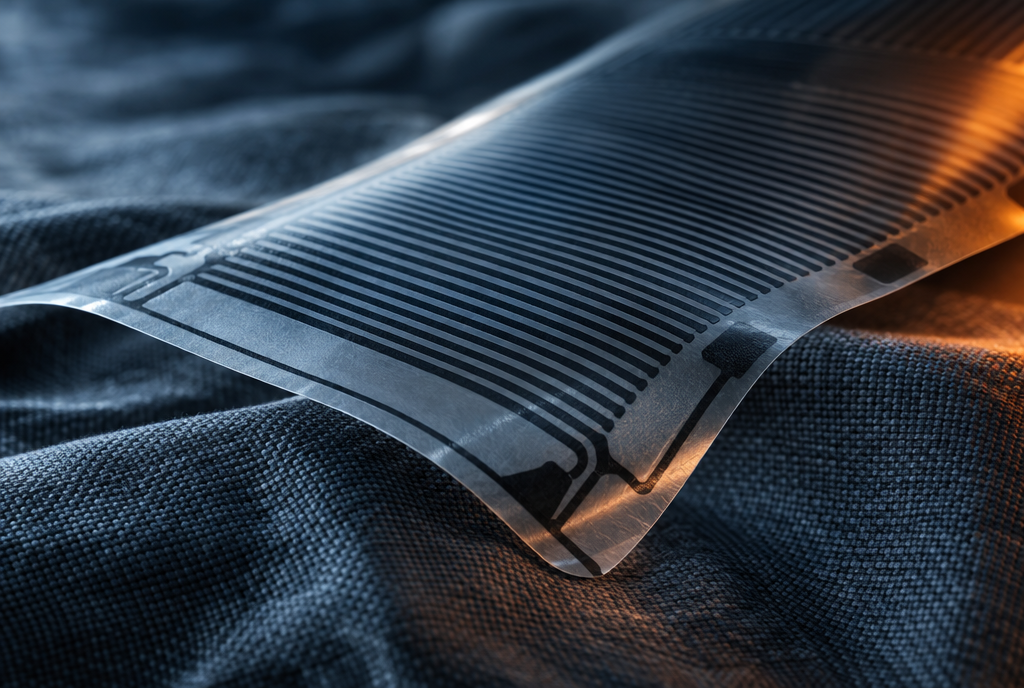
A PTC (positive temperature coefficient) heater is an element whose electrical resistance rises sharply as it warms. As it heats, less current flows, so heat output drops on its own near a designed switching temperature. In wearables, PTC films and inks provide built-in temperature limiting without a separate sensor, but the set point is fixed at manufacture and does not replace good design.
What does positive temperature coefficient mean?
Every conductor's resistance changes with temperature. A positive temperature coefficient means resistance increases as temperature increases. In most metals the effect is modest. In PTC heating materials it is engineered to be dramatic over a narrow temperature band.
That steep rise is what makes the element self-regulating. At a fixed voltage, higher resistance means less current and therefore less heat. The element approaches a balance point where the heat it produces matches the heat it loses to its surroundings.
How does a PTC heating element work?
Most flexible PTC heaters are conductive polymer composites. Particles of carbon black are dispersed through a polymer. At room temperature the particles touch or sit close enough to form continuous conductive paths, and current flows easily.
As the element warms through Joule heating, the polymer expands. Expansion pulls the carbon particles apart and breaks many of those paths, so resistance climbs and current falls. Researchers studying soft PTC heaters describe exactly this feedback loop: current heats the element, which raises resistance, which limits further heating.
Printed PTC inks often add fine wax particles tuned to swell at a chosen temperature. According to a technical overview from TechBlick, commercial self-regulating inks are available with switching temperatures from 40°C to 100°C, set by the formulation.
The TechBlick overview walks through a 9-volt demonstration heater designed to regulate at 60°C. For clothing, designers aim far lower than the top of that range, because skin comfort, not element temperature, is the real target. Formulation, voltage and the fabric layers between element and skin all shape what the wearer actually feels.
PTC vs constant-wattage heaters: what is the difference?
Most heated vests use constant-wattage elements such as carbon fiber strands or alloy wire. Their resistance stays roughly steady, so they produce a set amount of heat for a given voltage, and a controller cycles power to hit each heat level.
A PTC element carries part of that control inside the material itself. It still needs a sensible power supply and a controller for user settings, but it adds a physical ceiling on how hot the element tends to get.
| Feature | Constant-wattage element | PTC self-regulating element |
|---|---|---|
| Temperature control | Electronic controller and settings | Material limits its own output near a set point |
| Response to a hot spot | Relies on controller or sensor | Local resistance rises, reducing heat there |
| Adjustability | Easy to change with firmware or settings | Switching point fixed at manufacture |
| Startup behavior | Steady current | Higher inrush current when cold |
| Common forms | Carbon fiber strands, alloy wire | Printed inks, laminated films, heating cables |
Why use PTC heaters in wearables?
Clothing is a hard environment for heaters. Fabric bunches, a panel can be pressed against a seat, or a pocket can trap heat. A PTC element responds locally: if one area gets warmer, its resistance rises and it throttles itself. That behavior is useful as a layer of protection in gloves, insoles, seat pads and thin heated panels.
PTC materials also lend themselves to thin, flexible formats. They can be printed or laminated onto films and textiles, and flexible PTC heating assemblies have been patented, for example US4922083, which describes a flexible, elongated PTC heating assembly.
What are the limitations of PTC heating?
Self-regulation is not a guarantee of comfort or safety on its own. Designers work around several known constraints.
Fixed set point: the switching temperature is chosen in the formulation and cannot be adjusted after manufacture.
Inrush current: a cold PTC element has low resistance, so it draws more current at startup, and the wiring must be sized for it.
Aging: repeated heating cycles can shift resistance over time, so long-term reliability needs testing.
Overvoltage: TechBlick notes that excessive voltage can push the material past its regulating range, which is why the power supply still matters.
Skin versus element temperature: an element that limits itself at a set point can still feel too warm during long, direct contact.
Are PTC heated clothes safer?
PTC heating adds a meaningful physical safeguard, but safety depends on the whole system: battery quality, connectors, controller, fabric layers and how the garment is worn. A self-regulating element is one layer of protection, not a substitute for the others.
People who may not feel heat accurately, including some people with diabetes or peripheral neuropathy, should be cautious with any heated product. If you have questions about sensation or circulation, talk to a clinician before using heated clothing.
Key takeaways
PTC heaters raise their own resistance as they warm, which limits their heat output.
Flexible PTC elements use carbon particles in a polymer that expands and breaks conductive paths.
Switching temperatures are fixed at manufacture; commercial inks span roughly 40°C to 100°C.
PTC design adds protection against local hot spots but still needs a sound battery and controller.
Self-regulation does not remove the need for fabric layers and sensible use.
Frequently asked questions
What is a PTC heating element?
It is a heater made from a material whose resistance rises steeply with temperature. As it warms, current drops, so the element limits its own heat output near a designed temperature.
Do PTC heaters need a thermostat?
The material provides self-limiting behavior without a separate sensor. Products still use controllers to offer heat settings and to manage power safely.
Is PTC better than carbon fiber for heated clothing?
Each has strengths. Carbon fiber elements are flexible and easy to control with electronics, while PTC elements add built-in temperature limiting. Good products may combine an efficient element with solid electronic control.
Can a PTC heater overheat?
It resists overheating within its design range, but excessive voltage or damage can push it beyond that range. Battery and wiring design remain important.
Where are PTC heaters used besides clothing?
Self-regulating PTC heaters appear in heating cables, printed foil heaters and other surfaces where built-in temperature limiting is useful.
From HEATJAC
We design low-profile thermal garments: a heat-reflective vest and a thermal harness with pockets for warmers or cold packs.
Choosing gear? Heated vest vs heat-reflective vest · The thermal gear buying, safety and care guide
Related reading
Sources
Soft Self-Regulating Heating Elements for Thermoplastic Elastomer-Based Electronic Skin Applications, PMC (National Library of Medicine)
From Experiment to Final Print: Understanding Self-Regulation PTC Heaters, TechBlick
US4922083A: Flexible, elongated positive temperature coefficient heating assembly and method, Google Patents
Heated clothing, Wikipedia
About HEATJAC. HEATJAC is a thermal architecture company founded by an anesthesiologist. We design patented garment systems that capture, conduct and broaden warmth across the body, and we publish this knowledge hub because the science of staying warm should be public. HEATJAC products are not medical devices and are not intended to diagnose, treat, cure or prevent any disease.