
Heated vest batteries explained: volts, mAh, watt-hours and runtime
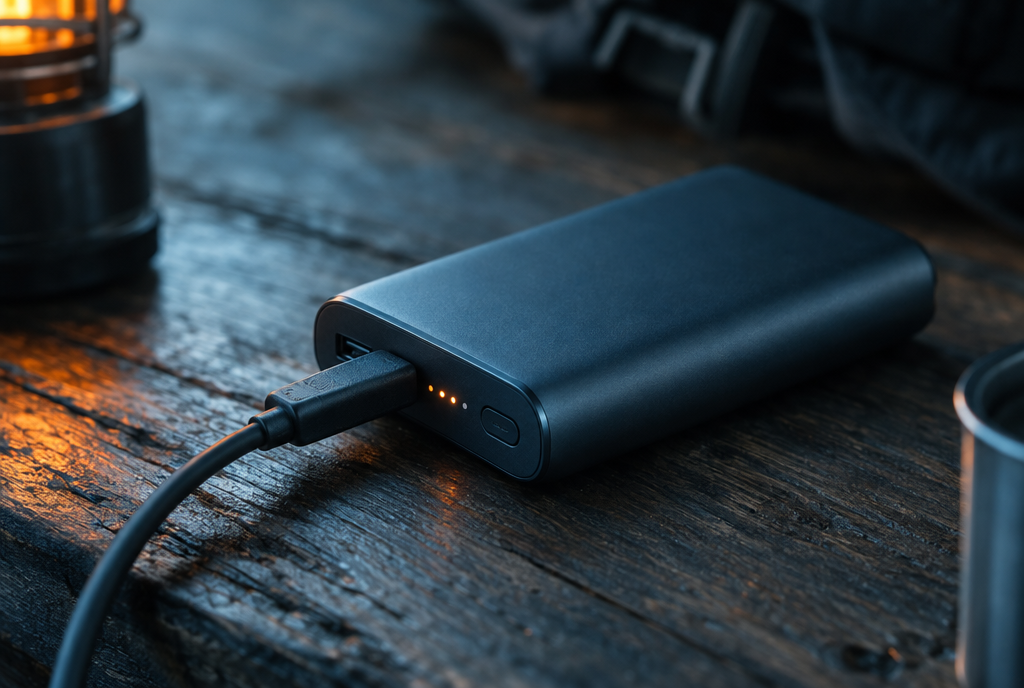
A heated vest battery's real capacity is its watt-hours (Wh), which you get by multiplying volts by amp-hours. Runtime is roughly that energy divided by how many watts the heating panels draw on a given setting. Milliamp-hours (mAh) alone can mislead, because packs run at different voltages, and cold weather temporarily cuts how much energy a lithium-ion pack can deliver.
What do volts, mAh and watt-hours mean on a heated vest battery?
Three numbers usually appear on a pack. Volts (V) describe electrical pressure, and they must match what the garment's heating system was designed for. Milliamp-hours (mAh) describe charge capacity at that voltage. Watt-hours (Wh) combine the two into energy, which is what actually becomes heat.
The FAA gives the conversion used for airline rules: multiply the battery's voltage by its capacity in amp-hours. Since 1,000 mAh equals 1 Ah, the formula is Wh = V × (mAh ÷ 1,000).
| Label term | What it measures | Why it matters |
|---|---|---|
| Volts (V) | Electrical pressure | Must match the garment; a mismatch can underheat or overheat |
| mAh | Charge capacity at the pack's own voltage | Only comparable between packs of the same voltage |
| Wh | Stored energy (V × Ah) | The fair way to compare packs, and the number airlines use |
| Watts (W) | Rate the heater uses energy | Set by the heat level; higher settings drain faster |
Why can mAh numbers be misleading?
Consider two illustrative packs. A 7.4 V pack labeled 5,000 mAh stores 7.4 × 5 = 37 Wh. A pack labeled 10,000 mAh looks twice as large, but if that figure is quoted at a lower internal cell voltage of 3.7 V, it also stores 37 Wh. Same energy, very different headline number.
When you compare packs or replacement batteries, convert everything to watt-hours. If a seller lists only mAh with no voltage, you cannot make a fair comparison.
How do you estimate heated vest battery runtime?
Divide the pack's watt-hours by the power the vest draws on a given setting. Makers sometimes publish the wattage for each level; if they do not, their stated runtimes let you work backward.
As a worked example with round numbers, a 37 Wh pack feeding a heater that draws 10 W would last a little under 3.7 hours in ideal conditions. In practice runtime is somewhat lower, because some energy is lost in conversion, and the pack delivers less when cold. Halve the heat level and runtime roughly doubles, which is why low settings and intermittent use matter more than any single battery upgrade.
High setting: fastest warm-up, shortest runtime
Low setting: often enough once you are warm, and several times the runtime
Pulsing heat on and off as needed stretches runtime further
Extra zones (collar, pockets) add draw; switch them off if you do not need them
How does cold weather affect heated vest batteries?
Lithium-ion cells deliver less energy when cold because their internal resistance rises. Battery University notes that a battery delivering full capacity at 27°C (80°F) will typically deliver about 50% at minus 18°C (0°F). The loss is temporary: capacity returns when the cell warms.
That is why the battery pocket location matters. A pack carried in an inner pocket, close to the body and under your outer layer, stays warmer and runs longer than one exposed to wind.
Charging is stricter than discharging. Battery University lists 0°C to 45°C (32°F to 113°F) as the permissible charging range for lithium-ion, and warns that charging below freezing can plate metallic lithium on the anode, permanently degrading performance and safety. Bring a cold pack indoors and let it reach room temperature before charging.
Can you use a power bank or another brand's battery?
Some heated garments are designed to run from a standard USB power bank; others use a proprietary pack at a different voltage. Only use a battery the garment's maker lists as compatible. A mismatched voltage can leave a vest barely warm or push the elements beyond their design temperature, and adapters bypass whatever protections the original system had.
When you buy a replacement pack, look for a stated safety certification. UL 2054 covers household and commercial batteries, and UL 62133-2 covers portable sealed secondary lithium cells and the batteries made from them. A certification mark from a recognized testing laboratory is a meaningful signal; a missing one is a reason to ask questions.
How do you charge and store a heated vest battery safely?
Most battery problems are preventable with ordinary habits.
Charge with the supplied or maker-approved charger, on a hard, nonflammable surface
Charge at room temperature, never below freezing
Unplug when charged, and avoid charging unattended overnight
Store off-season at around 40 to 50% charge in a cool, dry place, which Battery University links to slower aging
Retire any pack that is swollen, cracked, wet, unusually hot or smells odd
Take retired packs to a battery recycling or household hazardous waste point, not the trash
Key takeaways
Compare batteries in watt-hours (volts × amp-hours), not mAh alone.
Runtime is roughly watt-hours divided by the heater's wattage, so heat level dominates battery life.
Cold can temporarily halve delivered capacity; keep the pack in an inner pocket.
Never charge lithium-ion below freezing, and use only maker-approved, certified packs.
Frequently asked questions
How long does a heated vest battery last?
It depends on the pack's watt-hours, the heat setting and the temperature. Low settings can last several times longer than high, and packs deliver less energy in deep cold, so treat published runtimes as a best case.
How many watt-hours is my heated vest battery?
Multiply the voltage by the capacity in amp-hours. For example, a 7.4 V, 5,000 mAh pack is 7.4 × 5 = 37 Wh.
Can I leave my heated vest battery charging overnight?
It is safer not to. Charge where you can see it, on a hard surface, and unplug it when it is full.
How long do heated vest batteries last before they need replacing?
Lithium-ion packs lose capacity gradually with charge cycles, heat and age. Storing them at partial charge in a cool place and avoiding cold charging slows that loss.
Can I use a power-tool battery in any heated vest?
Only in garments built for that tool platform. Tool batteries run at specific voltages and connectors, and adapting them to another garment risks overheating and voids protections.
From HEATJAC
We design low-profile thermal garments: a heat-reflective vest and a thermal harness with pockets for warmers or cold packs.
Choosing gear? Heated vest vs heat-reflective vest · What warmth costs per shift
Related reading
Sources
PackSafe: Lithium Batteries, Federal Aviation Administration
BU-502: Discharging at High and Low Temperatures, Battery University
BU-410: Charging at High and Low Temperatures, Battery University
BU-702: How to Store Batteries, Battery University
Understanding Portable Battery Safety: the UL 62133 family of standards, UL Solutions
About HEATJAC. HEATJAC is a thermal architecture company founded by an anesthesiologist. We design patented garment systems that capture, conduct and broaden warmth across the body, and we publish this knowledge hub because the science of staying warm should be public. HEATJAC products are not medical devices and are not intended to diagnose, treat, cure or prevent any disease.