
Flying with heated clothing: TSA and airline battery rules
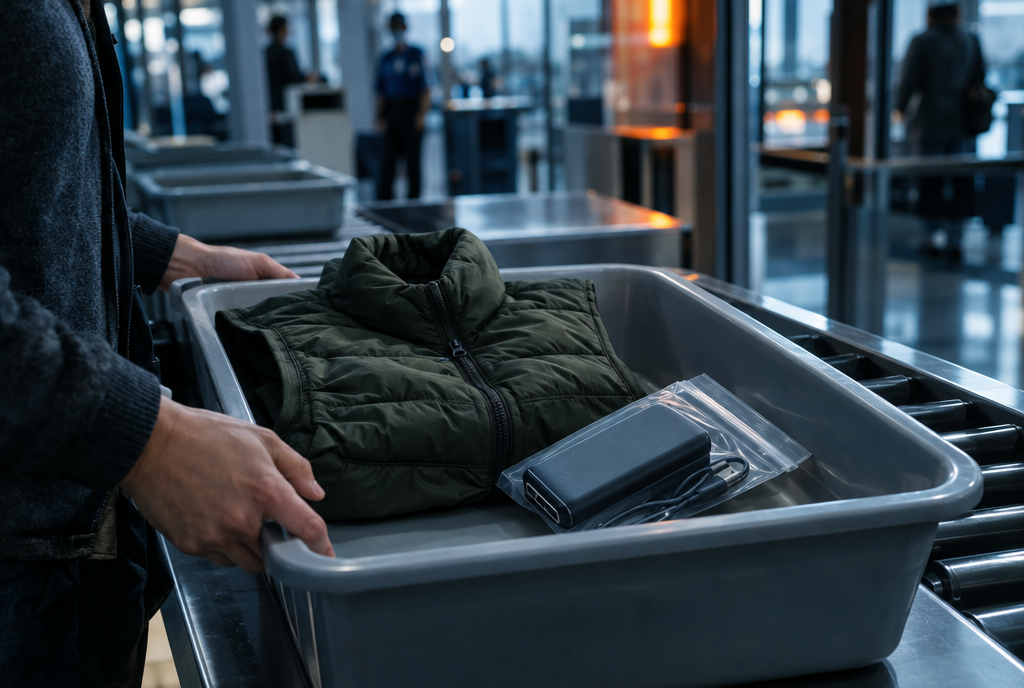
You can fly with a heated vest or jacket, but the lithium-ion battery must travel in the cabin, never in checked baggage when it is a spare. Under FAA rules, packs up to 100 watt-hours need no airline approval, packs from 101 to 160 Wh need airline approval with a limit of two spares, and larger packs are forbidden.
Can you bring a heated vest or jacket on a plane?
Yes. The garment itself is clothing, and without its battery it can go in a carry-on or a checked bag. The rules apply to the battery. Heated vest packs are rechargeable lithium-ion batteries, often in the same format as a power bank, so they fall under the FAA's hazardous materials rules for passengers.
The simplest, most defensible approach is to disconnect the battery, pack the garment wherever you like, and carry the battery on your person or in your carry-on bag with its terminals protected.
What are the FAA and TSA lithium battery limits?
The FAA and TSA publish the same core limits for rechargeable lithium-ion batteries carried by passengers. Airlines may set stricter rules, and the TSA officer at the checkpoint makes the final call on any item.
| Battery rating | Carry-on | Checked bag | Notes |
|---|---|---|---|
| Up to 100 Wh | Yes | No, if carried as a spare | No airline approval needed; batteries must be for personal use |
| 101 to 160 Wh | Yes, with airline approval | No | Limit of two spare batteries per person |
| Over 160 Wh | No | No | Forbidden on passenger aircraft |
How do you find your battery's watt-hours?
Look for a Wh figure printed on the pack. If only volts and milliamp-hours are shown, the FAA's method is to multiply the voltage by the capacity in amp-hours. For example, a pack labeled 7.4 V and 5,000 mAh is 7.4 × 5 = 37 Wh, well within the 100 Wh limit.
If a battery has no readable rating, you may not be able to show it is within limits. Photograph the label before you travel, and keep the product manual or spec sheet on your phone.
Can you put a heated jacket in checked luggage?
Yes, if you remove the battery first. The FAA says spare, uninstalled lithium batteries are always prohibited in checked baggage. It also says devices containing lithium batteries should be carried in the cabin; if one must be checked, it has to be completely powered off and protected against accidental activation or damage.
Because a heated vest's battery simply plugs into a cable, the practical answer is to unplug it and treat it as a spare. If your carry-on is gate-checked, the FAA says spare batteries and power banks must come out of the bag and stay with you in the cabin.
How should you pack a heated vest battery?
These steps follow FAA packing guidance and avoid most checkpoint questions.
Unplug the battery from the garment and switch it off
Protect the terminals from short circuit: use the original retail packaging, a battery case, a protective pouch or tape over exposed contacts
Keep the pack in your carry-on or on your person, not in a checked bag
Keep it separate from coins, keys and other metal objects
Bring only the spares you need, and check your airline's current count limit
Do not bring damaged, swollen or recalled batteries; the FAA bars them unless removed or made safe
Can you wear a heated vest and use it during the flight?
Wearing the garment is not a problem. Running its heater from a lithium pack in flight is an airline decision, and the rules have tightened. Since March 2026, many international carriers have limited passengers to two power banks in the cabin and banned charging them in flight, and some restrict where power banks may be stowed.
Because many heated vest packs are power banks in all but name, the conservative choice is to leave the heat off and the pack disconnected in flight, and to ask your airline before boarding if you want to use it. If any battery becomes hot, swells, smokes or smells, the FAA asks passengers to tell the flight crew immediately.
What about hand warmers, heated gloves and heated socks?
Air-activated hand warmers contain no battery, so lithium battery rules do not apply to them; they warm through a slow iron oxidation reaction once exposed to air. Keep unopened packs sealed until you need them. Rechargeable hand warmers, heated gloves, heated socks and heated insoles all contain lithium cells. Follow the same approach: carry them in the cabin, switch them off and protect any removable batteries as spares.
Rules outside the US follow similar international standards, but individual airlines and countries can be stricter. Check your carrier's dangerous goods page before every trip, especially for connecting international flights.
Key takeaways
The heated garment can go anywhere; the lithium battery goes in the cabin.
Up to 100 Wh needs no approval, 101 to 160 Wh needs airline approval with a two-spare limit, and over 160 Wh is forbidden.
Calculate watt-hours as volts × amp-hours if the label shows only mAh.
Protect terminals, remove the pack from gate-checked bags, and check your airline for in-flight power bank rules.
Frequently asked questions
Are heated jackets TSA approved?
TSA does not approve products, but heated jackets are allowed through screening. The battery must follow lithium battery rules, and the TSA officer has final say at the checkpoint.
Can I leave the battery connected in my heated vest in carry-on?
It is allowed in the cabin, but disconnecting it and protecting the terminals avoids accidental activation and questions at screening. Never leave it connected in a checked bag.
How many heated vest batteries can I bring on a plane?
For packs up to 100 Wh, the FAA sets no fixed number as long as they are for personal use, but airlines may set limits, and many international carriers now cap power banks at two. Packs from 101 to 160 Wh are limited to two spares with airline approval.
Can I wear my heated vest through airport security?
Yes, but you may be asked to remove it for screening, like any jacket. Unplugging the battery in advance and placing it in a bin speeds things up.
Can I bring hand warmers on a plane?
Air-activated hand warmers contain no battery, so lithium battery rules do not apply, though airlines can set their own policies. Rechargeable hand warmers contain lithium batteries and should be carried in the cabin.
Can you wear a heated vest on a plane?
Yes, you can wear a heated vest on board, since the garment is clothing. Its lithium-ion battery must stay in the cabin and within FAA limits, usually 100 Wh or less. Whether you may run the heater during the flight is up to the airline, so keep it off unless the crew says otherwise.
What are the battery pack rules for flying?
Spare lithium-ion battery packs and power banks go in carry-on baggage only, never in checked bags. The FAA limits them to 100 Wh each without airline approval, allows up to two spares of 101 to 160 Wh with airline approval, and forbids larger packs. Airlines may set stricter quantity and Wh limits.
What is the TSA mAh limit for batteries?
There is no mAh limit as such; the FAA and TSA limit is 100 watt-hours per battery without airline approval. To convert, multiply volts by amp-hours, so 100 Wh works out to about 27,000 mAh at 3.7 V or about 13,500 mAh at 7.4 V. Check the Wh rating printed on the pack first.
How do you get airline approval for batteries?
Contact your airline before you travel. Approval is needed only for spare lithium-ion batteries of 101 to 160 Wh, and the FAA says to check with your air carrier for its specific restrictions. Bring the battery's label or spec sheet showing its watt-hour rating.
Where do I pack a heated vest with batteries for a flight?
Unplug the battery and keep it in your carry-on bag or on your person; once the battery is out, the vest itself can go in either bag. The FAA says spare lithium batteries go in carry-on baggage only, with terminals protected by retail packaging, tape or a snug pouch. If your carry-on is gate-checked, take the battery out and keep it with you in the cabin.
Does American Airlines allow battery-heated clothing?
US airlines apply the FAA's passenger battery rules, and the FAA notes that airlines may set stricter quantity and watt-hour limits. Check American's own restricted items page before you fly, since carriers have recently tightened where power banks may be stowed and used. Keep the heater off in flight unless the crew allows it.
Can I bring heated socks or heated gloves on a plane?
Yes, heated socks and gloves can travel, but their lithium batteries follow the same rules as a heated vest. Wear or pack the garment, keep removable batteries in the cabin with terminals protected, and stay within 100 Wh per battery unless the airline approves a larger one. TSA notes the officer at the checkpoint makes the final decision.
From HEATJAC
We design low-profile thermal garments: a heat-reflective vest and a thermal harness with pockets for warmers or cold packs.
Choosing gear? Heated vest vs heat-reflective vest · What warmth costs per shift
Related reading
Sources
PackSafe: Lithium Batteries, Federal Aviation Administration
PackSafe: Portable Electronic Devices Containing Batteries, Federal Aviation Administration
Airline Passengers and Batteries, Federal Aviation Administration
Lithium batteries with 100 watt hours or less in a device, Transportation Security Administration
Lithium batteries with more than 100 watt hours, Transportation Security Administration
New airline power bank rules: what passengers need to know, AirlineRatings
About HEATJAC. HEATJAC is a thermal architecture company founded by an anesthesiologist. We design patented garment systems that capture, conduct and broaden warmth across the body, and we publish this knowledge hub because the science of staying warm should be public. HEATJAC products are not medical devices and are not intended to diagnose, treat, cure or prevent any disease.