
Battery-heated vs battery-free warmth: how to choose
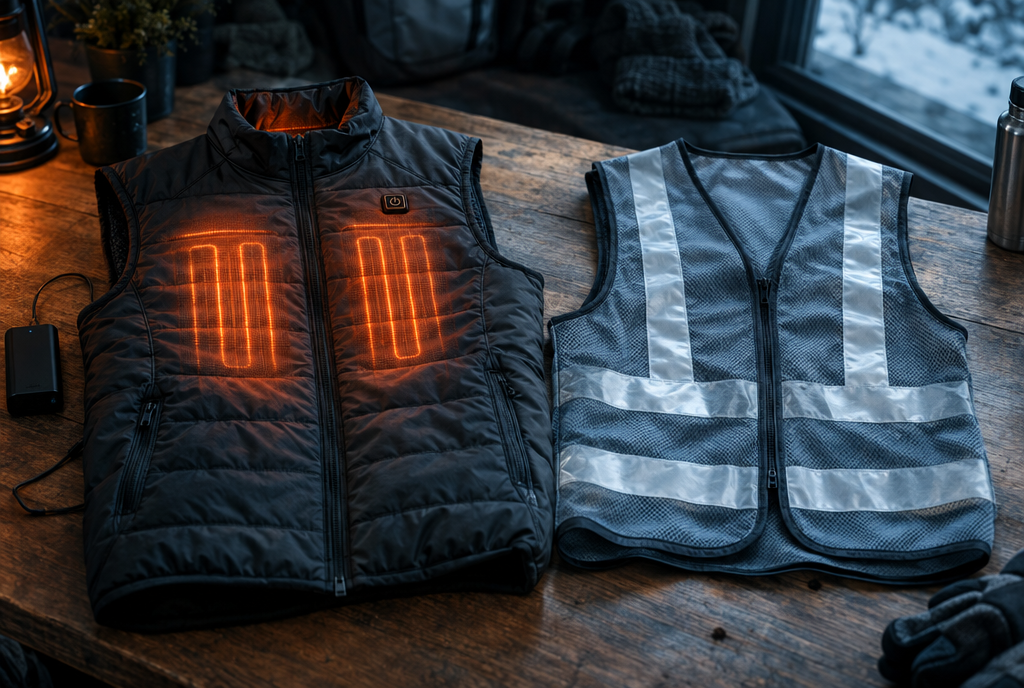
Battery-heated clothing adds heat on demand and is best when you are still for long periods in real cold. Battery-free warmth, from insulation, heat-reflective linings and air-activated warmers, works by slowing heat loss or adding chemical heat, with no charging, less to fail and simpler travel. Many people get the best result by combining them: good layers first, added heat only where needed.
What is the difference between adding heat and keeping heat?
Your body produces heat all the time. Staying warm is a balance between that production and the heat you lose to the environment. There are only two ways clothing can tip the balance: add heat from an outside source, or reduce the rate of loss.
Battery-heated panels and air-activated warmers add heat. Insulation and reflective linings reduce loss. Both approaches are legitimate; they simply fail in different ways. Added heat runs out when the battery or chemistry is spent. Reduced loss never runs out, but cannot make up for an inadequate layering system or a body that is producing little heat.
How do the main warming approaches compare?
The table summarizes the trade-offs. Exact figures vary by product, so check the maker's specifications.
| Approach | How it warms | Power source | Duration | Main risks | Travel |
|---|---|---|---|---|---|
| Battery-heated panels | Adds resistive heat to chosen zones | Rechargeable lithium-ion pack | Limited by watt-hours and setting; shorter in deep cold | Contact burns, battery faults | Battery rules apply |
| Insulation (down, synthetic fill, fleece) | Traps still air to slow conduction and convection | None | Indefinite while dry | Loses warmth when wet or compressed | No restrictions |
| Reflective linings | Reflects part of the body's radiant heat back inward | None | Indefinite | Works best with an air gap and a layer over it | No restrictions |
| Air-activated warmers | Adds heat from iron oxidation | Single-use chemical packet | Hours per packet; one leading maker states up to 10 hours for its standard hand warmer | Low-temperature burns on bare skin | No battery |
| Hybrid pocketed garments | Insulating or reflective body plus pockets for inserts | Warmers, battery inserts or none | Depends on insert | Depends on insert | Depends on insert |
When does battery heating make the most sense?
Battery heat shines when your own heat production is low and exposure is long: sitting in a hunting blind, watching an outdoor game, riding as a passenger, standing on a loading dock, or for people who run cold in air-conditioned workplaces. It also helps when adding more layers is impractical because of mobility or a uniform.
The trade-offs are charging, weight, cost, and performance that drops as it gets colder. Battery University notes that a lithium-ion cell giving full capacity at 27°C (80°F) typically delivers about 50% at minus 18°C (0°F). Batteries also add a layer of product safety to think about; the CPSC recall database lists heated apparel recalls for burn and fire hazards.
When does battery-free warmth make the most sense?
Battery-free options are the better default when you are moving, when you are away from charging for days, when reliability matters more than peak warmth, or when you fly often. OSHA's cold-stress guidance centers on battery-free layers: a wicking inner layer of wool, silk or synthetic, an insulating middle layer that works when wet, and a wind and rain layer that still lets some moisture escape.
Reflective linings target radiation, which a StatPearls overview estimates accounts for about 60% of total body heat loss. That is why a thin reflective layer can feel warmer than its thickness suggests. It is not a heater, though, and works best as part of a system with insulation over it. Air-activated warmers bridge the gap with real added heat, hours at a time, with no battery.
Can you combine battery-heated and battery-free warmth?
Yes, and it is often the most efficient approach. A reflective or insulating layer reduces the heat you lose, so any added heat, from a battery panel or a chemical warmer, lasts longer and can run at a lower setting. Pocketed garments make this modular: the same vest can carry an air-activated warmer on a long day away from power, a battery insert when you want adjustable heat, or nothing at all.
HEATJAC's products illustrate both ends of this range: REFLECT is a lightweight heat-reflective vest with warming pockets, and CORE is a low-profile harness platform whose pockets accept air-activated warmers, battery heating inserts or cold packs.
How should you choose?
Work through these questions in order.
Are your base, mid and outer layers already right? Fix layering first; it is cheaper than any heater.
Will you be mostly still or mostly moving? Stillness favors added heat; movement favors insulation and venting.
How long are you away from power? Multiday trips favor battery-free warmth or chemical warmers.
Do you fly often or work where batteries are restricted? Favor battery-free or removable-insert designs.
Do you have reduced sensation, diabetes or an implanted cardiac device? Ask a clinician before using any heat source against the body.
Key takeaways
Battery heat adds warmth on demand; insulation and reflective linings reduce heat loss and never run out.
Battery-heated gear is strongest for long, stationary cold exposure; battery-free gear is strongest for movement, travel and reliability.
Cold can halve a lithium-ion pack's delivered capacity, so pair any heater with good insulation.
Hybrid pocketed garments let you switch between chemical warmers, battery inserts and no insert.
Talk to a clinician before using heat sources if you have reduced sensation or a medical condition.
Frequently asked questions
Is a heated vest warmer than an insulated vest?
When you are sitting still in real cold, usually yes, because it adds heat your body is not producing. When you are active, a well-insulated vest may be warmer overall and will not run down.
Do heat-reflective linings work without a battery?
Yes. They reduce radiant heat loss by reflecting part of your body's infrared heat back toward you. They work best with a small air gap and an insulating layer over them.
Are air-activated warmers a good alternative to a heated vest?
For many uses, yes. They add real heat for hours with no charging, and work well in pocketed garments, but they must not rest directly on bare skin and they are single-use.
Which is better for air travel?
Battery-free gear avoids lithium battery rules entirely. Battery-heated gear can fly, but the pack must stay in the cabin and meet watt-hour limits.
From HEATJAC
We design low-profile thermal garments: a heat-reflective vest and a thermal harness with pockets for warmers or cold packs.
Choosing gear? Heated vest vs heat-reflective vest · What warmth costs per shift
Related reading
Sources
Physiology, Temperature Regulation (StatPearls), NCBI Bookshelf, National Library of Medicine
Cold Stress Guide, Occupational Safety and Health Administration
HotHands FAQs, Kobayashi Americas
BU-502: Discharging at High and Low Temperatures, Battery University
Recalls and Product Safety Warnings, US Consumer Product Safety Commission
About HEATJAC. HEATJAC is a thermal architecture company founded by an anesthesiologist. We design patented garment systems that capture, conduct and broaden warmth across the body, and we publish this knowledge hub because the science of staying warm should be public. HEATJAC products are not medical devices and are not intended to diagnose, treat, cure or prevent any disease.