
Radiant barriers in clothing: how they work and when they matter
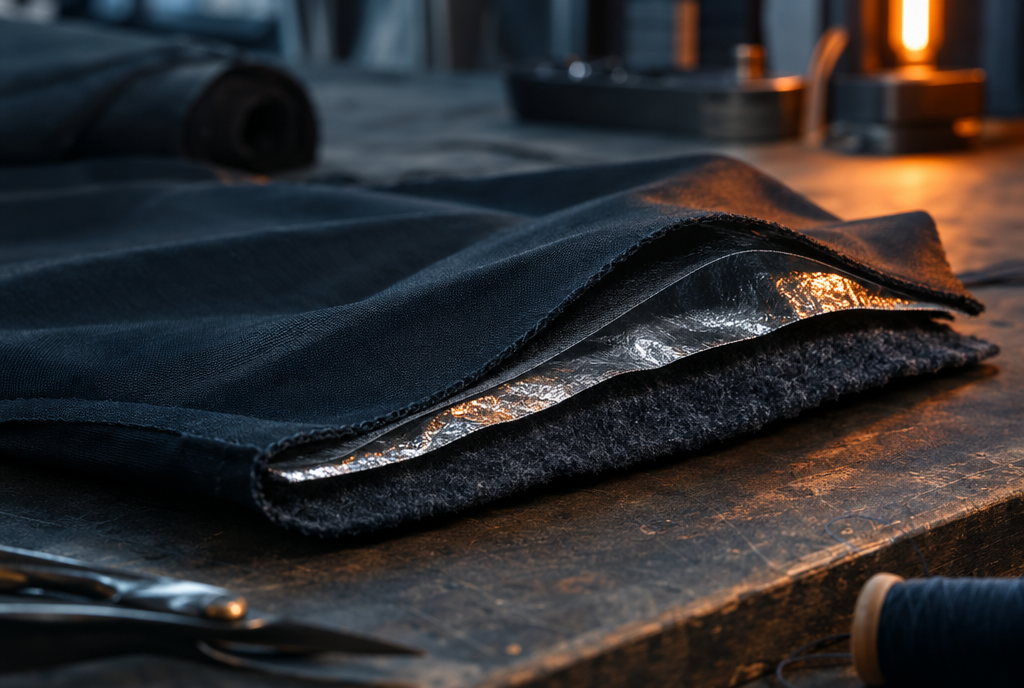
A radiant barrier in clothing is a thin, low-emissivity metallic layer that reflects infrared heat radiated by your body back toward you and radiates little heat outward itself. It works only when it faces an air space, and it addresses radiant heat loss, not conduction, wind or evaporation. It matters most in still, cold conditions and in low-bulk layers.
How does a radiant barrier work?
Skin is an excellent emitter of infrared radiation, with an emissivity near 0.98. It constantly radiates heat to any cooler surface it faces, including the inside of your clothing. A standard physiology reference estimates radiation at about 60% of total body heat loss.
A radiant barrier interrupts that path with a surface of very low emissivity, usually aluminum deposited on a film or fabric. For opaque surfaces, emissivity plus reflectance equals 1, so a surface with emissivity 0.03 reflects about 97% of incoming infrared. NASA uses that figure for aluminum in its description of radiant barrier technology.
Low emissivity also means the barrier's own surface radiates little heat onward to outer layers. The result is less radiant heat crossing that part of the garment. The benefit depends on how much of the body the layer covers and how much air sits on either side of it.
Where did radiant barrier technology come from?
According to NASA, the technique grew out of work at Langley Research Center in the 1950s, when engineers developed a way to coat polyester with vaporized aluminum for the Echo I communications satellite, launched in 1960. The same metallized films were later used to shield spacecraft and became the basis of emergency space blankets and building radiant barriers.
In buildings, the U.S. Department of Energy describes radiant barriers as systems that reduce radiant heat gain, most useful under hot roofs. The principles transfer directly to clothing, including the caveats.
Why does a radiant barrier need an air gap?
Reflection happens at a surface facing open space. The Department of Energy states that to be effective, the reflective surface must face an air space. If the metallic layer is pressed directly against skin or sandwiched tightly between fabrics, heat simply conducts through it and the reflective property contributes little.
Clothing naturally provides small air gaps. Research on the clothing microclimate shows that in air layers thinner than about 12 mm, heat moves mainly by conduction and radiation because the air is too thin to circulate. Radiation is therefore a meaningful share of heat transfer across those gaps, which is where a reflective layer can help.
When does a radiant barrier matter most?
Still, cold conditions where radiant loss is a large share of total heat loss.
Low-activity situations such as sitting, standing watch, spectating or waiting, when the body produces less heat.
Thin, low-bulk layers where adding thick insulation is impractical, such as under a work jacket or uniform.
Combined with heat sources such as air-activated warmers or heated elements, where reflecting heat inward keeps more of it near the body.
Large temperature differences across the layer, which the DOE notes increases the benefit.
What can't a radiant barrier do?
A reflective layer is not a substitute for insulation, windproofing or staying dry. Wind that reaches the body removes heat by convection, wet clothing conducts heat away and sweat evaporation cools the skin. None of these are stopped by reflecting infrared.
Surface condition matters too. The DOE notes that dust reduces reflective capability, and in clothing, abrasion, laundering and oils can gradually raise the surface's emissivity. Solid metallized films can also trap moisture, so garments often use perforated or patterned coatings to balance reflection with breathability.
| Heat loss route | Does a radiant barrier help? |
|---|---|
| Radiation from skin across an air gap | Yes, this is what it is designed to reduce |
| Conduction through compressed layers | Little; metal conducts well when in contact |
| Convection from wind | No; a windproof shell is needed |
| Evaporation of sweat | No; solid films may slow vapor escape |
Is radiant barrier clothing worth it?
It can be, when it is designed as part of a system. A reflective layer adds little weight or bulk, so it suits garments meant to be worn under other clothing or where freedom of movement matters. It is least useful when it is the only defense against wind and wet.
When comparing products, look for the material's measured emittance rather than marketing adjectives, and check whether the reflective side faces the body across an air space. Emittance is a material property measured on flat samples, for example under ASTM C1371; it does not describe how warm a finished garment is. As one example, the reflective lining material used in HEATJAC garments is rated at about 95% radiant heat reflectance (emittance about 0.05) in the supplier's standardized ASTM emittance testing, a figure that describes the material, not whole-garment performance.
Key takeaways
Radiant barriers are low-emissivity metallic layers that reflect body infrared back inward.
An emissivity of 0.03 means about 97% infrared reflectance for an opaque surface.
They must face an air space; pressed tight, they mostly conduct.
They reduce radiant loss only, so windproofing, insulation and dryness still matter.
Material emittance ratings describe the fabric, not the warmth of a finished garment.
Frequently asked questions
How does radiant barrier clothing keep you warm?
It reflects infrared heat radiated by your skin back toward your body and radiates little heat outward itself. This reduces the radiant share of heat loss when the reflective side faces an air gap.
Is radiant barrier fabric waterproof?
Not necessarily. Reflectivity and waterproofing are separate properties. Some metallized films block water and vapor, while perforated or dotted coatings are designed to let vapor escape.
Which side of a heat-reflective lining should face the body?
The reflective surface should face the heat source you want to keep, which in cold weather is your body, with a small air gap between them. Follow the manufacturer's construction, since linings are designed for a specific orientation.
Do radiant barriers work in wet or windy weather?
They still reflect radiant heat, but wind and wet clothing remove heat by other routes that reflection does not address. Pair a reflective layer with a windproof, water-resistant shell and dry insulation.
Is a space blanket a radiant barrier?
Yes. A space blanket is a thin polyester film coated with aluminum, the same principle as a radiant barrier. It reflects radiant heat and blocks wind, but it adds little insulation on its own.
From HEATJAC
We design low-profile thermal garments: a heat-reflective vest and a thermal harness with pockets for warmers or cold packs.
Choosing gear? Heated vest vs heat-reflective vest · The thermal gear buying, safety and care guide
Related reading
Sources
Radiant Barriers Save Energy in Buildings, NASA Spinoff 2013
Radiant Barriers, U.S. Department of Energy, Energy Saver
Physiology, Temperature Regulation (StatPearls), NCBI Bookshelf, National Library of Medicine
The effect of constitutive pigmentation on the measured emissivity of human skin, PLOS ONE (2020)
Clothing Thermophysiological Comfort: A Textile Science Perspective, Textiles (MDPI), 2023
ASTM C1371: Determination of Emittance of Materials Near Room Temperature Using Portable Emissometers, ASTM International
About HEATJAC. HEATJAC is a thermal architecture company founded by an anesthesiologist. We design patented garment systems that capture, conduct and broaden warmth across the body, and we publish this knowledge hub because the science of staying warm should be public. HEATJAC products are not medical devices and are not intended to diagnose, treat, cure or prevent any disease.