
Heated and thermal gear for motorcycle riders: a buying guide
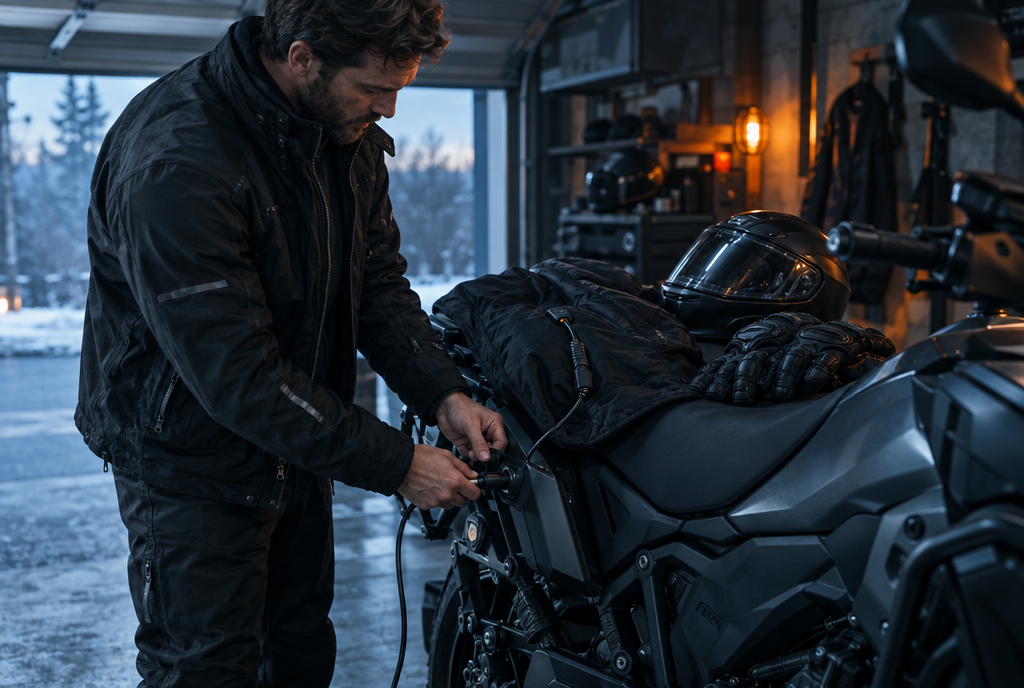
Most riders should start with wind protection and good layers, then add heated gear. Bike-powered 12V gear gives the most heat for as long as you ride, but only if your charging system has spare watts and the harness is fused correctly. Battery-powered gear needs no wiring and works off the bike, with shorter runtime. A controller lets you match heat to speed and temperature.
What should you buy first for cold riding?
Wind is the first problem. Speed creates its own wind chill, and the Georgia motorcycle operator manual notes that a windproof outer layer over protective gear can prevent cold air from reaching the skin. It also warns that cold weather significantly lengthens reaction time. Our guide to riding in the cold explains the physiology; this page is about what to buy.
Buy in this order: a windproof shell or jacket with sealed collar and cuffs, a wicking base layer, a thin insulating mid layer that fits under your armored jacket, then heated gear. Heat added under a jacket that leaks air is heat wasted.
Bike-powered or battery-powered heated gear: which is better?
Bike-powered gear runs off the motorcycle's 12V system through a battery harness. It typically puts out more heat and runs as long as the engine does, which suits touring and long commutes. The trade-off is that you are tethered by a cable and draw on the bike's limited electrical capacity.
Battery-powered gear carries its own packs. It installs nothing, works at stops and off the bike, and moves between riding and other uses. Runtime is limited and cold reduces capacity; Battery University reports about 50 percent of rated capacity at minus 18 °C (0 °F). Carry spares inside your jacket on long rides.
| If you ride... | Choose | Why |
|---|---|---|
| Long tours or all-day highway | 12V jacket liner and gloves with a dual controller | Continuous heat as long as the engine runs |
| Short urban commutes | Battery vest or 12V liner | Short trips fit battery runtime; either works |
| Small-displacement or older bikes | Battery gear, or 12V after a load check | Charging output may have little to spare |
| Adventure trips with time off the bike | Battery gear or passive layers | Warmth at camp and on foot |
| Occasionally in shoulder seasons | Windproof shell plus a passive core layer | No wiring or charging needed |
Can your motorcycle power heated gear?
Check before you buy. Every bike has a fixed charging output, and lights, ignition and accessories already use part of it. ADV Pulse worked through the numbers on a small dual sport rated at 170 watts of charging output: a 60 watt halogen headlight, taillight, 37 watt heated grips, a 47 watt heated vest, 47 watt heated pants and a USB charger created a 39 watt deficit. Switching to a 20 watt LED headlight brought the system back to a small surplus.
Add up the watts of everything you plan to run and compare that with your bike's charging output from the service manual. If the total is close, choose fewer heated pieces, lower-draw gear, or battery-powered items.
What do you need to know about wiring and fuses?
Most 12V gear connects through a harness bolted to the battery terminals with an inline fuse. Gerbing's instructions, for example, say to bolt the positive connector to the positive battery cable, the negative to the negative, and add the fuse last, using a fuse selector sized to the garments you connect. Always use the fuse your gear maker specifies rather than a larger one.
Route the harness away from hot engine parts and moving controls, and keep the connector where it disconnects cleanly if you step off the bike. Gerbing also warns against running its heated gear with the engine off or below the indicated engine speed, since that can damage the gear and electrical system.
Do you need a heat controller?
Yes, for most riders. Without one, some 12V garments run only at full output, which can be too hot at low speed and fine only at highway speed in deep cold. Controllers vary: single controllers set one level for everything, while dual controllers let you set jacket and gloves separately. Gerbing, for example, offers single and dual options, including wireless and Bluetooth versions.
Choose a controller you can adjust with gloves on, mounted where you can reach it without looking down for long. Battery gear usually has buttons on the garment itself; check that they are reachable under your jacket.
How do you layer heated gear under armor?
Heated liners and vests go under the armored jacket, over a base layer, and should fit close so the elements sit near the body. Armor pads that press elements hard against you can create hot spots, so start low and adjust. Make sure added layers do not push shoulder, elbow or back armor out of position; recheck fit with everything on.
Seal the gaps. A neck tube, gauntlet gloves over the jacket cuff, and a jacket that zips to the pants stop cold air from bypassing the heat.
What should be on your buying checklist?
Run through these before you order.
Windproof outer shell and sealed collar and cuffs.
Wicking base layer and a thin mid layer that fit under armor.
Charging capacity checked against total heated gear watts.
Correct harness and manufacturer-specified fuse.
Single or dual controller you can use with gloves.
Spare batteries if you choose battery gear.
Armor fit rechecked with all layers on.
Where HEATJAC fits
HEATJAC REFLECT is a lightweight heat-reflective vest with a snap front and pockets for compatible warming elements. It is passive, so it draws nothing from the bike and needs no wiring, which suits shoulder-season riding or bikes with little spare charging capacity. It does not replace a heated liner for sustained highway riding in deep cold.
Key takeaways
Block wind first; heat under a leaky jacket is wasted.
Choose 12V gear for long rides and battery gear for flexibility off the bike.
Add up heated gear watts and compare them with your charging output.
Use the harness and fuse your gear maker specifies.
A reachable controller makes heated gear usable across speeds and temperatures.
Frequently asked questions
Is 12V or battery heated gear better for motorcycles?
12V gear gives more continuous heat on long rides if your bike has spare charging capacity. Battery gear needs no wiring and works off the bike, but runtime is shorter, especially in the cold.
Can my motorcycle handle a heated jacket?
Compare your charging output from the service manual with the watts of everything you run, including lights. If there is little margin, choose fewer pieces or switch to an LED headlight or battery gear.
What size fuse do I need for heated gear?
Use the fuse your gear maker specifies for the combination of garments you connect. Never substitute a larger fuse.
Should heated gear go over or under motorcycle armor?
Under the armored jacket, over a base layer. Start on low, watch for hot spots where armor presses, and confirm the armor still sits correctly.
When should I stop riding because of the cold?
If you start shivering, feel clumsy or confused, leave the road at the first safe opportunity and warm up. For numbness or color change in hands or feet that lingers, talk to a clinician.
Related reading
Sources
Motorcycle Operator Manual, Section 9: Factors Affecting Rider Performance, Georgia Department of Driver Services
How I Added Heated Gear and Accessories to My Small Dual Sport, ADV Pulse
Gerbing 12V Frequently Asked Questions (Battery Harness Installation), Gerbing Heated Clothing
BU-502: Discharging at High and Low Temperatures, Battery University
About HEATJAC. HEATJAC is a thermal architecture company founded by an anesthesiologist. We design patented garment systems that capture, conduct and broaden warmth across the body, and we publish this knowledge hub because the science of staying warm should be public. HEATJAC products are not medical devices and are not intended to diagnose, treat, cure or prevent any disease.