
7.4V vs 12V heated gear: is more voltage better?
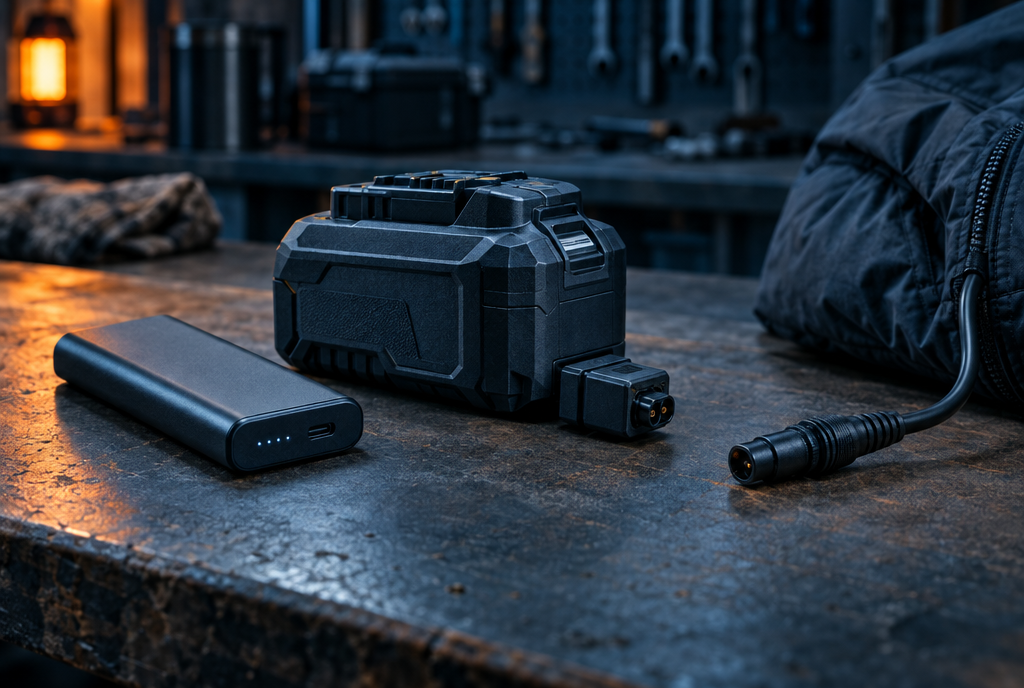
Not by itself. Heat output depends on watts, which designers can reach at 7.4V or 12V. A 12V system often supports more heating zones or higher peak output, and tool-battery gear lets you share packs, but runtime depends on watt-hours divided by watts, not voltage. Choose on rated watts, pack watt-hours, weight, and the battery ecosystem you already own.
Is a 12V heated jacket warmer than a 7.4V one?
Only if it is designed to draw more power. Heat from a resistive panel is electrical power, and OpenStax's physics text gives it as P = V²/R: voltage and the panel's resistance together set the watts. A 7.4V garment with low-resistance panels and a 12V garment with higher-resistance panels can produce the same heat.
What higher voltage does make easier is delivering more total watts at a lower current. That is why many larger jackets with several zones use 12V-class packs. The practical question for a buyer is not the voltage on the label but the watts per heat setting, and many makers do not publish them.
Why does runtime depend on watt-hours, not volts?
Runtime is stored energy divided by the rate of use. Our battery guide covers the conversion; the buying point is that a higher-voltage pack is not automatically a bigger one.
As an illustrative comparison, a 7.4V, 5 Ah pack stores 37 Wh. A 12V-class tool pack is typically about 10.8V nominal, so a 4 Ah version stores about 43 Wh. Run both at 10 W and they last roughly 3.7 and 4.3 hours before losses. Change the heat setting and the difference between settings is far larger than the difference between voltages.
How do 7.4V and 12V systems compare for buyers?
These are general patterns across the category. Check each product's own specifications.
| Factor | 7.4V class | 12V class (including tool packs) |
|---|---|---|
| Typical garments | Vests, gloves, socks, lighter jackets | Jackets and vests with more zones; work gear |
| Peak heat | Depends on rated watts | Often designed for higher total watts |
| Pack weight and bulk | Often smaller and lighter | Often heavier, especially tool packs |
| Runtime | Watt-hours divided by watts | Watt-hours divided by watts |
| Battery sharing | Usually brand-specific | Tool packs shared with drills and other tools |
| Flying | Check Wh rating; spares in cabin | Check Wh rating; larger tool packs may exceed 100 Wh |
Should you buy heated gear that runs on tool batteries?
If you already own a tool platform, it is often the most practical choice. You can swap in a charged pack from the job box, and you avoid buying a separate charger. ToolGuyd notes that 12V Max tool packs are about 10.8V nominal and that 20V Max packs are 18V nominal, so the naming reflects marketing conventions as much as physics.
The trade-offs are weight and fit. A tool pack is designed for a drill handle, not a pocket, and larger packs can pull on a vest or jacket. Only use packs the garment maker lists as compatible, since an adapter or mismatched voltage can overheat the panels.
Can you swap a 7.4V battery for a 12V one?
No. Because power rises with the square of voltage in a fixed resistor, the same panel fed 12V instead of 7.4V would draw roughly 2.6 times the power. That can push elements past their design temperature and create a burn or fire risk. Treat voltage as a matching requirement, not an upgrade.
Which voltage flies more easily?
Neither, as a rule. Airlines regulate watt-hours. The FAA limits lithium-ion batteries to 100 Wh each without airline approval, allows up to two spares from 101 to 160 Wh with approval, and requires spares to travel in carry-on baggage.
Small 7.4V garment packs usually fall well below 100 Wh. Large 18V-class tool packs can approach or exceed it, so check the Wh marking before you pack. Our flying guide covers the details.
Does voltage change cold-weather performance?
Not in a way that should drive the purchase. Both use lithium-ion cells, and Battery University notes that a battery giving full capacity at 27°C (80°F) typically delivers about 50% at minus 18°C (0°F). Pack size, pocket location and your heat setting matter more than the voltage class.
Keep the pack in an insulated inner pocket
Carry a spare in a warm pocket on long, cold days
Warm packs to room temperature before charging
Which voltage should you choose?
Start from how you will use the gear, then check the numbers that actually decide heat and runtime.
| If you... | Lean toward |
|---|---|
| Already own a tool battery platform | Heated gear built for that platform |
| Want the lightest vest or gloves under other layers | 7.4V class with a small pack |
| Need several zones and high output for static cold work | 12V class, with rated watts published |
| Fly often | Any voltage with packs clearly marked under 100 Wh |
| Cannot find watts or Wh on the listing | Ask the seller before buying |
Where HEATJAC fits
HEATJAC garments are passive, with no built-in battery, so the voltage question does not apply to them directly. HEATJAC REFLECT is a lightweight heat-reflective vest with integrated warming pockets for compatible warming elements (sold separately), and can be worn as a layer with heated gear or on its own.
Key takeaways
Heat output depends on watts; voltage alone does not make gear warmer.
12V-class systems often support more zones and higher peak output, usually with heavier packs.
Runtime equals watt-hours divided by watts, whatever the voltage.
Tool-battery gear is practical if you already own the platform; never mix voltages.
Airlines limit watt-hours, not volts, and cold cuts output for every lithium-ion pack.
Frequently asked questions
Is 12V heated clothing warmer than 7.4V?
Not automatically. Warmth depends on the watts a garment is designed to draw. Many 12V jackets are built for higher output, but a well-designed 7.4V garment can be just as warm for its zones.
Do higher-voltage heated jackets last longer?
Only if the pack stores more watt-hours or the heater draws fewer watts. Compare watt-hours and heat settings rather than volts.
Can I use my 18V or 20V tool battery in a 12V heated jacket?
Only if the jacket maker lists it as compatible. Using a higher voltage than a garment is designed for can overheat the heating elements.
Can I take a tool battery on a plane?
Yes, as a spare in carry-on baggage, if it is 100 Wh or less. Packs from 101 to 160 Wh need airline approval, with a limit of two.
Is 7.4V or 12V better for heated gloves?
Most gloves use small packs to keep weight at the wrist down. For gloves, pack weight and fit usually matter more than peak output.
Related reading
Sources
20.4 Electric Power and Energy (College Physics 2e), OpenStax, Rice University
PackSafe: Lithium Batteries, Federal Aviation Administration
BU-502: Discharging at High and Low Temperatures, Battery University
Cordless Power Tool Battery Specs for Popular Brands, ToolGuyd
About HEATJAC. HEATJAC is a thermal architecture company founded by an anesthesiologist. We design patented garment systems that capture, conduct and broaden warmth across the body, and we publish this knowledge hub because the science of staying warm should be public. HEATJAC products are not medical devices and are not intended to diagnose, treat, cure or prevent any disease.