
Heated gloves vs glove liners vs mittens with warmer pockets
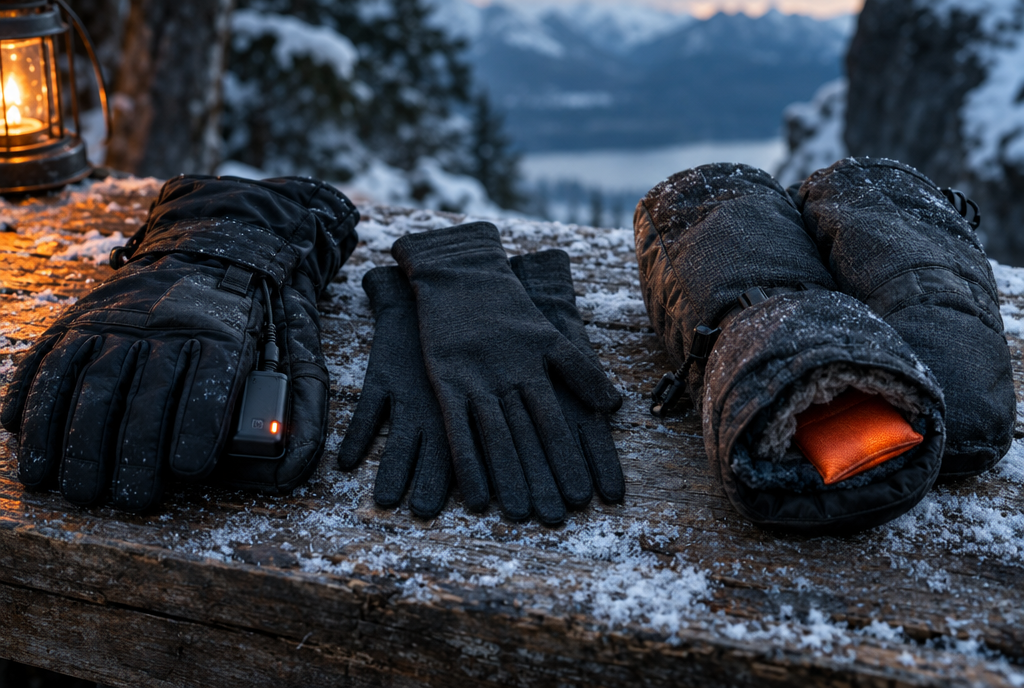
Choose on how much finger work you do. Heated gloves give adjustable heat with moderate dexterity but add battery weight and cost. Glove liners keep fingers covered for fine tasks but add little warmth alone. Mittens with a warmer pocket are the warmest simple option for waiting and walking, with the least dexterity. Many people use a liner under a mitten and add heat when needed.
What is the trade-off between warmth and dexterity?
Every layer on the hand costs some finger control, and cold fingers lose control too. A study in the International Journal of Environmental Research and Public Health cites a finger skin temperature threshold of about 14 to 15°C for manual performance, below which dexterity drops regardless of the glove.
So the goal is not the thinnest glove or the thickest mitten. It is the least bulk that keeps your fingers above that threshold for the task and the time you are out. A trade review of Finnish occupational research reports that even thin gloves can cut finger dexterity by as much as 60% compared with bare hands in the cold, which is why fit matters as much as thickness.
OSHA's cold-stress guidance lists insulated gloves, waterproof if necessary, among basic protection for cold work. The three options below are different ways to meet that need while keeping the hands usable.
How do the three options compare?
Designs vary widely, so treat this as a starting point and check each product's specifications.
| Factor | Heated gloves | Glove liners | Mittens with warmer pocket |
|---|---|---|---|
| Warmth | High, adjustable | Low alone; high under a shell | Highest passive option, plus added heat |
| Dexterity | Moderate | Best | Lowest |
| Bulk and weight | Battery at the cuff adds weight | Minimal | Bulky, light |
| Heat source | Built-in battery panels | None (heated liners exist) | Air-activated or rechargeable warmer |
| Runtime limit | Battery and heat setting | None | Warmer life, hours per pack |
| Cost to own | Highest; batteries age | Lowest | Low, plus warmers |
| Care | Remove battery; follow label | Machine washable in many cases | Remove warmer; wash as labeled |
When are heated gloves the right buy?
Heated gloves make sense when your hands are cold even in good insulation and you still need to grip, steer or handle tools: riding, snow clearing, cold-storage picking or standing jobs outdoors. They are the only option that adds heat at the fingers while leaving them separate.
The costs are weight at the wrist, a battery to charge and protect, and a higher price than passive options. Batteries also deliver less energy in deep cold, so the warmest setting may not last a full shift. Our battery and voltage guides explain how to judge runtime claims.
When are glove liners enough?
Liners suit fine-motor work in mild cold: typing in a cold office, lab work, photography, or any task where you keep taking an outer glove off. They are cheap, light and keep skin covered during the moments of exposure that chill hands fastest.
Alone they add little warmth. Their real value is as the inner layer of a system. The same study found that double gloves were more efficient than single gloves for a manual task at minus 1°C, supporting a liner plus outer layer over one thick glove.
When is a mitten with a warmer pocket best?
Mittens are the warmest passive choice because fingers share one space. Cleveland Clinic describes mittens as warmer than gloves, and the Raynaud's Association calls them even better protection. A pocket on the back of the hand holds an air-activated or rechargeable warmer without it touching skin.
They fit waiting, walking, spectating, ice fishing and commuting. For quick tasks, slip the mitten off and work in a liner underneath.
Which option fits your use?
Match the choice to the task, not to the coldest day of the year.
| If you mostly... | Choose |
|---|---|
| Handle tools or controls in hard cold for hours | Heated gloves |
| Type, write or do fine work in a cool room | Glove liners |
| Wait, walk or watch outdoors | Mittens with a warmer pocket |
| Ski or snowboard | Mittens or insulated gloves with a liner; heat for very cold days |
| Switch between tasks and waiting | Liner under a mitten, warmer in the pocket |
| Have cold-sensitive hands or Raynaud's | Mitten plus liner first; add heat after checking with a clinician |
What about Raynaud's and cold-sensitive hands?
Mittens and layers come first. The Raynaud's Association also stresses warming the full body, especially the core, not just the hands, and suggests carrying hand and foot warmers. Heated gloves can help on very cold days, but reduced sensation raises burn risk.
Talk to a clinician about color changes, numbness, sores or symptoms that are getting worse. Our Raynaud's glove guide covers the features to look for.
Where HEATJAC fits
HEATJAC does not make gloves. For cold hands, HEATJAC CORE addresses the core-warmth side: a low-profile thermal harness platform with integrated heat-reflective inserts and pockets for air-activated warmers (sold separately), worn with whichever hand option you choose.
Key takeaways
Dexterity drops once finger skin falls below about 14 to 15°C, whatever you wear.
Heated gloves add heat with moderate dexterity, at the cost of battery weight, charging and price.
Liners give the best dexterity and work best as the inner layer of a two-layer system.
Mittens with a warmer pocket are the warmest simple option for waiting and walking.
For Raynaud's, start with mittens, liners and core warmth, and talk to a clinician before using heat.
Frequently asked questions
Are heated gloves warmer than mittens?
A heated glove on a warm setting can outpace an unheated mitten, but a mitten with a warmer in its pocket is often comparable and simpler. Mittens also keep fingers together, which loses less heat.
Are heated glove liners better than heated gloves?
Liners fit under your own shell and offer more dexterity, while full heated gloves include insulation and weather protection. Liners suit people who already own good outer gloves.
Can you put a hand warmer inside a glove?
Yes, ideally in a dedicated pocket on the back of the hand or between a liner and outer layer. Do not place a warmer directly against bare skin.
What gloves keep hands warm but still let you work?
A thin, well-fitting liner under a removable outer glove or mitten is the usual answer. For hard cold with constant tool use, heated work gloves are the other option.
Do glove liners actually add warmth?
A little on their own, and more as part of a system. Their main job is to keep fingers covered when you remove an outer layer.
Related reading
Sources
The Impact of Protective Gloves on Manual Dexterity in Cold Environments: A Pilot Study, International Journal of Environmental Research and Public Health (MDPI), 2022
Cold work gloves, Health and Safety International
Raynaud's Syndrome, Cleveland Clinic
Frequently Asked Questions, Raynaud's Association
Protecting Workers from Cold Stress, Occupational Safety and Health Administration
About HEATJAC. HEATJAC is a thermal architecture company founded by an anesthesiologist. We design patented garment systems that capture, conduct and broaden warmth across the body, and we publish this knowledge hub because the science of staying warm should be public. HEATJAC products are not medical devices and are not intended to diagnose, treat, cure or prevent any disease.