
The clothing microclimate: the air layer that decides how warm you feel
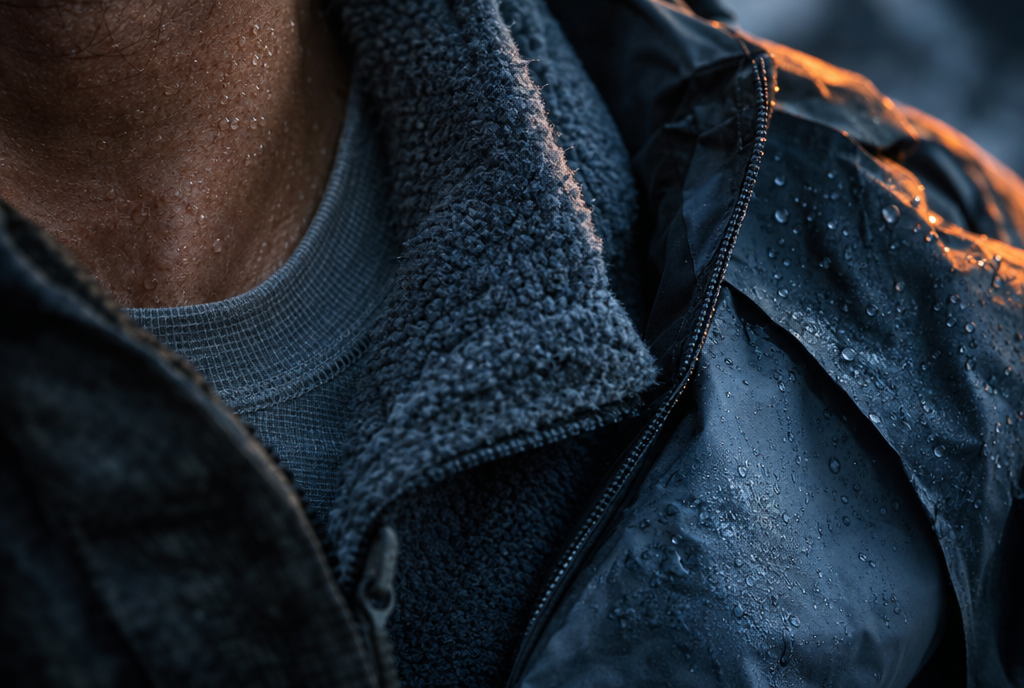
The clothing microclimate is the thin layer of air trapped between your skin and your clothing. Its temperature, humidity and thickness largely decide how warm and dry you feel. Comfortable conditions are often described as about 32°C and 50% relative humidity. Still air in gaps of up to about a centimeter insulates well; wind, movement and moisture disrupt it.
What is the clothing microclimate?
Textile scientists use the term for the air gap between skin and the first layer of clothing, sometimes called the enclosed air layer. In layered outfits, similar air layers sit between each garment. Together they form a small, private climate around the body.
Your skin does not feel the room directly. It feels the temperature, humidity and air movement of this layer. That is why two people in the same room can be comfortable or cold depending on what they wear and how it fits.
What are comfortable microclimate conditions?
Research on thermoregulating textiles describes a comfortable body-textile microclimate as about 32 ± 1 °C and 50 ± 10% relative humidity. When the microclimate cools well below that, you feel cold; when humidity climbs, you feel clammy even if the temperature is fine.
These conditions are easily disturbed. Stepping outside, starting to work, sitting down after exertion or a gust of wind can shift the microclimate within minutes, which is why comfort depends on how clothing responds to change, not just on its static warmth.
Why does trapped air insulate so well?
Still air is a poor conductor of heat, with a thermal conductivity of about 0.024 W/m·K at 0 °C, lower than wool felt. Most insulation, from down to fleece, works by holding air still in small spaces. The microclimate is the first of those spaces.
Adding layers adds air. A manikin study of detachable jacket inserts found that insulation rose markedly when an inner layer was paired with an outer fabric layer, largely because of the air gap created between them.
How does air gap thickness change warmth?
Thicker is not always better. Research summarized in a 2023 textile science review found that below about 12 mm, heat crosses the air gap mainly by conduction and radiation because the air cannot circulate. Above about 12 mm, natural convection begins and thermal resistance starts to fall, reaching a plateau beyond about 18 mm.
A 2025 study in the International Journal of Biometeorology added the effect of wind. It found that an air layer of at least 5 mm and a wind speed of 1.3 m/s were needed before forced convection through the fabric became measurable. At 1.3 m/s, differences in fabric air permeability changed heat flux by up to 23%, and at 2.5 m/s by 24% to 35%. With 25 mm gaps, fabric differences shrank to 1% to 5%.
| Microclimate condition | Effect on warmth |
|---|---|
| Still air gap under about 12 mm | Air cannot circulate; good insulation, radiation and conduction dominate |
| Gap above about 12 mm | Natural convection starts; insulation falls, then plateaus beyond about 18 mm |
| Wind or brisk movement with permeable fabric | Air is pumped out; permeable fabrics lose noticeably more heat |
| Compressed layers (straps, packs, sitting) | Air squeezed out; local insulation drops |
| High humidity or damp fabric | Evaporative and conductive losses rise; feels clammy and cold |
Why do tight or very loose clothes feel colder?
Very tight garments leave almost no air gap, and they compress insulation, so heat conducts straight through. Very loose garments leave large gaps where air can circulate and be pumped out through openings as you move, sometimes called the bellows effect.
Good cold-weather fit sits between the two: close enough to limit circulation, loose enough to preserve loft and a thin air layer. Closures at the neck, wrists and hem help keep the microclimate from venting when you move.
How does moisture change the microclimate?
Skin constantly releases water vapor, and much more during work or exercise. If vapor cannot escape, microclimate humidity rises, fabrics dampen and the air layer loses its insulating value. The same review notes that in thin, immobile air gaps, water-vapor diffusion is slow, which raises evaporative resistance.
Managing moisture is therefore as important as adding warmth. Breathable base layers, venting during exertion and removing a layer before you sweat keep the microclimate dry. Once sweat soaks in and activity stops, the damp layer cools quickly.
How can you manage your own microclimate?
Wear a close but not tight base layer that moves vapor away from skin.
Add insulating layers that trap air without compressing each other.
Use a wind-resistant outer layer so moving air cannot flush the microclimate.
Seal or open the neck, cuffs and hem to hold heat when still and vent when working.
Add or remove heat at the core, where a small change in the microclimate is felt across the torso.
Key takeaways
The clothing microclimate is the air layer between skin and clothing, and it is what your skin actually feels.
Comfortable conditions are often cited as about 32°C and 50% relative humidity.
Still air gaps up to about 12 mm insulate well; larger gaps allow convection and lose effectiveness.
Wind and movement pump air out of permeable clothing, raising heat loss.
Moisture management matters as much as insulation for staying warm.
Frequently asked questions
What is microclimate in clothing?
It is the small zone of air between skin and clothing, and between clothing layers. Its temperature, humidity and air movement determine how warm, cool, dry or clammy you feel.
Why do layers keep you warmer than one thick garment?
Each layer adds its own trapped air gap, and layers let you adjust to changing activity. Removing a layer before you sweat keeps the microclimate dry, which a single thick garment cannot do.
Does clothing fit affect warmth?
Yes. Tight clothing compresses insulation and removes the air gap, while very loose clothing lets air circulate and pump out as you move. A close, non-compressing fit usually traps air most effectively.
Why do I feel cold after I stop exercising?
During exertion, sweat raises humidity in the microclimate and dampens fabrics. When activity stops and heat production drops, that damp layer loses heat quickly through evaporation and conduction.
Does wind go through clothing?
Air-permeable fabrics let wind push through and replace warm microclimate air, especially when you move. A 2025 study found fabric permeability changed heat loss by up to 23% at 1.3 m/s and more at higher speeds.
From HEATJAC
We design low-profile thermal garments: a heat-reflective vest and a thermal harness with pockets for warmers or cold packs.
Choosing gear? Heated vest vs heat-reflective vest · The thermal gear buying, safety and care guide
Related reading
Sources
Clothing Thermophysiological Comfort: A Textile Science Perspective, Textiles (MDPI), 2023
Impact of garment construction and environmental factors on heat transfer, International Journal of Biometeorology (Springer Nature), 2025
Sustainable bi-directional thermoregulation fabric for clothing microclimate, PubMed Central
Comparative Analysis of the Thermal Insulation of Multi-Layer Thermal Inserts in a Protective Jacket, Materials (MDPI), via PubMed Central
Thermal Conductivity table, HyperPhysics, Georgia State University
About HEATJAC. HEATJAC is a thermal architecture company founded by an anesthesiologist. We design patented garment systems that capture, conduct and broaden warmth across the body, and we publish this knowledge hub because the science of staying warm should be public. HEATJAC products are not medical devices and are not intended to diagnose, treat, cure or prevent any disease.