
The thermal science of the human body: a complete guide
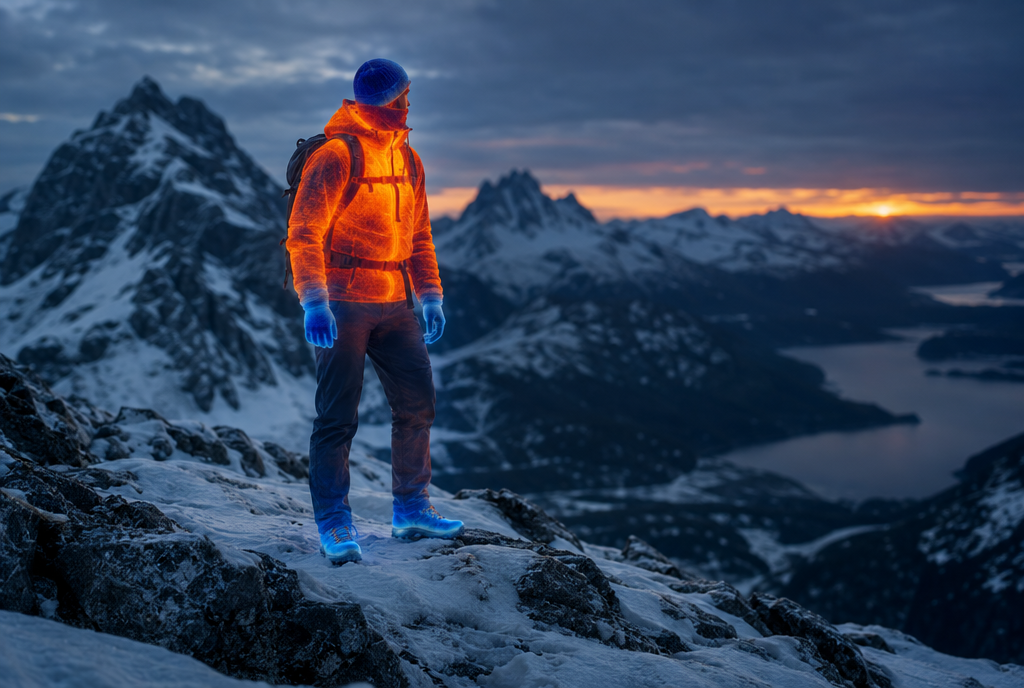
The body stays warm by balancing heat production against heat loss. Metabolism generates heat continuously, and the hypothalamus defends a core temperature of about 37°C by narrowing skin blood vessels and, if needed, triggering shivering. Clothing helps by trapping still air and slowing the four routes of heat loss: radiation, conduction, convection and evaporation. Wind, water and cold surfaces speed those losses.
How does the body stay warm?
Human warmth starts with metabolism. Every cell releases heat as it works, and muscles produce much more during activity. Blood then distributes that heat, and by adjusting how much blood reaches the skin, the body controls how much heat it gives away.
The hypothalamus, at the base of the brain, acts as the thermostat. It compares signals from temperature sensors in the skin and core with a set point near 37°C. When you get cold, it acts through the sympathetic nervous system to constrict skin arterioles so blood bypasses the skin, and if that is not enough it triggers shivering, rapid involuntary muscle contractions that raise heat production. Infants also use brown fat for non-shivering heat production.
Behavior completes the system. Adding layers, moving, seeking shelter and eating are all part of how people stay warm, and they are the parts clothing and equipment can support.
What is a normal body temperature?
Normal is a range, not a single number. A standard physiology reference gives about 37°C plus or minus 0.5°C, and another puts the range at 36.1 to 37.2°C (roughly 97 to 99°F). Temperature is lowest around 4 AM and highest around 6 PM, and it varies with age and measurement site. Hypothermia begins below 35°C (95°F).
The full explanation of the thermostat, the daily rhythm and why 98.6°F is an average rather than a rule is in our guide to normal body temperature and thermoregulation.
How does the body lose heat?
Heat leaves mainly through the skin, which accounts for about 90% of total heat loss. A standard physiology reference estimates the shares below for typical conditions. Those shares shift dramatically in wind, water or on cold ground.
| Route | How it works | Estimated share of heat loss |
|---|---|---|
| Radiation | Infrared emitted from skin to cooler surroundings | About 60% |
| Evaporation | Sweat and moisture evaporating from skin and airways | About 22% |
| Conduction and convection | Contact with colder objects; moving air or water carrying heat away | About 15% combined |
Why do hands and feet get cold first?
When heat loss rises, the body protects its core by cutting blood flow to the skin of the extremities. Fingers and toes are thin, far from the core and have a lot of surface for their small volume, so they cool quickly once warm blood slows. Specialized vessels in the hands and feet can shut down skin blood flow sharply.
That is why cold hands are often the first sign of a cold environment and why protecting the core and the extremities together works better than either alone. Our article on why your hands and feet get cold first covers the physiology and the warning signs that deserve a clinician's attention.
What is conductive heat loss?
Conduction is heat flowing directly into anything colder that you touch. It is a small share of loss in dry conditions but becomes dominant when you sit on frozen ground, grip metal or wear wet clothing. Standard reference values put the thermal conductivity of still air at about 0.024 W/m·K and water at about 0.6 W/m·K, roughly 25 times higher, while steel and aluminum conduct thousands of times better than air.
Our guide to conductive heat loss explains why metal feels colder than wood at the same temperature and how insulated pads, palms and insoles break the contact path.
What does wind chill really mean?
Wind strips away the thin layer of warm air around exposed skin, which speeds convective heat loss. The U.S. National Weather Service wind chill index, in effect since November 2001, turns that faster cooling into a felt temperature. At 0°F with a 15 mph wind, the chart gives a wind chill of -19°F, a level at which exposed skin can freeze in about 30 minutes.
Wind chill applies to exposed skin and does not cool cars or pipes below air temperature. Our wind chill explainer covers the formula, its assumptions and what it means for dressing.
What is emissivity and why does it matter for warmth?
Emissivity describes how efficiently a surface radiates heat, on a scale from 0 to 1. For opaque surfaces, emissivity and reflectance add up to 1, so a surface that emits little also reflects most incoming infrared. Human skin has an emissivity of about 0.98, which makes it a very efficient radiator and explains why radiation is the largest heat-loss route.
Our explainer on emissivity, reflectance and absorptance covers the physics, typical material values and why visible color does not predict infrared behavior.
How do radiant barriers work in clothing?
A radiant barrier is a thin metallic layer with low emissivity. Facing the body across an air gap, it reflects infrared back toward the skin and radiates little heat outward. The U.S. Department of Energy notes that a reflective surface must face an air space to be effective and that dust reduces its reflectivity, principles that apply to garments too.
Reflection addresses only the radiant share of loss, so it works best combined with insulation and wind protection. HEATJAC garments use a reflective lining material rated at about 95% radiant heat reflectance (emittance about 0.05) in the supplier's standardized ASTM emittance testing, a material property rather than a whole-garment measure. Our article on radiant barriers in clothing explains when they matter and when they do not.
What is the clothing microclimate?
Your skin feels the thin layer of air trapped under your clothing, not the room. Research on textile comfort shows that in air gaps thinner than about 12 mm, the air cannot circulate and heat crosses mainly by conduction and radiation. Above that, natural convection starts and insulation falls, leveling off beyond about 18 mm.
Wind, movement and moisture all disrupt this layer. Our guide to the clothing microclimate explains how fit, layering and venting keep it warm and dry.
How is clothing warmth measured?
Clothing insulation is expressed in clo. ASHRAE Standard 55 defines 1 clo as 0.155 m²·°C/W, roughly a business suit. Its tables list about 0.36 clo for shorts and a short-sleeve shirt and 0.96 clo for trousers, a long-sleeve shirt and a suit jacket. Our explainer on the clo value covers the unit, typical values and why most jackets do not list one.
Those numbers come from laboratory tests. Fabrics are measured on sweating guarded hotplates, whole outfits on heated thermal manikins, and reflective surfaces with emissometers. Our article on how clothing warmth is tested explains what each method measures and what it leaves out, including the effects of movement and wind.
How can you apply thermal science to stay warm?
The same principles apply whether you work in a freezer, stand in an operating room, hunt from a blind or wait for a bus. Each route of heat loss has its own countermeasure, and the most effective systems address all of them. Active heat sources, such as air-activated warmers or battery heating elements, add warmth when insulation alone cannot keep up, especially during long periods of low activity.
Trap still air with layers that do not compress each other.
Block wind with a tightly woven or windproof outer layer.
Stay dry: vent before you sweat and change damp gloves and socks.
Break contact with cold surfaces using pads, insoles and insulated palms.
Reflect radiant heat with low-emissivity layers that face an air gap.
Keep the core and head warm so the body has less reason to restrict blood flow to hands and feet.
When should cold be a health concern?
Feeling cold in cold conditions is normal. Symptoms such as uncontrollable shivering, confusion, drowsiness, numb or discolored fingers and toes, or feeling far colder than people around you are different. This guide is educational; talk to a clinician about symptoms, and seek emergency care for signs of hypothermia or frostbite.
Key takeaways
The body stays warm by balancing metabolic heat production against heat loss, controlled by the hypothalamus.
Radiation is the largest route of heat loss, estimated at about 60%, followed by evaporation and then conduction and convection.
Hands and feet cool first because the body restricts their skin blood flow to protect the core.
Clothing works mainly by trapping still air; wind, water and compression undo it.
Low-emissivity reflective layers reduce radiant loss when they face an air gap.
Clo values, hotplate tests, manikin tests and emittance tests each measure a different part of warmth.
Frequently asked questions
How does the human body keep warm?
Metabolism generates heat, and the hypothalamus conserves it by narrowing skin blood vessels and, if needed, triggering shivering. Clothing and behavior, such as moving and seeking shelter, complete the system.
What are the four ways the body loses heat?
Radiation, conduction, convection and evaporation. In typical conditions, radiation is the largest route, but wind boosts convection, wet clothing and cold surfaces boost conduction, and sweating boosts evaporation.
Where does the body lose the most heat?
Most heat leaves through the skin, which accounts for about 90% of total loss. Any uncovered area loses heat, so covering the head, neck, hands and face matters in cold weather along with the torso.
Why do clothes keep you warm?
Clothes do not produce heat; they slow its loss. They trap still air, which conducts heat poorly, block wind and, with reflective layers, return some radiant heat to the body.
What is the best way to stay warm in extreme cold?
Combine layered insulation, a windproof outer layer, dry base layers, protection for hands, feet and face, and insulation from cold surfaces. Keep moving when you can and take warm-up breaks in shelter.
Why do I feel cold when my temperature is normal?
Feeling cold is driven largely by skin temperature, especially in the hands, feet and face. The body can keep its core normal while the skin cools. Persistent or unusual cold intolerance is worth discussing with a clinician.
From HEATJAC
We design low-profile thermal garments: a heat-reflective vest and a thermal harness with pockets for warmers or cold packs.
Choosing gear? Heated vest vs heat-reflective vest · The thermal gear buying, safety and care guide
Related reading
Sources
Physiology, Temperature Regulation (StatPearls), NCBI Bookshelf, National Library of Medicine
Physiology, Heat Loss (StatPearls), NCBI Bookshelf, National Library of Medicine
Thermal Conductivity table, HyperPhysics, Georgia State University
Wind Chill Chart and Frostbite Times, National Weather Service (NOAA)
The effect of constitutive pigmentation on the measured emissivity of human skin, PLOS ONE (2020)
Radiant Barriers, U.S. Department of Energy, Energy Saver
Clothing Thermophysiological Comfort: A Textile Science Perspective, Textiles (MDPI), 2023
ANSI/ASHRAE Standard 55-2013, Thermal Environmental Conditions for Human Occupancy, ASHRAE
About HEATJAC. HEATJAC is a thermal architecture company founded by an anesthesiologist. We design patented garment systems that capture, conduct and broaden warmth across the body, and we publish this knowledge hub because the science of staying warm should be public. HEATJAC products are not medical devices and are not intended to diagnose, treat, cure or prevent any disease.