
Conductive heat loss: why cold surfaces drain warmth so fast
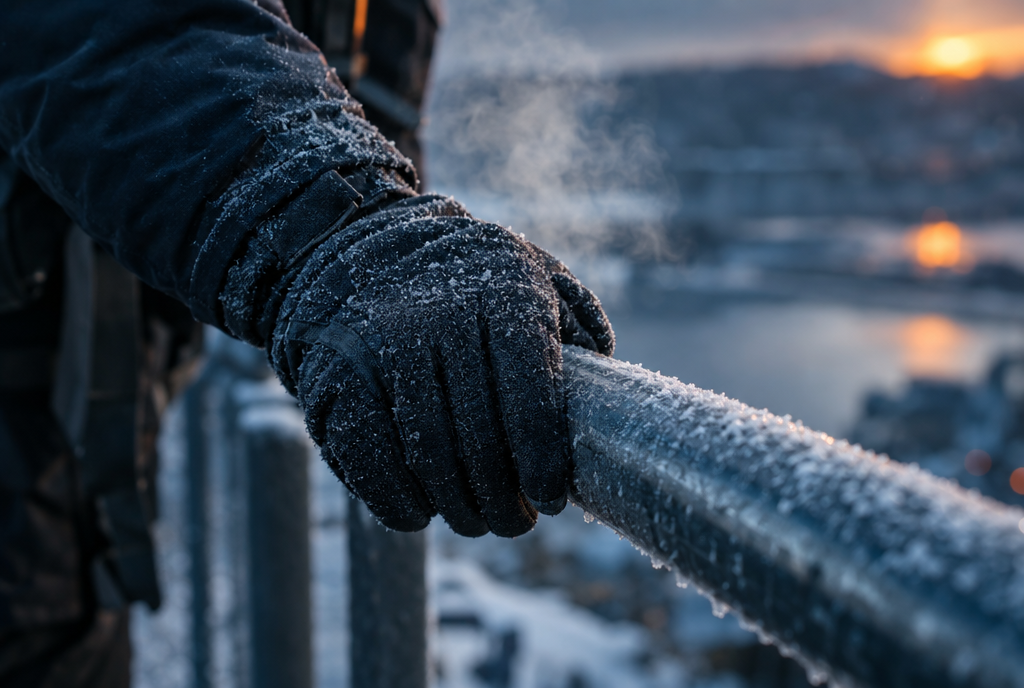
Conductive heat loss is the transfer of body heat directly into a colder object you touch, such as a metal tool, cold ground, a wet shirt or water. Its rate depends on the temperature difference, contact area and the material's thermal conductivity. Water conducts heat roughly 25 times better than air, and metals conduct far more, which is why they drain warmth so quickly.
What is conductive heat?
Conduction is heat moving through direct contact, molecule to molecule, from a warmer region to a cooler one. No air flow or light is involved. When your palm rests on a cold railing, heat travels from skin into the metal and spreads away through it.
Physics describes the rate with Fourier's law: heat flow rises with the temperature difference and the contact area and falls with the thickness of whatever sits in between. Materials differ enormously in how easily heat moves through them, a property called thermal conductivity.
How much body heat is lost by conduction?
In everyday dry conditions, conduction is a small share of total heat loss. A standard physiology reference estimates direct-contact conduction at about 3% of total body heat loss, well behind radiation and evaporation.
That share can change fast. Sitting on frozen ground, kneeling on concrete, gripping metal tools or wearing wet clothing all multiply contact losses. Princeton University's outdoor safety guide notes that conduction normally accounts for only about 2% of heat loss but increases about fivefold with wet clothing.
Why does metal feel colder than wood at the same temperature?
A steel bench and a wooden bench left outside overnight sit at the same temperature, yet steel feels far colder. The difference is how fast each material pulls heat from your skin and spreads it away from the contact point.
Wood conducts heat poorly, so the surface under your hand warms quickly and heat flow slows. Metal conducts heat very well, so it keeps drawing warmth from skin and skin temperature at the contact drops sharply. Your nerves sense that falling skin temperature, not the object's actual temperature.
The table shows why. Using standard reference values, steel conducts heat about 2,000 times better than still air and aluminum more than 8,000 times better. Ice and concrete also conduct heat better than water, which is why kneeling on a frozen floor chills knees so quickly.
| Material | Thermal conductivity (W/m·K, approximate) |
|---|---|
| Air (still, 0 °C) | 0.024 |
| Wool felt | 0.04 |
| Wood | 0.04 to 0.12 |
| Water (20 °C) | 0.6 |
| Concrete | 0.8 |
| Ice | 1.6 |
| Steel | 50.2 |
| Aluminum | 205 |
Why does wet clothing make you so cold?
Insulating fabrics work mostly by trapping still air, which conducts heat poorly. When water replaces that air, the layer becomes a conductor. Water's conductivity is about 25 times that of still air, based on standard reference values.
Wet fabric also cools through evaporation, so damp clothing drains heat two ways at once. This is why cold-weather guidance repeatedly stresses staying dry, venting before you sweat and changing wet socks and gloves promptly.
Immersion is the extreme case. Water surrounds the whole body and carries heat away much faster than air at the same temperature, which is why cold water is so dangerous even when the air feels mild.
Where does conductive heat loss matter most?
Mayo Clinic notes that frostbite can happen in an instant if bare skin touches something very cold, such as freezing metal. Anyone with numbness, color change or pain after cold contact should talk to a clinician.
Sitting or lying on cold ground, snow, ice or concrete, especially in camps, blinds and ice-fishing shelters.
Kneeling or leaning on cold floors, vehicles and racking in freezers and outdoor work sites.
Holding metal tools, rails, ladders and steering wheels with thin gloves.
Feet standing on cold surfaces for long periods, where boot soles and insoles form the only barrier.
Wet clothing, gloves or socks from rain, snow or sweat.
How do you reduce conductive heat loss?
The fix is to put a thick, dry, low-conductivity layer between you and the cold surface, and keep it dry. Closed-cell foam pads, insulated seat cushions, knee pads and thick insoles all work this way.
Sleeping pads are a good example of treating conduction as its own problem. Their insulation is now rated with an R-value under ASTM F3340, which measures heat flow from a warm plate down through the pad. A sleeping bag compressed under body weight loses much of its loft, so the pad beneath carries most of the load against the ground.
For hands, choose gloves with insulation on the palm and fingers, not just the back, and consider insulated handles or grips for metal tools. Keep a dry spare pair of gloves and socks when work or play will make them damp.
Key takeaways
Conduction is heat flowing into anything colder you touch; its rate depends on temperature difference, contact area and conductivity.
In dry everyday conditions it is a small share of heat loss, but cold ground, metal and wet clothing multiply it.
Water conducts heat about 25 times better than still air; common metals conduct thousands of times better.
Metal feels colder than wood at the same temperature because it pulls heat from skin faster.
Dry, thick, low-conductivity barriers such as foam pads, insulated palms and thick insoles are the most direct fix.
Frequently asked questions
What is an example of conductive heat loss?
Sitting on a cold bench, standing on ice or gripping a cold metal tool are all examples. Heat moves directly from skin or clothing into the colder object through contact.
Is conduction or convection worse for heat loss?
In dry, still air, convection and radiation usually remove more heat than conduction. Conduction becomes dominant when you touch cold ground, metal or water, or when clothing is wet.
Why do I get cold sitting on the ground even in a warm jacket?
Your weight compresses the jacket's insulation where you sit, squeezing out the trapped air. The cold ground then conducts heat away through the thin compressed layer. A foam pad or insulated seat restores the barrier.
Does wool stay warm when wet?
Wet wool still loses a lot of its insulation, like any fabric, because water replaces trapped air. Staying dry, and carrying a dry spare layer, matters more than fiber choice.
How can workers reduce conduction in a freezer?
Use insulated boots and insoles, gloves with insulated palms, knee pads for kneeling tasks and insulated grips on cold tools. Change damp gloves and liners promptly, and follow the employer's warm-up schedule.
From HEATJAC
We design low-profile thermal garments: a heat-reflective vest and a thermal harness with pockets for warmers or cold packs.
Choosing gear? Heated vest vs heat-reflective vest · The thermal gear buying, safety and care guide
Related reading
Sources
Thermal Conductivity table, HyperPhysics, Georgia State University
Outdoor Action Guide to Hypothermia and Cold Weather Injuries, Princeton University Outdoor Action
Physiology, Temperature Regulation (StatPearls), NCBI Bookshelf, National Library of Medicine
Frostbite: Symptoms and causes, Mayo Clinic
New standardized R-value: ASTM F3340, NEMO Equipment Journal
About HEATJAC. HEATJAC is a thermal architecture company founded by an anesthesiologist. We design patented garment systems that capture, conduct and broaden warmth across the body, and we publish this knowledge hub because the science of staying warm should be public. HEATJAC products are not medical devices and are not intended to diagnose, treat, cure or prevent any disease.