
The 4 ways the body loses heat: radiation, convection, conduction and evaporation
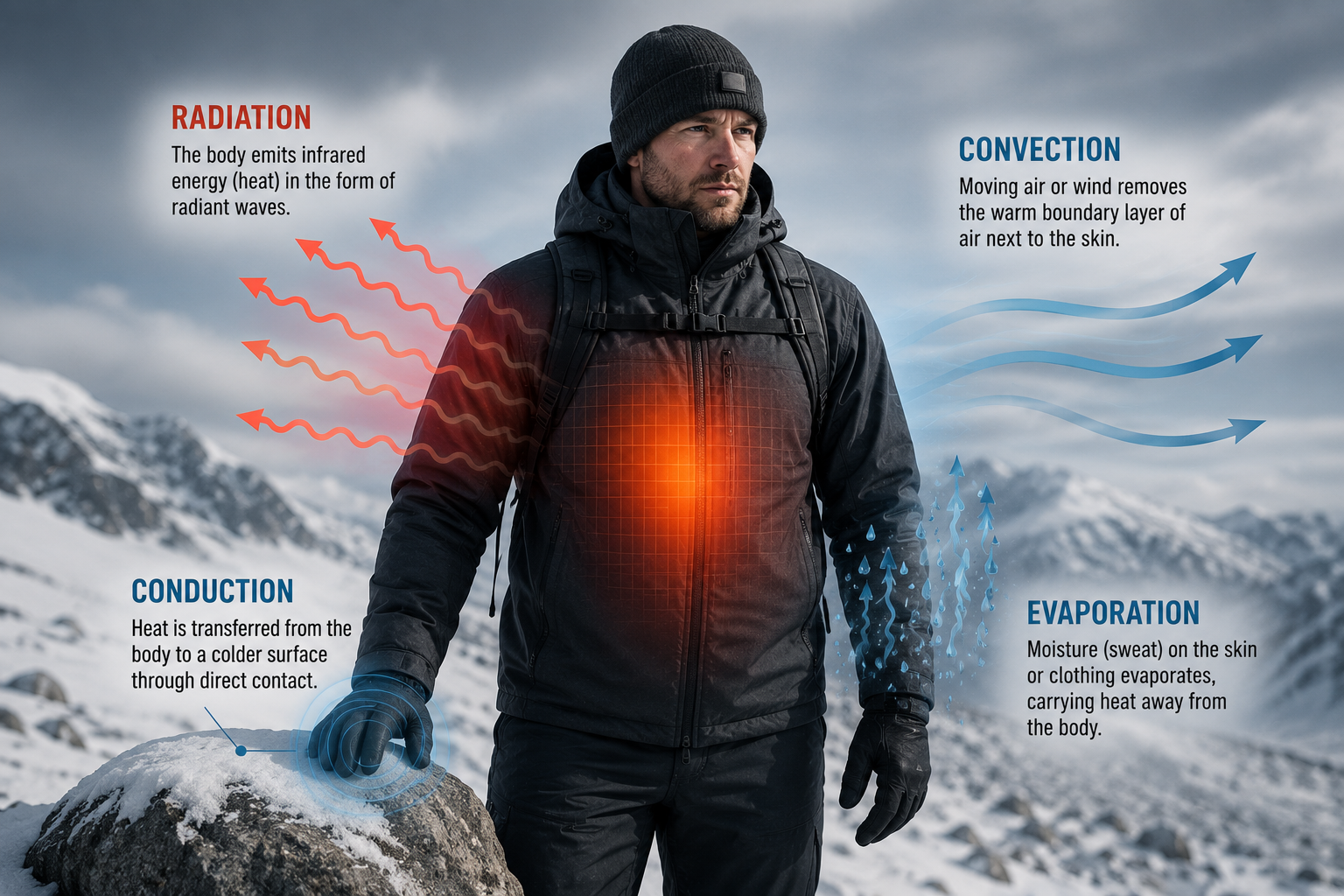
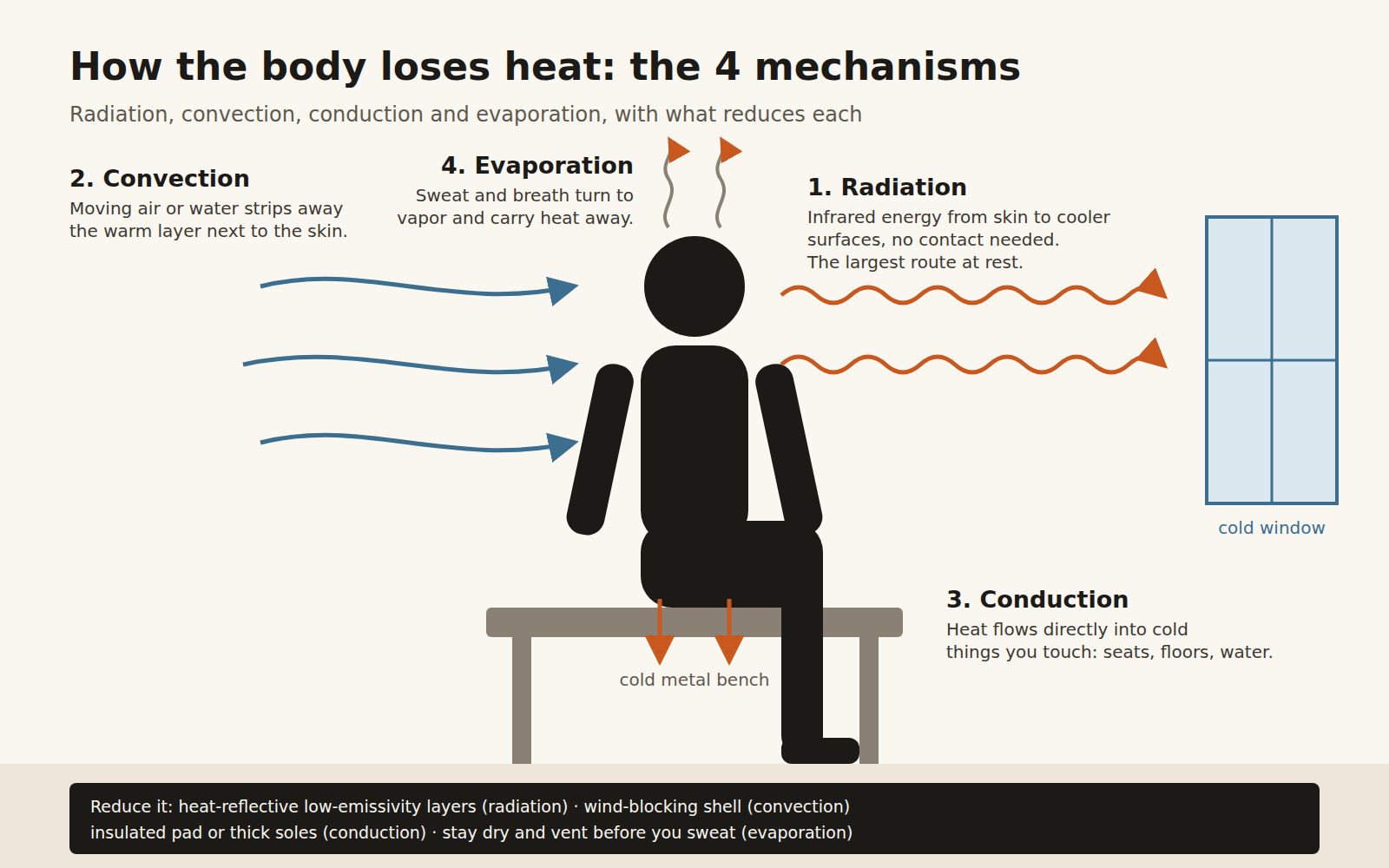
The body loses heat in four ways. Radiation sends infrared energy from skin to cooler surfaces nearby. Convection carries heat away in moving air or water. Conduction passes heat into anything cooler you touch. Evaporation removes heat as sweat and moisture turn to vapor. At rest in a cool room, radiation is the largest route, at about 60 percent.
What are the 4 types of heat loss?
Physiology texts and first aid guidance name the same four mechanisms. Three of them (radiation, convection and conduction) depend on a temperature difference: heat flows only from warmer to cooler. The fourth, evaporation, works by turning liquid water into vapor, which absorbs heat even when the air is warm.
| Mechanism | How it works | Everyday example | What reduces it |
|---|---|---|---|
| Radiation | Skin emits infrared energy to cooler surfaces around it, without touching them | Feeling chilly next to a cold window even in still, warm air | Covering skin, heat-reflective low-emissivity layers, warmer surrounding surfaces |
| Convection | Moving air or water carries away the warm layer next to the skin | Wind on a cold day, or a draft from a vent | Wind-blocking shells, trapped still air in insulation, closing gaps at cuffs and collar |
| Conduction | Heat flows directly into cooler objects you touch | Sitting on a cold bench, standing on a cold floor, cold water | Insulating pads, thick soles, staying dry, avoiding contact with cold surfaces |
| Evaporation | Water from sweat, skin and lungs turns to vapor and takes heat with it | Sweating during exercise, wet clothing in wind | Staying dry, moisture-wicking layers, venting before you sweat |
What are the ways the body loses and gains heat?
Body temperature stays steady only when heat gained equals heat lost. The body gains heat mainly from its own metabolism: every working muscle and organ releases heat, and shivering raises that output on purpose. It can also gain heat from outside through the same physical routes running in reverse, such as sunlight or a fire (radiation), warm water or hot air (convection), and a warm seat or hot water bottle (conduction).
Evaporation is the exception. It only removes heat, which is why it becomes so important when everything around you is warm. Understanding which way each route is running at a given moment explains most cold and heat problems, from a chilly office to heat illness on a humid day.
What is the primary means of body heat loss?
At rest in a cool environment, radiation is the main route. OpenStax Anatomy and Physiology puts radiation at about 60 percent of heat loss, evaporation at about 20 percent, convection at about 15 percent and conduction at about 3 percent. StatPearls gives very similar shares, with evaporation at about 22 percent.
These shares are a textbook snapshot for a person at rest, not a fixed rule. Wind, water, exercise, clothing and a hot environment all change the balance, sometimes dramatically.
How does the body lose heat through radiation?
Every surface warmer than absolute zero gives off infrared energy, and skin is an efficient emitter. Your body radiates to walls, windows, the ground and the sky, and they radiate back. The net loss depends on the temperature difference between your skin and those surfaces, not the air temperature alone.
That is why a room with cold exterior walls can feel chilly even when the thermostat reads normal, and why a clear night sky feels colder than an overcast one. Radiation needs no contact and no moving air, so it continues even when you are perfectly still.
How does the body lose excess heat when the surroundings are hotter than the body?
When the air and surrounding surfaces are warmer than your skin, radiation, convection and conduction reverse direction and add heat instead of removing it. HyperPhysics at Georgia State University notes that the only mechanisms left in those conditions are the evaporation of sweat from the skin and of moisture in exhaled breath.
This answers a common quiz question: if the environment is above body temperature, the body expels heat by evaporation. Evaporation is also the dominant route during hard exercise, when the body produces far more heat than radiation and convection can shed. Humid air slows evaporation, which is why heat feels more dangerous on humid days.
Which mechanism causes the least amount of heat loss?
In typical conditions, conduction causes the least heat loss, at about 3 percent, because air is a poor conductor and most of your body touches only air. Your feet on the floor and your back against a chair are small contact areas.
The ranking flips when you lie on cold ground, sit on snow or metal, or enter cold water. Water and solid surfaces pull heat away many times faster than still air, so a person lying on cold ground can lose a large share of heat by conduction. This is why insulation underneath a cold person matters as much as a blanket on top.
How much heat do you lose by breathing?
Breathing removes heat in two ways. Inhaled air is warmed and humidified in the airways, and that warm, moist air is then exhaled. StatPearls notes that water evaporates from the skin and lungs at about 600 to 700 mL a day even without sweating, a steady background heat loss.
In very cold, dry air, respiratory heat and moisture loss rises, which is one reason a scarf or buff over the mouth can feel warmer. For most people at rest, though, breathing is a modest part of the total.
Where does heat leave the body?
Heat leaves mainly through the skin surface, and exposed skin loses the most. Areas with a large surface relative to their volume, like the hands, feet, ears and nose, cool fastest. The head is not a special exit; it loses heat in proportion to its surface area, but it is often the only uncovered part.
The body also controls where heat goes. In the cold, the sympathetic nervous system narrows skin blood vessels so blood bypasses the skin, and goosebumps (piloerection) trap a thin layer of air, according to StatPearls. That conserves core heat at the expense of cooler fingers and toes.
How do newborns lose heat?
Newborns lose heat through the same four mechanisms, but faster. StatPearls notes that they have little subcutaneous fat for insulation and rely on nonshivering heat production from brown fat. A wet newborn loses heat by evaporation, and cold surfaces, drafts and cold walls add conduction, convection and radiation. Questions about a baby's temperature belong with a clinician.
How does thermal insulation work on the human body?
Insulation does not make heat; it slows each route of loss. Most clothing insulation works by trapping still air, which is a poor conductor and cannot carry heat away by convection while it stays still. Loft, layering and a snug but not compressed fit all protect that air.
Each mechanism has its own countermeasure:
Radiation: cover skin, and use heat-reflective, low-emissivity layers that return infrared energy toward the body.
Convection: block wind with a shell and seal gaps at the neck, wrists and waist.
Conduction: put insulation between you and cold surfaces, and keep layers dry, since wet fabric conducts heat far better than dry fabric.
Evaporation: manage sweat with wicking base layers and by venting or removing layers before you overheat.
Physiology: the body adds its own insulation by narrowing skin blood vessels and, over time, through body fat.
Key takeaways
The four mechanisms of heat loss are radiation, convection, conduction and evaporation.
At rest in a cool room, radiation is the largest route (about 60 percent) and conduction the smallest (about 3 percent).
When the environment is hotter than the skin, evaporation is the only way left to shed heat.
Cold ground and cold water make conduction the dominant route.
Insulation works by slowing each route: still air, wind blocking, dryness and heat-reflective layers.
Frequently asked questions
Which mechanism causes the least amount of heat loss?
Conduction, at about 3 percent of heat loss for a person at rest surrounded by air. Air conducts heat poorly and only small areas of the body touch solid surfaces. Lying on cold ground or entering cold water changes that, and conduction can become the largest route.
What is the primary means of body heat loss?
Radiation, at about 60 percent of heat loss at rest in a cool environment. The body emits infrared energy to cooler walls, windows and sky. During exercise or in hot weather, evaporation of sweat takes over as the main route.
How does the human body expel heat if the surroundings are above body temperature?
By evaporation. When the surroundings are warmer than the skin, radiation, convection and conduction add heat instead of removing it. Evaporation of sweat and of moisture in the breath is the only way left to cool down.
Name three ways the human body gives up heat.
Any three of radiation, convection, conduction and evaporation. Radiation is infrared energy given off by the skin, convection is heat carried away by moving air or water, conduction is heat flowing into cooler objects you touch, and evaporation is heat removed as water turns to vapor.
Do you lose most of your heat through your head?
No. The head loses heat roughly in proportion to its surface area, which is a small fraction of the body. It feels important because it is often the only uncovered part, so a hat helps when the rest of you is already dressed warmly.
What heat loss mechanism matters most in newborns?
All four matter, and newborns lose heat faster than adults because of their size and thin fat layer. A wet newborn loses heat quickly by evaporation, and cold surfaces, drafts and cold walls add the other three. A clinician or nurse can advise on keeping a newborn warm.
From HEATJAC
We design low-profile thermal garments: a heat-reflective vest and a thermal harness with pockets for warmers or cold packs.
Choosing gear? Heated vest vs heat-reflective vest · The thermal gear buying, safety and care guide
Related reading
Sources
Anatomy and Physiology 2e, 24.6 Energy and Heat Balance, OpenStax, Rice University
Physiology, Temperature Regulation, StatPearls, NCBI Bookshelf (NIH)
Perspiration Cooling of Body, HyperPhysics, Georgia State University
Table 10. The 4 Mechanisms of Heat Loss (2024 First Aid Guidelines), American Heart Association
About HEATJAC. HEATJAC is a thermal architecture company founded by an anesthesiologist. We design patented garment systems that capture, conduct and broaden warmth across the body, and we publish this knowledge hub because the science of staying warm should be public. HEATJAC products are not medical devices and are not intended to diagnose, treat, cure or prevent any disease.