
Heated vest vs heat-reflective vest: which to buy for which job
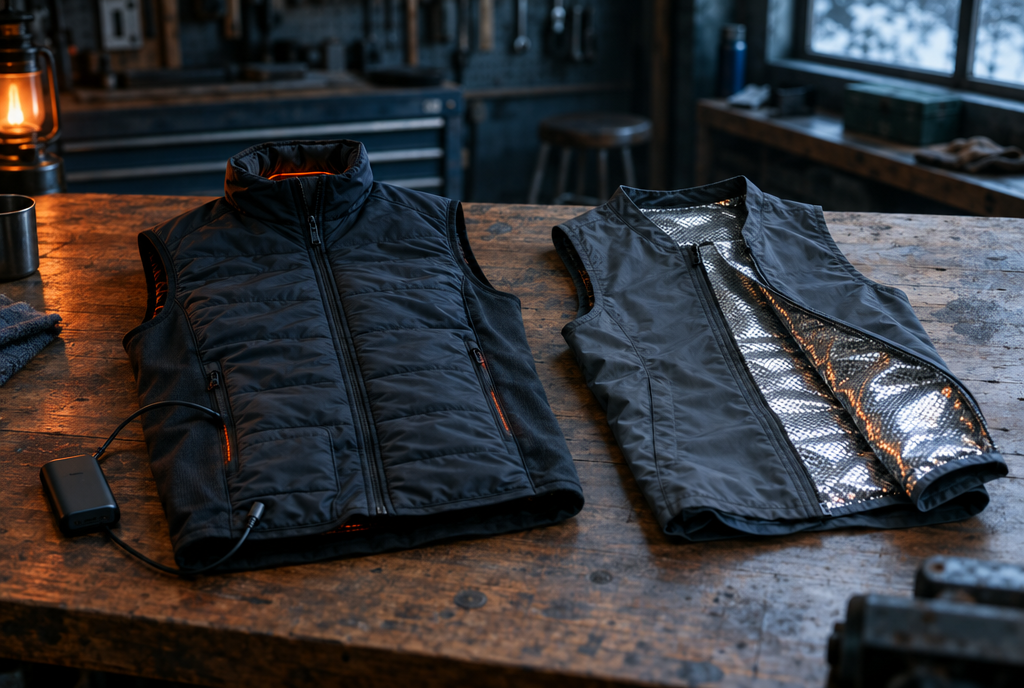
Buy a heated vest when you stand or sit still in real cold for hours and can charge every day. Buy a heat-reflective vest when you move a lot, work where batteries need approval, get wet, or want a layer that never runs down. Many buyers end up with a heat-reflective or insulated vest plus pockets for added heat on the coldest days.
What are you actually choosing between?
A heated vest carries thin resistive panels and a lithium-ion pack. It adds heat you can turn up or down, until the battery is spent. A reflective vest has a low-emissivity metallized lining that returns part of your body's radiant heat. It adds no heat, but it keeps working as long as you wear it.
The underlying physics is covered in our guide to battery-heated and battery-free warmth. This page is about the purchase: which one fits a given job, what each costs to own, and how each one fails.
Which vest fits which job?
Match the vest to how much you move, how long you are out, whether you can charge, and what rules apply where you work.
| Job or setting | Better first choice | Why |
|---|---|---|
| Sedentary indoor work (cold office, lab, pharmacy) | Reflective vest | Mild cold, long hours, no charging or heat settings to manage |
| Active outdoor work (loading, walking routes, trades) | Reflective or insulated vest | Movement makes heat; a heated vest can push you into sweating |
| Long static posts (security, traffic control, stands, blinds) | Heated vest | Low heat production and long exposure call for added heat |
| Clinical areas with battery rules (OR, procedure rooms) | Reflective vest | No battery to approve; check your facility's attire policy |
| Wet work (rain, washdown, fishing, marine) | Reflective vest under a waterproof shell | Fewer electrical parts to protect; keep any vest dry under the shell |
| Very cold and still, away from power for days | Reflective vest plus air-activated warmers | Added heat without charging |
Is a heated vest worth it for sitting still in the cold?
Usually, yes. When you stand a post or sit in a blind, your muscles make little heat, and insulation alone can only slow a loss your body cannot keep up with. Added heat on the torso is the one option that directly offsets that deficit.
The catch is runtime in the cold. Battery University notes that a lithium-ion battery giving full capacity at 27°C (80°F) typically delivers only about 50% at minus 18°C (0°F). On the coldest shifts, expect a shorter day from the same pack, and carry a spare or run a lower setting.
Is a heat-reflective vest warm enough for active outdoor work?
For most active work, yes, as part of a layered system. OSHA's cold-stress guidance centers on layers of loose-fitting, insulating clothes, with waterproof outer layers when needed. A reflective vest adds warmth for its weight without the bulk that slows you down.
Radiation is a large share of heat loss at rest; StatPearls puts it at about 60% of total body heat loss. That is why a thin reflective layer can feel warmer than its thickness suggests. It still needs an air space to work, a point the US Department of Energy makes for all radiant barriers, so size it to sit over a base layer rather than skin-tight.
Which vest works in clinical settings with battery rules?
Hospitals treat personal battery devices with more caution than homes do, especially in operating rooms. A passive vest removes the battery question entirely, which often makes it the simpler request to your unit or infection-prevention team.
If you prefer a heated vest at work, ask before you buy. Confirm what your facility allows under scrubs, whether the pack must be certified, and where it can be charged. Our pages on vests under scrubs and battery devices in clinical areas cover the details.
What about wet and washdown work?
Water changes the choice. OSHA recommends waterproof outer layers where needed, and any vest works best when it stays dry under a shell. A heated vest adds connectors, wiring and a pack that must be protected from soaking.
Moisture also weakens a reflective lining. A film of sweat or condensation on the metallized surface reduces how much infrared it returns. In wet jobs, pair either vest with a wicking base layer and a waterproof shell, and dry it fully between shifts.
What does each vest cost to own?
A heated vest costs more up front and keeps costing: a pack that loses capacity with age and cycles, a charger, and often a spare battery for long shifts. A reflective vest is a one-time purchase with no running cost beyond normal care.
Maintenance follows the same pattern. Heated vests need the battery removed before washing, and the wiring flexes with every cycle. Reflective linings need gentle care so abrasion and heat do not wear the metallized surface.
Heated vest: purchase, spare battery, charger, eventual pack replacement
Reflective vest: purchase, then care
Pocketed passive vest: purchase, plus warmers or inserts only on the days you need them
How does each type fail?
A heated vest fails suddenly: the pack runs flat, a connector breaks or a panel stops heating, and you lose the added heat all at once. Battery faults are also a safety issue. The CPSC recall database includes heated jackets and vests recalled for overheating, and NFPA advises stopping use of any battery that is swollen, damaged, unusually hot or smells odd.
A reflective vest fails gradually. Warmth drops when the lining is compressed flat against skin, wet, or worn. Nothing switches off, so you can plan around it. If you have reduced sensation in your skin or a medical condition, talk to a clinician before using any heat source against the body.
Where HEATJAC fits
HEATJAC REFLECT is a lightweight heat-reflective vest with a snap front and integrated warming pockets for compatible warming elements (sold separately). Its lining material is rated at about 95% radiant heat reflectance in the supplier's ASTM emittance testing, a material property rather than a whole-garment claim. It has no built-in battery, so it fits the reflective column above, with the option to add heat through its pockets.
Key takeaways
Choose a heated vest for long, still exposure in real cold when you can charge daily.
Choose a reflective vest for active work, mild indoor cold, wet jobs and workplaces with battery rules.
Cold cuts lithium-ion output, so heated vests run shorter on the days you need them most.
Heated vests fail suddenly and carry battery risks; reflective vests lose warmth gradually when wet or compressed.
A pocketed passive vest lets you add heat only on the coldest days.
Frequently asked questions
Is a heated vest warmer than a heat-reflective vest?
When you are still in real cold, usually yes, because it adds heat instead of only slowing loss. When you are moving, a reflective or insulated vest is often warm enough and will not run down.
Can I wear a heated vest in the operating room?
Only if your facility allows it. Many clinicians choose passive vests because there is no battery to approve. Check your attire and electrical safety policies first.
Do heat-reflective vests work when wet?
Less well. A film of water on the lining reduces how much infrared it reflects, and damp layers lose heat faster. Keep the vest under a waterproof shell.
Are heated vests worth it for outdoor work?
For static jobs such as security posts or traffic control, often yes. For active work, many people overheat and sweat in a heated vest, so a passive vest with good layers is usually the better value.
Can I combine a heat-reflective vest with a heat source?
Yes. A reflective layer helps keep added heat near the body, so pocketed vests that hold air-activated warmers or inserts combine both approaches. Never place a warmer directly on bare skin.
Related reading
Sources
Protecting Workers from Cold Stress, Occupational Safety and Health Administration
BU-502: Discharging at High and Low Temperatures, Battery University
Physiology, Temperature Regulation (StatPearls), NCBI Bookshelf, National Library of Medicine
Radiant Barriers, US Department of Energy
Lithium-Ion Battery Safety, National Fire Protection Association
Recalls and Product Safety Warnings, US Consumer Product Safety Commission
About HEATJAC. HEATJAC is a thermal architecture company founded by an anesthesiologist. We design patented garment systems that capture, conduct and broaden warmth across the body, and we publish this knowledge hub because the science of staying warm should be public. HEATJAC products are not medical devices and are not intended to diagnose, treat, cure or prevent any disease.