
Emissivity, reflectance and absorptance explained
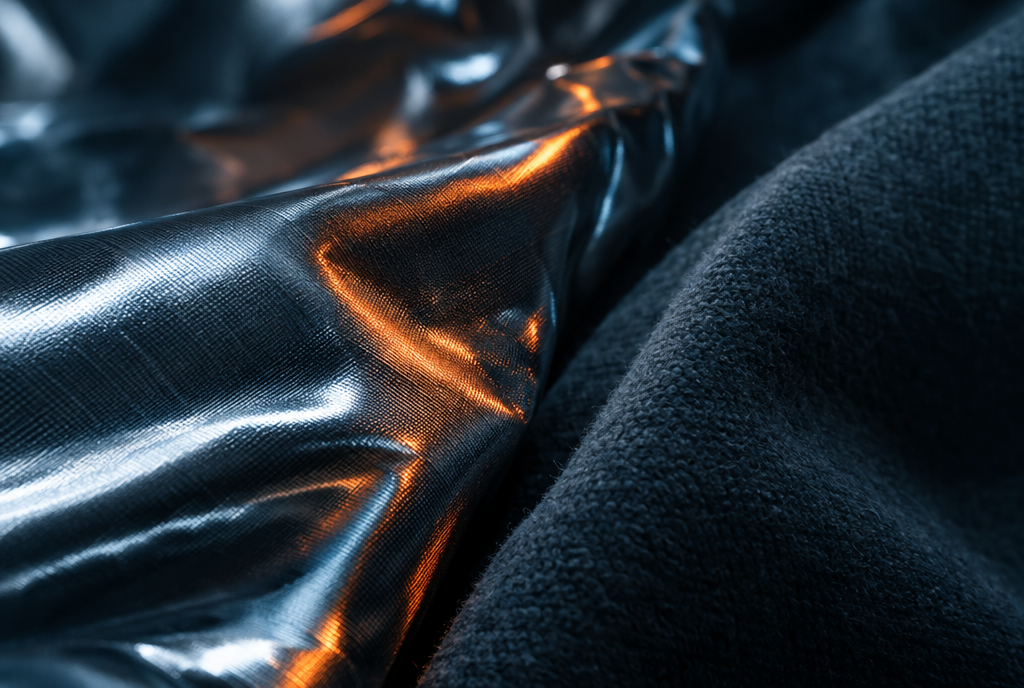
Emissivity is a number from 0 to 1 that describes how efficiently a surface gives off thermal (infrared) radiation compared with a perfect emitter at the same temperature. For opaque materials, emissivity and reflectance add up to 1, so a surface with low emissivity reflects most incoming infrared. Human skin sits near 0.98, while bright aluminum can be as low as 0.02 to 0.03.
What is emissivity in heat transfer?
Every object above absolute zero radiates energy. The amount depends on its temperature and on a surface property called emissivity, written with the Greek letter epsilon. A theoretical perfect emitter, called a blackbody, has an emissivity of 1. Real surfaces fall somewhere below that.
The relationship is captured by the Stefan-Boltzmann law, in which radiated energy scales with emissivity multiplied by the fourth power of absolute temperature. Two surfaces at the same temperature can therefore radiate very different amounts of heat if their emissivities differ.
Emissivity is a surface property, not a bulk one. A thin coating of vapor-deposited aluminum on plastic film behaves radiatively like solid metal, which is why reflective films can be so light.
How are emissivity, reflectance and absorptance related?
When infrared radiation strikes a surface, it can be absorbed, reflected or transmitted. The three fractions always sum to 1. Kirchhoff's law of thermal radiation adds a second rule: at a given wavelength and temperature, a surface's emissivity equals its absorptance.
For opaque materials that transmit essentially no infrared, the practical shortcut is emissivity plus reflectance equals 1. A surface with an emissivity of 0.05 therefore reflects about 95% of incoming thermal radiation, and it also emits only about 5% as much as a blackbody would at the same temperature.
This is why good emitters are also good absorbers, and why a poor emitter is a good reflector. The same physics explains both the heat-shedding black radiator fin and the heat-holding shiny thermos liner.
Emissivity (epsilon): how well a surface radiates heat, from 0 to 1.
Absorptance (alpha): the fraction of incoming radiation a surface absorbs; equal to emissivity at the same wavelength.
Reflectance (rho): the fraction reflected; for opaque surfaces, 1 minus emissivity.
Transmittance (tau): the fraction that passes through; near zero for metals and most coated films.
What is the emissivity of common materials?
Published values vary with surface finish, oxidation and measurement method, so treat any table as a guide. The figures below come from a NASA reference compilation of spacecraft thermal-control surfaces and from a 2020 study of human skin.
One surprise is that visible color is a poor guide to infrared behavior. White paints that look bright to the eye can have infrared emissivities around 0.90, close to black paint. Infrared reflectance comes mainly from metal, not from color.
| Surface | Typical emissivity | Source note |
|---|---|---|
| Human skin | About 0.98 (measured 0.96 to 0.99) | PLOS ONE, 2020 |
| Vapor-deposited aluminum | 0.02 (normal emittance) | NASA RP 1121 |
| Buffed aluminum | 0.03 | NASA RP 1121 |
| Aluminized polyester (Mylar) film, metal side | 0.03 | NASA RP 1121 |
| White paint (magnesium oxide based) | 0.90 | NASA RP 1121 |
| Carbon black paint | 0.88 | NASA RP 1121 |
What is the emissivity of human skin?
Skin is close to a blackbody in the infrared. A 2020 study of 65 participants measured a mean skin emissivity of 0.972, with individual values from 0.96 to 0.99, and found no significant difference by skin pigmentation. The accepted value used in thermal imaging is 0.98.
High skin emissivity has a direct consequence for warmth. Radiation is the largest single route of body heat loss, estimated at about 60% of the total in a standard physiology reference. Skin radiates efficiently to any cooler surface it can see, including walls, windows and the night sky.
What is emissivity on a thermal camera or infrared thermometer?
Thermal cameras and infrared thermometers measure radiated energy, then convert it to temperature using an assumed emissivity. If the setting is wrong, the reading is wrong. Skin is easy because its emissivity is high and stable.
Shiny metal is hard. A low-emissivity surface emits little of its own radiation and reflects the surroundings, so a camera may show the temperature of reflected objects rather than the metal itself. Technicians often apply tape or paint of known emissivity before measuring.
Why does low emissivity matter in clothing?
A low-emissivity layer facing the body reflects infrared from the skin back inward and radiates little heat outward from its own surface. That is the principle behind space blankets, reflective jacket linings and building radiant barriers.
The effect has limits. Reflection only works across an air space, and radiation is just one of several heat-loss routes alongside conduction, convection and evaporation. A reflective layer pressed tight between other fabrics mostly behaves as a conductor. Dust, sweat and wear can also raise emissivity over time.
Emissivity also describes a material, not a finished garment. Whole-garment warmth depends on insulation, fit, coverage and wind, which is why clothing is tested as a system on heated manikins.
Key takeaways
Emissivity runs from 0 to 1 and describes how well a surface radiates heat compared with a blackbody.
For opaque surfaces, emissivity plus reflectance equals 1, so low emissivity means high infrared reflectance.
Human skin has an emissivity near 0.98, so it radiates heat very efficiently.
Bright aluminum surfaces measure around 0.02 to 0.03; color alone does not predict infrared behavior.
Reflective layers need an adjacent air space and address only the radiant share of heat loss.
Frequently asked questions
Is emissivity the same as reflectivity?
No. They are opposite sides of the same coin. For an opaque surface, emissivity plus reflectance equals 1, so a surface with emissivity 0.1 reflects about 90% of incoming infrared.
What does an emissivity of 0.95 mean?
It means the surface radiates 95% as much thermal energy as a perfect blackbody at the same temperature. Most organic materials, paints and skin fall in the 0.85 to 0.99 range.
Does color change emissivity?
Visible color has little to do with infrared emissivity. White paint can have an emissivity around 0.90, similar to black paint. Low emissivity usually requires a bare metallic surface.
Why is emissivity important for infrared thermometers?
The thermometer converts measured radiation into temperature using an emissivity setting. On shiny metal the reading can be far off because the surface reflects its surroundings. Skin readings are more reliable because skin emissivity is high and consistent.
How is emissivity measured?
Common methods include portable emissometers, described in ASTM C1371, and laboratory spectral measurements. Portable instruments compare a sample against reference standards of known emittance near room temperature.
Does low emissivity mean high reflectance?
Yes, for an opaque surface at the same wavelength. Because an opaque surface transmits no radiation, reflectance equals 1 minus emissivity, which follows from Kirchhoff's law that emissivity equals absorptance. A surface with an emissivity of 0.05 therefore reflects about 95% of incoming infrared.
Does a low emissivity surface emit more heat?
No, it emits less. Emissivity is the fraction of a blackbody's radiation a surface gives off at the same temperature, so a surface with an emissivity of 0.05 radiates only about 5% as much as a blackbody would. That is why low-emissivity linings hold heat in rather than shedding it.
Do you need low emissivity for high reflectance?
For infrared on an opaque surface, yes: the two are linked, so high infrared reflectance and low emissivity come together. A transparent or semi-transparent material can have low absorptance without reflecting much, because radiation passes through it. Visible color does not tell you either value, since white paint can still emit strongly in the infrared.
What emissivity does a radiant barrier have?
ASTM C1313, the US specification for sheet radiant barriers in buildings, covers materials with at least one surface having a far-infrared emittance of 0.1 or less, such as metallic foils or metallic deposits. Some products claim lower values, and a surface with an emissivity of 0.01 would reflect about 99% of incoming infrared. The US Department of Energy notes that the heat-reflective surface must face an air space to work, and that dust reduces its performance.
From HEATJAC
We design low-profile thermal garments: a heat-reflective vest and a thermal harness with pockets for warmers or cold packs.
Choosing gear? Heated vest vs heat-reflective vest · The thermal gear buying, safety and care guide
Related reading
Sources
Kirchhoff's Law of Thermal Radiation, Optris Knowledge Library
Kirchhoff's Law explains why nobody is perfect (METEO 300), Penn State College of Earth and Mineral Sciences
Solar Absorptance and Thermal Emittance of Some Common Spacecraft Thermal-Control Coatings (Reference Publication 1121), NASA Technical Reports Server
The effect of constitutive pigmentation on the measured emissivity of human skin, PLOS ONE (2020)
Physiology, Temperature Regulation (StatPearls), NCBI Bookshelf, National Library of Medicine
ASTM C1371: Determination of Emittance of Materials Near Room Temperature Using Portable Emissometers, ASTM International
ASTM C1313/C1313M-13(2019): Standard Specification for Sheet Radiant Barriers for Building Construction Applications, ASTM International
Radiant Barriers, US Department of Energy, Energy Saver
About HEATJAC. HEATJAC is a thermal architecture company founded by an anesthesiologist. We design patented garment systems that capture, conduct and broaden warmth across the body, and we publish this knowledge hub because the science of staying warm should be public. HEATJAC products are not medical devices and are not intended to diagnose, treat, cure or prevent any disease.