
How space blankets work, and what they cannot do
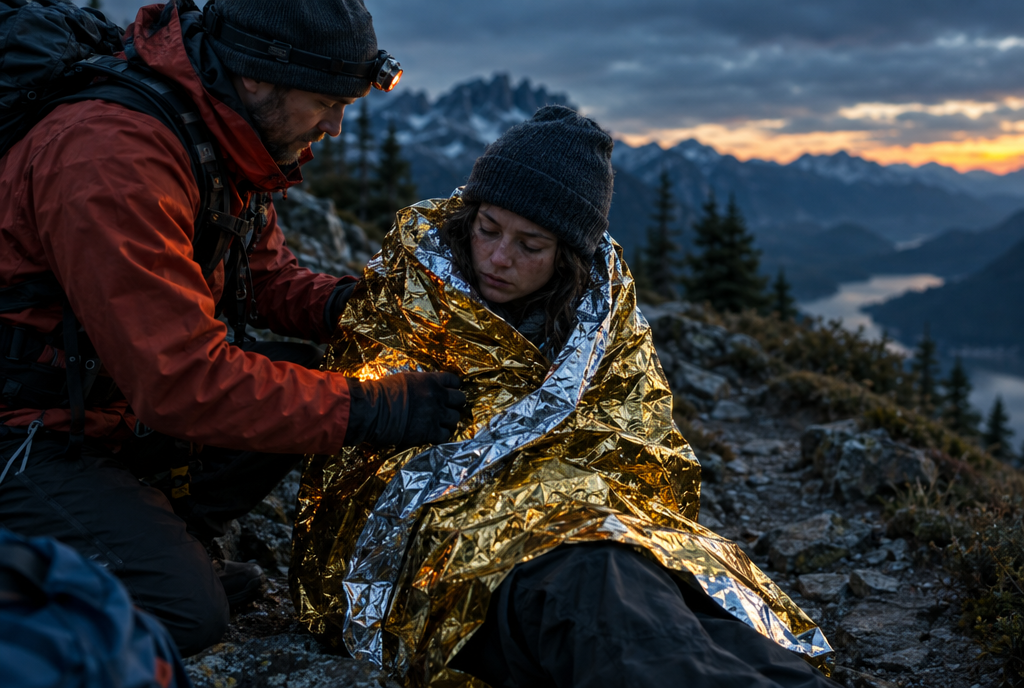
A space blanket is a thin plastic film coated with vaporized aluminum. It works mainly by reflecting the infrared heat your body radiates back toward you, and secondarily by blocking wind and trapping moist air, which cuts convective and evaporative loss. It adds almost no insulation, so it cannot stop heat draining into cold ground and works best combined with a pad and insulating layers.
What is a space blanket made of?
NASA's Marshall Space Flight Center developed the material in 1964. It is typically a thin polyethylene terephthalate (PET) film onto which a precise amount of pure aluminum vapor is deposited in a vacuum, producing metallized PET.
NASA Spinoff describes the original material as a strong, plastic, vacuum-metallized film with a highly efficient, infrared-reflective coating of aluminum, designed to protect spacecraft from extreme temperature swings. The same family of films now appears on marathon finish lines, in rescue kits and on hospital beds.
How does a space blanket keep you warm?
Warm skin radiates infrared energy. At rest, radiation is the largest route of heat loss, which OpenAnesthesia puts at about 60% of the total. A shiny aluminum surface has very low emissivity, so it reflects most of that radiation instead of absorbing and passing it on.
The quoted numbers vary by product and test. Wikipedia's summary cites reflection of up to 97% of radiated heat, while an emergency sleeping bag featured by NASA Spinoff is described as reflecting up to 90% of a person's body heat. Both describe reflection of radiant heat, not total heat retention.
The film also helps in a second way. It is windproof and vapor-tight, so a well-wrapped blanket reduces convection and evaporative heat loss. A commentary on rescue blankets notes they reduce heat loss from convection, conduction, evaporation and radiation, with thermal imaging suggesting that reflection of infrared radiation accounts for most of the protection.
What can a space blanket not do?
The limits are as important as the benefits, especially in an emergency.
It adds almost no insulation. The film is too thin to trap a meaningful layer of still air.
It does not stop conduction into cold ground, rock or snow. You need a pad, pack or branches underneath.
It cannot fully make up a heat deficit. Research summarized in the rescue-blanket commentary found blankets significantly reduced heat loss but could not completely compensate for the temperature deficit.
It traps moisture. Sweat and condensation build up inside, which can dampen clothing over time.
It can overheat people in hot conditions, because the airtight film traps body heat. Wikipedia also notes research finding reflective blankets did not affect cooling rates after running in hot, humid conditions.
Thin versions tear, flap and are noisy in wind.
How to use a space blanket for warmth
Insulate from the ground first, then wrap. Sit or lie on a pad, pack or dry vegetation so you are not losing heat by conduction. Wrap the blanket around the body with the edges overlapping, and cover the head and neck while keeping the face clear.
Placement relative to clothing is a judgment call. Wrapping over clothing keeps the film from sticking to damp skin and lets clothing insulation work inside the reflective shell. If you have more insulation available, such as a jacket or sleeping bag, put it outside the blanket too, so the film also serves as a wind and vapor barrier.
In the field, many kits pair a reflective shell with an active heat source such as a chemical heat blanket, because reflection holds added heat close far better than it creates warmth on its own.
Space blanket, emergency bivy or rescue blanket: what is the difference?
A basic space blanket is a flat sheet. An emergency bivy is the same kind of film shaped into a bag, which is easier to keep closed in wind and wastes less heat through open edges. Heavier rescue blankets add thicker or reinforced film, sometimes with a fabric backing, trading weight for durability.
All three rely on the same principle. None replaces a sleeping bag or insulated clothing, but a closed bag shape usually outperforms a loose sheet that the wind keeps pulling open.
Which side of a space blanket goes out?
Two-tone blankets raise this question more than any other. The practical guidance in the rescue-blanket commentary focuses on visibility: the silver side is highly reflective, and placing the gold side up increases a person's visibility in snow and glacier environments.
For warmth, the more important factors are a complete wrap, insulation from the ground and staying dry. A 2020 study in Wilderness & Environmental Medicine reported that higher tensile strength increases the multifunctional use of survival blankets, which is one reason rescue teams value sturdier designs over the thinnest film.
Space blankets and hypothermia: when to get help
A space blanket is a stopgap that slows cooling while you get to shelter or help arrives. Shivering that becomes uncontrollable, confusion, slurred speech or drowsiness are warning signs of hypothermia and call for emergency care. For anyone with ongoing symptoms after cold exposure, talk to a clinician.
Key takeaways
Space blankets are aluminum-coated PET film first developed by NASA in 1964.
They mainly reflect radiant body heat, with extra benefit from blocking wind and evaporation.
They add almost no insulation and cannot stop heat loss into cold ground.
Use one with a ground pad and insulating layers, and pair it with a heat source when possible.
Gold side up improves visibility on snow; a complete, dry wrap matters most for warmth.
Frequently asked questions
Do space blankets really work?
Yes, for what they are designed to do. They reflect radiant heat and block wind, which slows heat loss, but they add little insulation and cannot fully make up for a large heat deficit on their own.
What are space blankets used for?
Common uses include emergency warmth, marathon finish lines, first-aid and rescue kits, hospital bedding and signaling. Stronger blankets lend themselves to more of these tasks in wilderness settings.
Is a mylar blanket the same as a space blanket?
Usually, yes. Mylar is a brand name for PET film, and most space blankets are aluminum-coated PET, so the terms are used interchangeably.
Should a space blanket go over or under clothes?
Wrapping over clothing is often practical, since it keeps the film off damp skin and lets clothing insulate inside the reflective shell. Add any extra insulation outside and always insulate from the ground.
Can a space blanket make you too hot?
Yes. In hot or humid conditions the airtight film can trap body heat and moisture. Use it for cold, wet or windy situations, not for cooling.
Why is it called a space blanket?
Because the material was developed for spacecraft. NASA's Marshall Space Flight Center developed the vacuum-metallized film in 1964 to protect spacecraft from extreme temperature swings, and the same film later moved into emergency blankets.
What is space blanket material?
It is usually a thin polyethylene terephthalate (PET) film coated with a very thin layer of vaporized aluminum, often called metallized PET or mylar. The aluminum gives the shiny, low-emissivity surface that reflects infrared heat.
What does a space blanket do?
A space blanket slows heat loss. It reflects most of the infrared heat your body radiates back toward you and blocks wind and moisture, which cuts convective and evaporative loss. It adds almost no insulation, so it needs a pad or other insulation underneath.
How do heat-reflective blankets work?
They work by reflecting radiant heat. Warm skin gives off infrared energy, and a shiny aluminum surface has very low emissivity, so it sends most of that energy back instead of absorbing it. Wrapping the blanket closely also traps a layer of warm, still air and blocks wind.
From HEATJAC
We design low-profile thermal garments: a heat-reflective vest and a thermal harness with pockets for warmers or cold packs.
Choosing gear? Heated vest vs heat-reflective vest · The thermal gear buying, safety and care guide
Related reading
Sources
Reflecting on Space Benefits: A Shining Example, NASA Spinoff
Space blanket, Wikipedia
Rescue blankets as multifunctional rescue equipment in alpine and wilderness emergencies: a commentary, PMC (National Library of Medicine)
High Tensile Strength Increases Multifunctional Use of Survival Blankets in Wilderness Emergencies, Wilderness & Environmental Medicine, 2020
Normal Thermoregulation, OpenAnesthesia (International Anesthesia Research Society)
About HEATJAC. HEATJAC is a thermal architecture company founded by an anesthesiologist. We design patented garment systems that capture, conduct and broaden warmth across the body, and we publish this knowledge hub because the science of staying warm should be public. HEATJAC products are not medical devices and are not intended to diagnose, treat, cure or prevent any disease.