
Prehospital hypothermia prevention: blankets, wraps and active warmers
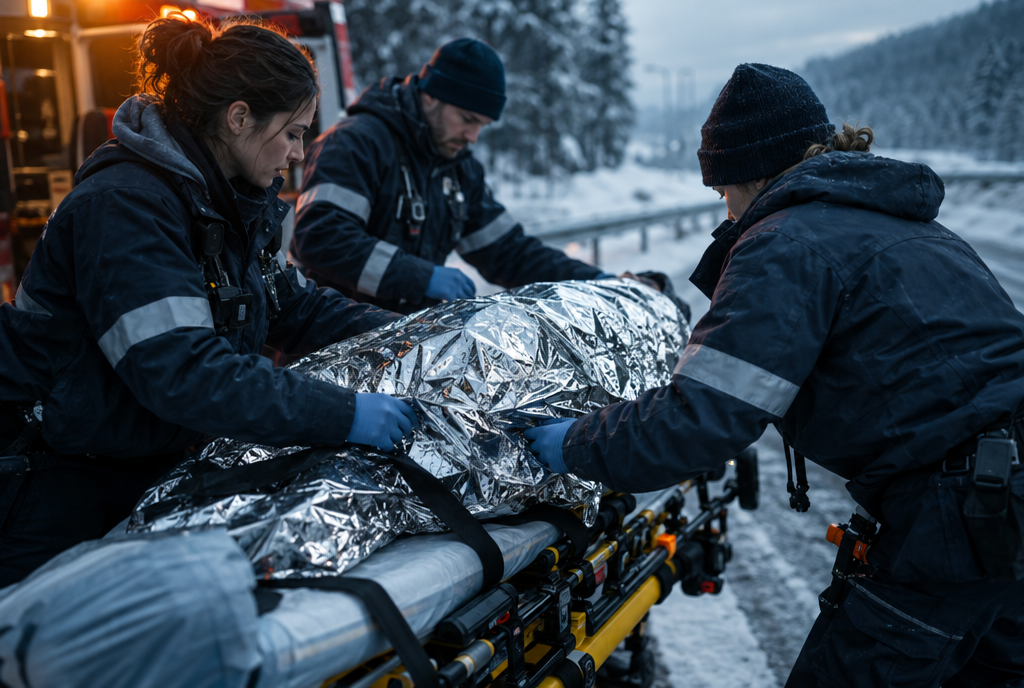
Prehospital hypothermia prevention works in layers: get the patient off cold ground, remove wet clothing, block wind and moisture, add insulation, then add external heat to the torso without direct skin contact. Heat-reflective wraps and vapor barriers limit loss; insulated wraps trap still air; chemical and battery warmers add heat. Military guidance rates simple space blankets as the least effective option on their own.
Why does prehospital hypothermia prevention matter?
Injured and ill patients lose heat faster than they can make it, and every minute on scene or in transport adds to the deficit. The Joint Trauma System (JTS) guideline reports that hypothermic trauma patients die at about twice the rate of similarly injured patients with normal temperature.
The problem is common in civilian care too. A 2014 JEMS article cites research finding that nearly half of trauma patients transported by EMS arrived at the emergency department below 36 °C, in every season. The National Association of EMS Physicians (NAEMSP) published a compendium of prehospital trauma position statements in 2024 that agencies use alongside local protocols.
What are the first steps to stop heat loss in the field?
The cheapest interventions come first and matter most. Tactical Combat Casualty Care (TCCC) guidelines list them in order of priority.
Minimize exposure to cold ground, wind and air, and place insulation between the patient and any cold surface as soon as possible.
Replace wet clothing with dry clothing or another thermal barrier such as a sleeping bag.
Cover the head and body, and protect the patient from wind and precipitation on any evacuation platform, especially under rotor wash.
Keep the transport compartment warm; the JEMS article suggests about 27 °C or higher.
How do blankets, wraps and active warmers compare?
Options differ in what they do. Some add heat, some trap still air, and some only block wind, moisture and radiant loss. The JTS guideline includes a comparison of passive and active systems; its ratings and the underlying physics are summarized below.
| Option | How it works | Strengths | Limits |
|---|---|---|---|
| Space (Mylar) blanket | Thin reflective film | Tiny, cheap, blocks wind when sealed | JTS rates it not effective to mildly effective alone |
| Wool or cotton blanket | Traps air in fibers | Widely available | Heavy; loses insulation when wet |
| Insulated reflective blanket (for example Blizzard) | Reflective layers with trapped air cells | No power or activation needed | Adds no heat; rated higher than space blankets by JTS |
| Reflective clinical wraps (for example Thermoflect) | Aluminized layer plus quilted insulation | Reusable or low-cost passive warmth | Adds no heat |
| Chemical heater plus vapor barrier (HPMK) | Air-activated liner inside reflective shell | Adds heat for hours; compact | Not insulated; burn risk if on skin |
| Warmed IV fluids and blood | Inline battery-powered warmers | Stops cold fluids cooling the core | Requires equipment and training |
How do heat-reflective wraps like Thermoflect work?
Encompass Group describes Thermoflect as a passive warming technology in which vaporized aluminum reflects body heat, a quilted material holds that warmth in an insulating microclimate, and clear polyethylene shields against wind and fluids. The company says the line has been available for more than 25 years and includes blankets and ponchos.
Reflective wraps work best when they also trap still air and seal out wind. A reflective film alone, with no air gap, does little against conduction to a cold stretcher or ground.
When should active warmers be added?
When insulation alone cannot keep up, TCCC calls for adding external heat. The guideline instructs providers to place an active heating blanket on the front of the torso and under the arms, and not to place any active heat source directly on skin or wrap it around the torso.
The JTS guideline notes that the widely used Hypothermia Prevention and Management Kit is non-insulated and suitable only for short-term prevention in cold climates. For long evacuations, TCCC recommends placing a hooded sleeping bag or other insulation inside the outer vapor-barrier shell.
What should an EMS or tactical team stock for cold-weather calls?
Kit decisions belong to the medical director, but the guidance points to a layered cache rather than a single product. Teams in cold regions often plan for the longest realistic evacuation, not the average one, because a delayed helicopter or a rural transport can turn a short-term wrap into an hours-long exposure.
Ground insulation: a foam pad, litter pad or blanket to break contact with cold surfaces.
Dry replacements: a way to swap out wet clothing, or a sleeping bag as a thermal barrier.
A wind and vapor barrier sized for an adult with equipment.
An external heat source with clear placement instructions.
A fluid warmer if the team gives IV fluids or blood.
A thermometer suited to repeated field measurements.
Why do warmed fluids matter?
Infusing room-temperature fluid pulls heat from the core. The JTS guideline recommends warming resuscitation fluids and blood products to 38 to 42 °C, with flow rates up to 150 mL per minute, using battery-powered warmers in the field. Local protocols set the specific devices and indications.
This page is educational and does not replace training or medical direction. Anyone with symptoms of cold exposure should talk to a clinician.
Key takeaways
Insulate from the ground, remove wet clothing and block wind before adding heat.
Space blankets alone are rated the least effective passive option in JTS guidance.
Chemical heaters go on the front of the torso and under the arms, never directly on skin.
Vapor-barrier kits need added insulation for long or very cold evacuations.
Warmed fluids stop resuscitation from cooling the core.
Frequently asked questions
Do space blankets prevent hypothermia?
On their own they help only modestly. The JTS guideline rates space blankets from not effective to mildly effective, largely because they trap little still air. They work better as a wind and moisture barrier over real insulation.
What is the best way to keep a trauma patient warm in the field?
Guidance stresses early basics: insulate from the ground, remove wet clothing, cover the patient and block wind. Then add external heat to the torso and warmed fluids according to protocol.
Where should a chemical heating blanket be placed?
TCCC guidelines place it on the front of the torso and under the arms, not directly on the skin and not wrapped around the torso. This reduces burn risk while warming the core.
How warm should the ambulance be for a trauma patient?
A 2014 JEMS article recommends about 27 °C or higher in the patient compartment. Crew comfort is secondary to limiting patient heat loss.
Is the HPMK used by civilian EMS?
Some civilian EMS and tactical teams carry it. Its use should follow agency protocol and training.
From HEATJAC
We design low-profile thermal garments: a heat-reflective vest and a thermal harness with pockets for warmers or cold packs.
Choosing gear? Cold-weather gear for EMS crews · Cold-weather gear for police and security officers
Related reading
Sources
Hypothermia: Prevention and Treatment, CPG ID 23 (07 Jun 2023), Joint Trauma System, DoD Center of Excellence for Trauma
Tactical Combat Casualty Care (TCCC) Guidelines, 25 January 2024, Committee on Tactical Combat Casualty Care, via Deployed Medicine
The National Association of EMS Physicians Compendium of Prehospital Trauma Management Position Statements and Resource Documents (2024), Prehospital Emergency Care
Thermoflect Heat Reflective Technology, Encompass Group
Hypothermia Prevention and Management Kit (HPMK), North American Rescue
About HEATJAC. HEATJAC is a thermal architecture company founded by an anesthesiologist. We design patented garment systems that capture, conduct and broaden warmth across the body, and we publish this knowledge hub because the science of staying warm should be public. HEATJAC products are not medical devices and are not intended to diagnose, treat, cure or prevent any disease.