
The Hypothermia Prevention and Management Kit (HPMK) explained
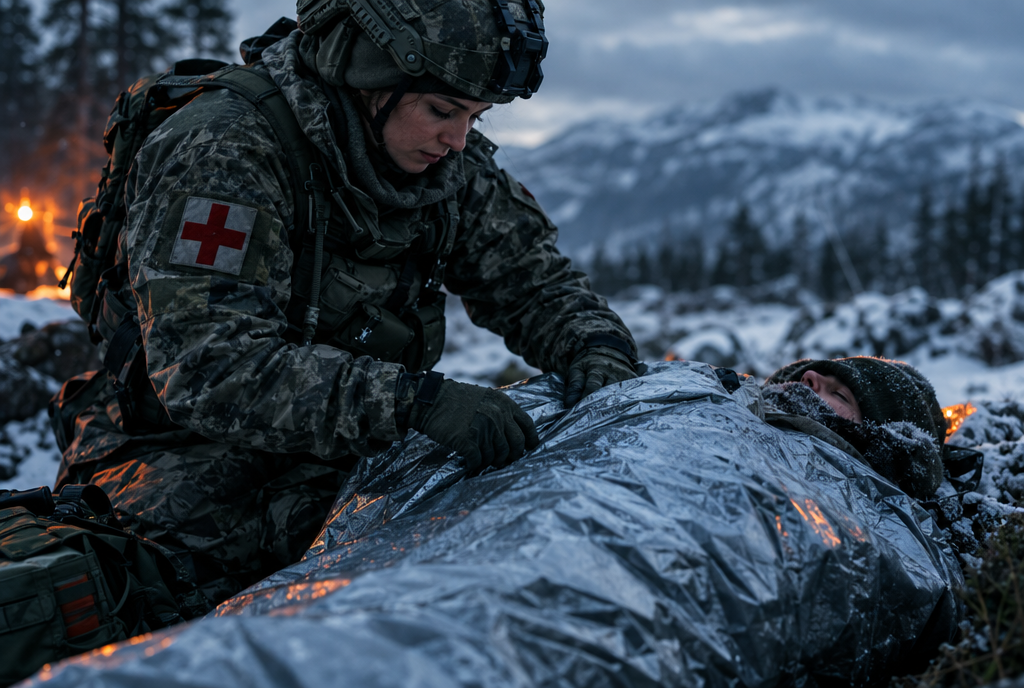
The Hypothermia Prevention and Management Kit (HPMK) is a compact casualty-warming kit used in military and tactical medicine. It pairs a chemical, air-activated heating liner with a hooded, heat-reflective vapor-barrier shell. Medics use it to limit heat loss in trauma casualties during care and evacuation. It is not insulated, so guidelines treat it as a short-term tool.
What is in a Hypothermia Prevention and Management Kit?
The best-known HPMK is made by North American Rescue. The manufacturer lists three items: a Heat Reflective Shell with a built-in hood, a self-heating shell liner, and a plastic vacuum bag that keeps the kit compact. The listed weight is 3 lb 8 oz, and the kit carries NATO stock number 6515-01-532-8056.
The heating element is an oxygen-activated liner of the Ready-Heat type. It warms when exposed to air, much like a large hand warmer. The manufacturer states the liner sustains 10 hours of continuous dry heat, while the Joint Trauma System (JTS) guideline lists the Ready-Heat blanket at 8 hours at 104 °F (40 °C). The shell has hook-and-loop closures for access to wounds, a tapered shape and a hood.
Why do combat casualties need a hypothermia kit?
Bleeding casualties lose the ability to make heat, and cold blood clots poorly. The JTS guideline reports that the mortality of hypothermic trauma patients is about twice that of similarly injured patients with normal temperature. It defines trauma-induced hypothermia as mild at 34 to 36 °C, moderate at 32 to 34 °C and severe below 32 °C.
This is why hypothermia prevention is part of the lethal triad discussion in trauma care. Heat loss starts at the point of injury, from wet clothing, cold ground, wind and rotor wash, long before a patient reaches a surgeon.
How is the HPMK used under TCCC?
Tactical Combat Casualty Care (TCCC) guidelines, published by the Committee on TCCC, place hypothermia prevention in Tactical Field Care. The 2024 guideline tells providers to take early and aggressive steps to prevent further heat loss and add external heat when possible. A 2017 review by Bennett and Holcomb in Wilderness & Environmental Medicine notes the HPMK was integrated into TCCC guidelines in 2006.
Minimize exposure to cold ground, wind and air, and place insulation between the casualty and any cold surface.
Replace wet clothing with dry clothing when possible.
Place the active heating blanket on the front of the torso and under the arms, never directly on skin and never wrapped around the torso.
Enclose the casualty in the impermeable outer shell.
Protect the casualty from wind and precipitation on any evacuation platform.
What are the limits of the HPMK?
The JTS guideline is direct on this point: the HPMK is non-insulated and therefore suitable only for short-term hypothermia prevention, especially in cold climates. The reflective shell blocks wind, moisture and some radiant loss, but it traps very little still air.
For longer care or colder conditions, TCCC recommends upgrading to an insulated enclosure, such as a hooded sleeping bag or other available insulation placed inside the outer vapor-barrier shell. The JTS guideline also rates passive options: in its comparison table, simple space blankets score between not effective and mildly effective, while an insulated reflective option such as the Blizzard blanket scores higher for passive rewarming.
How does the HPMK compare with other casualty wraps?
Casualty warming options differ in whether they add heat, trap still air, or simply block wind and moisture. The HPMK is the only one of these common options that combines active heat with a vapor barrier in one package.
| Option | Adds heat | Insulates | Blocks wind and moisture |
|---|---|---|---|
| Space (Mylar) blanket | No | Very little | Yes, if sealed |
| Wool blanket | No | Moderately, less when wet | Poorly |
| Insulated reflective blanket | No | Yes | Yes |
| HPMK | Yes, chemical liner | Very little | Yes |
| HPMK plus sleeping bag inside the shell | Yes | Yes | Yes |
Why is burn risk part of HPMK training?
Chemical heaters can cause burns, especially on skin that is cold, poorly perfused or under pressure. Both the JTS guideline and TCCC instruct providers never to place an active heat source directly on skin and to follow the manufacturer's directions.
Casualties may be unconscious or sedated and unable to report pain, so placement and checks matter. Training and local protocol govern exactly how a service or agency uses the kit.
Has the HPMK changed battlefield practice?
The JTS guideline reports that hypothermia (below 97 °F) in patients arriving at the first role of care was as high as 15.42 percent in 2004, and that by 2014 and beyond it was under 5 percent. The guideline does not attribute that decline to any single product.
Bennett and Holcomb described the HPMK as a low-cost, lightweight, small commercial product, and noted a prospective observational study in which wool blankets were still the most frequently used warming method despite HPMK availability. Their point was that equipment only helps when medics use it early. Anyone with symptoms of cold exposure should talk to a clinician; this page is educational and not a treatment protocol.
Key takeaways
The HPMK combines an air-activated heating liner with a hooded, reflective vapor-barrier shell in a 3.5 lb package.
TCCC places the heater on the front of the torso and under the arms, never directly on skin.
The JTS guideline calls the HPMK non-insulated and suitable only for short-term use, especially in cold climates.
For prolonged care, add real insulation such as a sleeping bag inside the vapor barrier.
Frequently asked questions
What does HPMK stand for?
HPMK stands for Hypothermia Prevention and Management Kit. The name is most associated with the North American Rescue kit used in military and tactical casualty care.
How long does the HPMK heater last?
The manufacturer states the self-heating liner sustains 10 hours of continuous dry heat. The Joint Trauma System guideline lists the Ready-Heat blanket at 8 hours at 104 °F (40 °C).
Can civilians or EMS use an HPMK?
The kit is sold commercially and is used by some civilian EMS and tactical teams. Its use should follow agency protocol and training, especially the rule against placing the heater directly on skin.
Is the HPMK enough on its own in extreme cold?
No. The JTS guideline states the HPMK is non-insulated and suitable only for short-term prevention in cold climates. TCCC recommends adding insulation such as a hooded sleeping bag inside the outer shell for longer evacuations.
What is the HPMK blanket made of?
The heating liner uses an oxygen-activated chemical reaction similar to disposable hand warmers. The outer Heat Reflective Shell is an impermeable, reflective layer with a hood that limits wind, moisture and radiant heat loss.
What is the difference between an HPMK and a Blizzard blanket?
The HPMK adds heat: it pairs a Ready-Heat chemical blanket with the Heat-Reflective Shell (HRS), an impermeable outer layer, while a Blizzard blanket is a passive wrap that only holds in the casualty's own heat. The Joint Trauma System guideline notes that the Blizzard blanket was the outer shell in an earlier HPMK version. In a simulated torso study it cites, with no human volunteers, the Blizzard blanket alone was one of the two best passive options and matched two of three active heating methods at 120 minutes.
Is an HPMK better than a space blanket?
In the simulated torso study summarized by the Joint Trauma System guideline, a tucked-in space blanket ranged from not effective to mildly effective, while the HPMK was rated highly effective. A study with human volunteers found the HPMK the least effective of the wraps tested because it has no insulation, and the guideline notes patients can get cold in under 60 minutes in cold environments. Adding a sleeping bag or wool blankets inside the shell closes that gap.
When should the HPMK heating blanket be replaced?
The Joint Trauma System guideline says to replace the Ready-Heat blanket after more than 10 hours of use, and to check the skin under it often for contact burns. The heater belongs on the front of the torso and under the arms, never directly on skin, never under the back of a casualty lying face up and never wrapped around the torso.
Do hand warmers help a hypothermic casualty?
Not much. The Joint Trauma System guideline rates small chemical hand-warmer packs as not effective, because they transfer too little heat to affect core temperature or stop further heat loss. Anyone with signs of hypothermia, such as confusion, slurred speech, drowsiness, clumsiness or slow, shallow breathing, needs a call to 911 or the local emergency number, and a clinician should guide care.
From HEATJAC
We design low-profile thermal garments: a heat-reflective vest and a thermal harness with pockets for warmers or cold packs.
Choosing gear? Cold-weather gear for EMS crews · Cold-weather gear for police and security officers
Related reading
Sources
Hypothermia Prevention and Management Kit (HPMK), North American Rescue
Hypothermia: Prevention and Treatment, CPG ID 23 (07 Jun 2023), Joint Trauma System, DoD Center of Excellence for Trauma
Tactical Combat Casualty Care (TCCC) Guidelines, 25 January 2024, Committee on Tactical Combat Casualty Care, via Deployed Medicine
Battlefield Trauma-Induced Hypothermia: Transitioning the Preferred Method of Casualty Rewarming (Bennett and Holcomb, 2017), Wilderness & Environmental Medicine
Committee on Tactical Combat Casualty Care (CoTCCC), Joint Trauma System
Hypothermia: Symptoms and causes, Mayo Clinic
About HEATJAC. HEATJAC is a thermal architecture company founded by an anesthesiologist. We design patented garment systems that capture, conduct and broaden warmth across the body, and we publish this knowledge hub because the science of staying warm should be public. HEATJAC products are not medical devices and are not intended to diagnose, treat, cure or prevent any disease.