
Hypothermia in trauma and the lethal triad
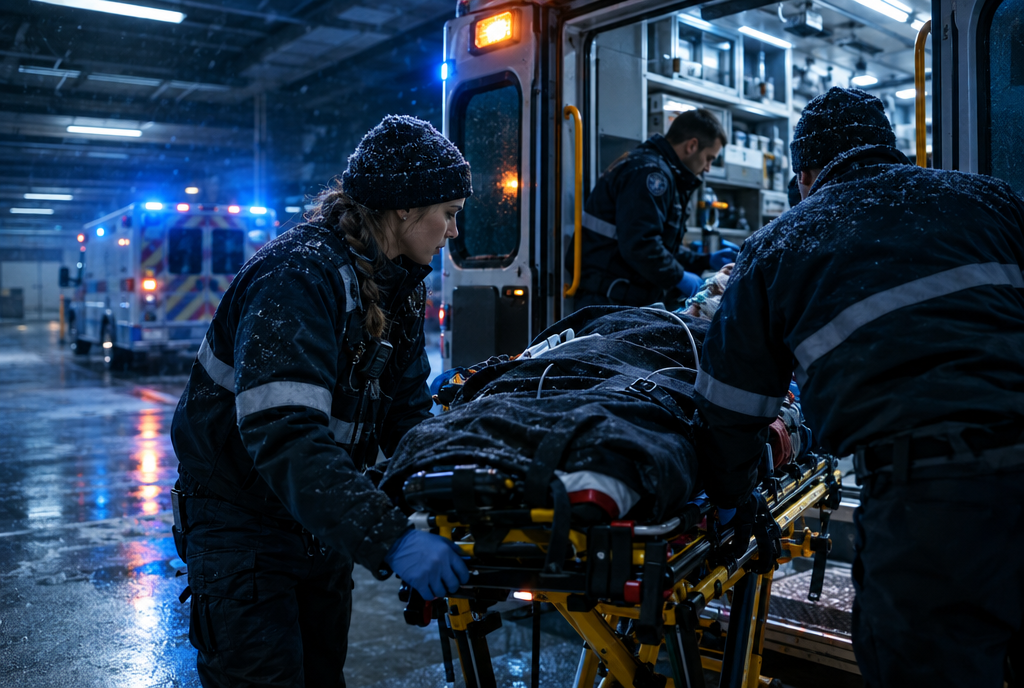
The lethal triad is the combination of hypothermia, acidosis and coagulopathy in severely injured patients. Each worsens the others: cold slows clotting enzymes, poor perfusion causes acidosis, and uncontrolled bleeding deepens both. Military trauma guidance reports that hypothermic trauma patients die at about twice the rate of similarly injured patients with normal temperature, so heat loss is treated as a threat from the point of injury.
What is the lethal triad in trauma?
The term describes a vicious cycle rather than three separate problems. A 2026 review in the Chinese Journal of Traumatology traces the concept to Kashuk and colleagues in 1982, who studied 161 patients with major abdominal vascular injuries and described hypothermia, acidosis and coagulopathy as a mutually reinforcing bloody vicious cycle.
The Joint Trauma System (JTS), the Department of Defense Center of Excellence for Trauma, uses the same framing. Its hypothermia guideline describes the three derangements as the triad of death in trauma patients.
Why do trauma patients get cold so fast?
Heat production depends on blood flow and metabolism, both of which collapse in hemorrhagic shock. At the same time, casualties are often lying on cold ground, exposed for assessment, wet with blood or rain, and moved through wind or rotor wash.
Cold fluids add to the problem. A 2014 JEMS article by emergency physician Ryan Gerecht notes that room-temperature IV fluids at 20 to 25 °C contribute to heat loss during resuscitation, and cites research finding that nearly half of trauma patients transported by EMS arrived at the emergency department below 36 °C.
How does hypothermia impair blood clotting?
Clotting is a chain of enzyme reactions, and enzymes slow down as temperature falls. A 2016 review in Military Medical Research summarizes animal work by Martini and colleagues: hypothermia to 32 °C primarily inhibited the initiation phase of thrombin generation and reduced fibrinogen synthesis by about 50 percent.
Acidosis compounds the damage. In the same body of work, acidosis at pH 7.1 cut thrombin generation to 47 percent of control values and increased fibrinogen breakdown about 1.8-fold. The review also notes that correcting pH alone did not immediately restore clotting, which is one reason prevention is emphasized over later correction.
What temperature counts as hypothermia in trauma?
Trauma care uses stricter thresholds than accidental hypothermia, because an injured patient tolerates cold far worse than a healthy hiker. The JTS guideline defines trauma-induced hypothermia as follows.
| Category | Core temperature (JTS) | What the guideline reports |
|---|---|---|
| Mild | 34 to 36 °C | Mortality roughly doubles compared with normothermic patients of similar injury |
| Moderate | 32 to 34 °C | More than 80 percent of non-survivors in one cited series arrived below 34 °C |
| Severe | Below 32 °C | The guideline cites reports of 100 percent mortality at this level |
How is the lethal triad defined in research?
Definitions have shifted. The 2026 review reports that the original 1982 criteria used a temperature below 35 °C, pH below 7.2 and an INR above 1.5, which was highly specific but identified few patients. A 2016 revision by Endo and colleagues used a core temperature below 36.0 °C with markers of fibrinolysis and base deficit, trading specificity for sensitivity.
Some authors add hypocalcemia to make a lethal diamond. The same review notes that a 2025 multicenter study found adding calcium improved mortality prediction only slightly, so its place as a fourth element remains debated.
How do EMS crews reduce heat loss during transport?
Civilian EMS faces the same physics as military medics, often with shorter transport times but more patients. In his JEMS article, Gerecht recommends treating the ambulance itself as a warming device and paying attention to every source of heat loss.
Keep the patient compartment warm, around 27 °C or higher; his rule of thumb is that if the crew is not sweating, it is not warm enough.
Give IV fluids warmed to roughly 40 °C rather than at room temperature.
Remove wet or bloody clothing promptly and cover the patient with warm blankets.
Limit crystalloid volume, which can worsen acidosis and dilute clotting factors.
How is temperature monitored in injured patients?
You cannot manage what you do not measure. The JTS guideline calls for converting to continuous temperature monitoring as care progresses, using scheduled measurements, forehead indicators or core probes depending on the setting. It notes that core temperatures should be obtained when a patient reads below 97 °F or above 100 °F.
What does this mean for prehospital care?
Because rewarming a bleeding patient is slow, both TCCC and JTS guidance stress stopping heat loss early. Practical steps include insulating the casualty from the ground, removing wet clothing, covering the body and head, adding external heat to the torso without direct skin contact, and warming fluids and blood products.
The JTS guideline notes that hypothermia on arrival at the first role of care fell from as high as 15.42 percent in 2004 to under 5 percent from 2014 onward, a period when warming practices were emphasized in military training. This page is educational; anyone with questions about injury care or cold exposure should talk to a clinician.
Key takeaways
Hypothermia, acidosis and coagulopathy form a self-reinforcing cycle after major injury.
The JTS defines trauma-induced hypothermia as below 36 °C, with severe hypothermia below 32 °C.
Hypothermic trauma patients die at about twice the rate of similarly injured normothermic patients.
Stopping heat loss at the point of injury is easier than rewarming later.
Frequently asked questions
What are the three parts of the lethal triad?
Hypothermia, acidosis and coagulopathy. Each one makes the others worse, which is why the combination is so dangerous in bleeding patients.
Why does cold make bleeding worse?
Clotting depends on enzymes and platelets that work best at normal body temperature. Research summarized in Military Medical Research found that cooling to 32 °C slowed the start of thrombin generation and reduced fibrinogen production.
What is the lethal diamond?
Some clinicians add low calcium (hypocalcemia) as a fourth element, calling it the lethal diamond or diamond of death. A 2026 review notes the evidence for adding it is still limited and debated.
Is trauma hypothermia the same as accidental hypothermia?
No. Accidental hypothermia is usually defined as a core temperature below 35 °C in otherwise healthy people. Trauma guidance from the JTS uses a higher threshold of 36 °C because injured patients tolerate cold far less well.
When should warming start for an injured person?
Military and EMS guidance calls for early steps at the point of injury, such as insulating from the ground and covering the patient. Follow local protocols and seek medical care for any serious injury.
From HEATJAC
We design low-profile thermal garments: a heat-reflective vest and a thermal harness with pockets for warmers or cold packs.
Choosing gear? Cold-weather gear for EMS crews · Cold-weather gear for police and security officers
Related reading
Sources
Hypothermia: Prevention and Treatment, CPG ID 23 (07 Jun 2023), Joint Trauma System, DoD Center of Excellence for Trauma
The lethal triad: Past, present, and future (Xiao and Zhang, 2026), Chinese Journal of Traumatology
Coagulation complications following trauma (Martini, 2016), Military Medical Research
Tactical Combat Casualty Care (TCCC) Guidelines, 25 January 2024, Committee on Tactical Combat Casualty Care, via Deployed Medicine
TB MED 508: Prevention and Management of Cold-Weather Injuries (April 2005), US Army / USARIEM
About HEATJAC. HEATJAC is a thermal architecture company founded by an anesthesiologist. We design patented garment systems that capture, conduct and broaden warmth across the body, and we publish this knowledge hub because the science of staying warm should be public. HEATJAC products are not medical devices and are not intended to diagnose, treat, cure or prevent any disease.