
Core temperature monitoring: methods and accuracy
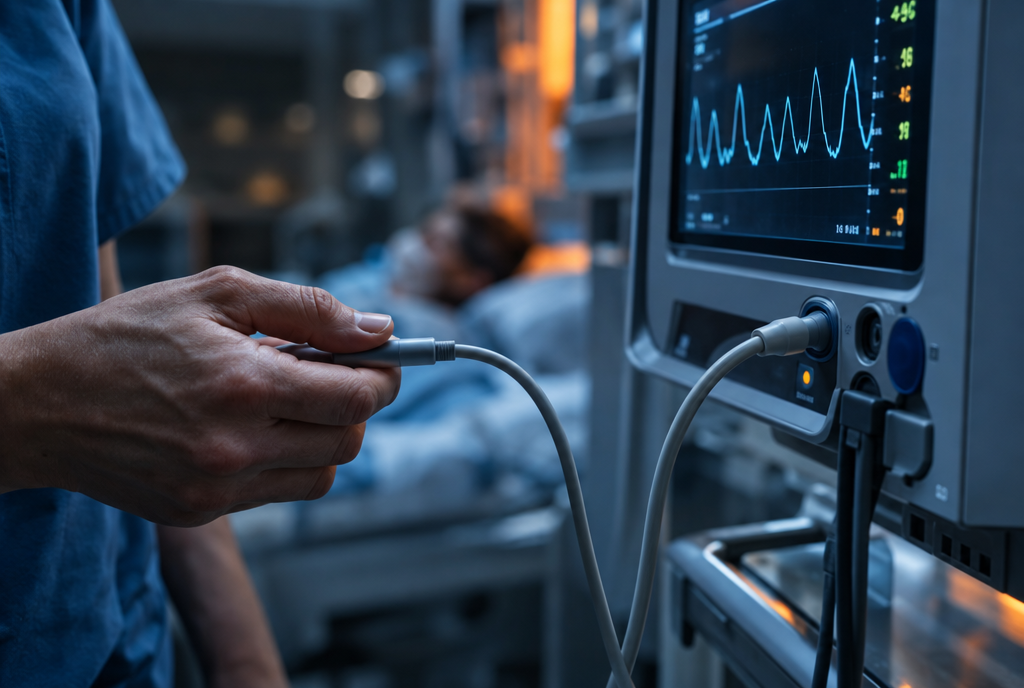
Core temperature is best measured where blood from the body's core is sampled directly or closely: the pulmonary artery, distal esophagus, nasopharynx or tympanic membrane. Bladder, oral, axillary and zero-heat-flux forehead sensors are practical near-core options with known limits. Infrared temporal and ear scanners are not accurate enough to guide perioperative care, and NICE advises against indirect estimates.
Why does core temperature monitoring matter in surgery?
Perioperative hypothermia is defined by core temperature, so a unit cannot manage what it does not measure accurately. The ASA Standards for Basic Anesthetic Monitoring require that every patient receiving anesthesia have temperature monitored when clinically significant changes in body temperature are intended, anticipated or suspected.
OpenAnesthesia translates this into practice: core temperature monitoring is indicated for general anesthesia lasting more than 30 minutes and for major surgery under neuraxial anesthesia. NICE CG65 adds a schedule: measure before induction, then every 30 minutes until the end of surgery, then on arrival in recovery and every 15 minutes after that.
Which sites measure true core temperature?
OpenAnesthesia lists four reference sites: the pulmonary artery, distal esophagus, nasopharynx and tympanic membrane. Each sits close to blood flowing from the core. The pulmonary artery is the single best estimate but is rarely used, because it requires a pulmonary artery catheter placed for other reasons.
In most anesthetized, intubated patients, an esophageal probe positioned in the distal esophagus is the practical reference. Nasopharyngeal probes are an alternative; OpenAnesthesia notes they should be inserted 10 to 20 cm in adults to estimate core temperature accurately.
The tympanic membrane counts as a core site only when it is measured by a probe in contact with the eardrum. A handheld infrared ear scanner is a different device that reads the ear canal, and it does not carry the same accuracy. The distinction is easy to miss when policies simply say "tympanic."
How accurate are the other methods?
Each alternative site trades accuracy for convenience. The table summarizes their strengths and weaknesses.
| Method | Accuracy and practical notes |
|---|---|
| Pulmonary artery catheter | Best single estimate; used only when the catheter is already indicated |
| Distal esophageal probe | Reference standard in intubated patients |
| Nasopharyngeal probe | Reliable when inserted 10 to 20 cm in adults |
| Urinary bladder | Acceptable, but lags when urine output is low |
| Rectal | Can lag substantially during rapid temperature change |
| Zero-heat-flux forehead sensor | Noninvasive; found comparable to esophageal measurement in studies cited by AORN |
| Sublingual (oral) and axillary | Useful in awake patients with correct technique; axillary best over the artery with the arm at the side |
| Skin surface | Reads lower than core; forehead skin may read about 2°C cooler |
| Infrared tympanic and temporal artery scanners | Not sufficiently accurate for anesthesia; not recommended to estimate core temperature |
What does NICE say about measurement sites?
The 2016 update to NICE CG65 lists acceptable measurement approaches: pulmonary artery catheter, distal esophagus, urinary bladder, zero-heat-flux deep forehead, sublingual, axilla and rectum. It also states directly that clinicians should not use indirect estimates of core temperature in adults having surgery.
The practical effect is to separate devices that measure, or closely track, core temperature from devices that estimate it through a calculation from skin or ear-canal readings. Many units choose one method for the operating room and a compatible method for holding and recovery, so the trend is meaningful across the pathway.
Oral and axillary readings remain on the list because they are practical for awake patients before and after surgery. Their accuracy depends on technique, including correct probe placement under the tongue and, for the axilla, positioning over the artery with the arm held at the side.
How does zero-heat-flux thermometry work?
A zero-heat-flux sensor is an adhesive pad placed on the forehead. It contains a heater and temperature sensors that warm the skin surface until no heat flows out of the tissue beneath it. At that point, the skin under the pad reaches the temperature of the deeper tissue, and the sensor reports it.
The appeal is that it is noninvasive and works in awake patients and under regional anesthesia, where esophageal probes are not tolerated. AORN's evidence table includes a 2017 study finding zero-heat-flux thermometry comparable to esophageal or iliac arterial measurements. It can also be applied in pre-op holding and left in place through recovery, giving a continuous record.
Why are temporal and ear scanners a problem?
Infrared temporal artery and tympanic scanners are fast and familiar, but they estimate core temperature from surface readings. OpenAnesthesia describes infrared tympanic scanners as not sufficiently accurate for monitoring during anesthesia, and AORN's evidence table includes a 2019 study concluding that temporal artery thermometers are not recommended because they inaccurately estimate core temperature.
The problem is not that these devices are useless. In triage and routine ward care they are quick and well tolerated. The problem is that perioperative decisions depend on small differences around a 36.0°C threshold, and a method that estimates rather than measures core temperature can place a patient on the wrong side of that line.
An inaccurate reading can hide hypothermia or trigger unnecessary interventions. That is why AORN's 2025 guideline update recommends pre-purchase evaluation of all devices used for patient temperature management, including thermometers.
How should a hospital choose monitoring methods?
Match the method to the phase: esophageal or nasopharyngeal under general anesthesia, zero-heat-flux or careful oral or axillary measurement when awake.
Avoid indirect estimates in adults having surgery, as NICE advises.
Keep methods consistent across holding, the operating room and recovery so trends are comparable.
Document readings on the NICE schedule or local equivalent, and act on values below 36.0°C.
Evaluate thermometers before purchase, as AORN recommends, and train staff on correct placement.
What does this mean for patients?
Patients may have a probe placed after they are asleep, a sensor on the forehead, or oral readings before and after surgery. Each is chosen to give the team a reliable view of core temperature. Anyone with questions about their own monitoring should talk to a clinician on their anesthesia team.
Key takeaways
Reference core sites are the pulmonary artery, distal esophagus, nasopharynx and tympanic membrane.
ASA requires temperature monitoring when significant changes are intended, anticipated or suspected.
NICE lists acceptable sites and advises against indirect core temperature estimates in surgical adults.
Zero-heat-flux forehead sensors offer noninvasive, near-core readings for awake and anesthetized patients.
Infrared temporal and ear scanners are not accurate enough to guide perioperative temperature care.
Frequently asked questions
What is the most accurate way to measure core temperature?
The pulmonary artery catheter gives the best single estimate, but it is only used when already indicated. In intubated surgical patients, a distal esophageal probe is the practical reference standard.
Is a temporal artery thermometer accurate for surgery?
No. OpenAnesthesia and studies cited by AORN describe infrared temporal and tympanic scanners as not accurate enough to estimate core temperature during perioperative care, and NICE advises against indirect estimates.
What is a zero-heat-flux thermometer?
It is a forehead sensor with a built-in heater that stops heat flowing out of the skin beneath it, so the skin reaches deep-tissue temperature. It is noninvasive and has been found comparable to esophageal measurement.
How often should temperature be measured during surgery?
NICE recommends measuring before induction and every 30 minutes until the end of surgery. In recovery it recommends measuring on arrival and then every 15 minutes.
Is bladder temperature a good core measurement?
It is acceptable in many cases and is listed by NICE, but it lags behind true core temperature when urine output is low. Teams should interpret it with that limit in mind.
From HEATJAC
We design low-profile thermal garments: a heat-reflective vest and a thermal harness with pockets for warmers or cold packs.
Choosing gear? What nurses and OR staff should look for in thermal gear · Getting a thermal vest approved for clinical areas
Related reading
Sources
Standards for Basic Anesthetic Monitoring, American Society of Anesthesiologists
Temperature Monitoring, OpenAnesthesia (International Anesthesia Research Society)
Addendum to Clinical Guideline CG65, Inadvertent Perioperative Hypothermia (2016), NICE via NCBI Bookshelf
Hypothermia: prevention and management in adults having surgery (CG65), Recommendations, National Institute for Health and Care Excellence (NICE)
AORN Guideline for Patient Temperature Management: Evidence Table, AORN
Maintaining Normothermia: Implementing AORN's Updated Patient Temperature Management Guideline, AORN
About HEATJAC. HEATJAC is a thermal architecture company founded by an anesthesiologist. We design patented garment systems that capture, conduct and broaden warmth across the body, and we publish this knowledge hub because the science of staying warm should be public. HEATJAC products are not medical devices and are not intended to diagnose, treat, cure or prevent any disease.