
What nurses and OR staff should look for in thermal gear
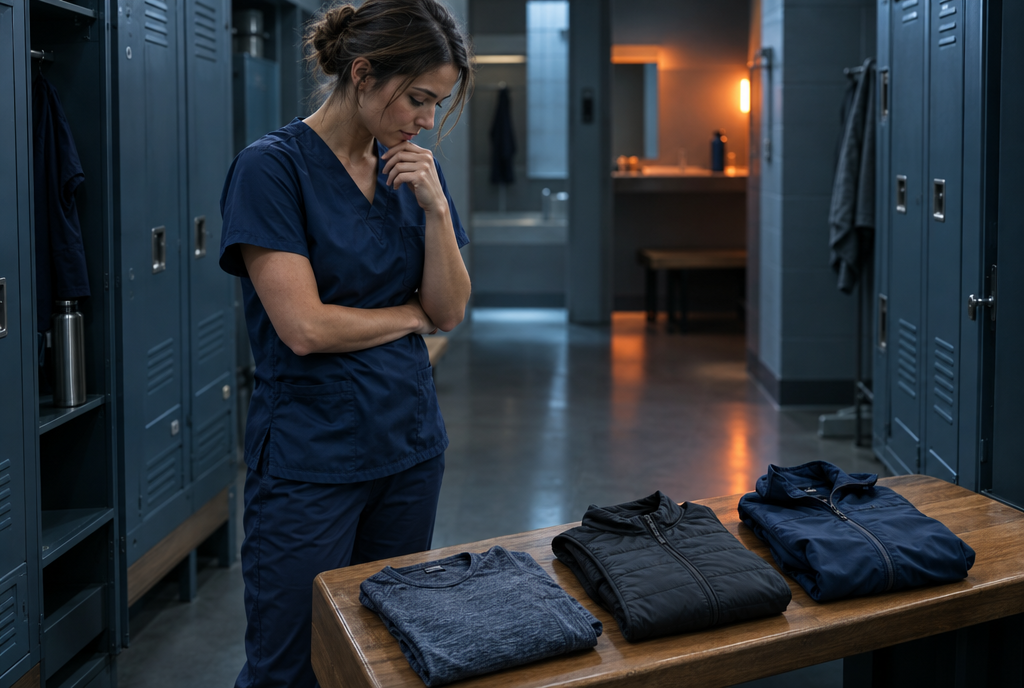
To stay warm under scrubs, buy for your unit's rules first and warmth second: a close-fitting, low-lint base layer, a thin core vest that sits fully under the scrub top, and a warm-up jacket where arms may be covered. Choose fabrics you can launder the way your facility requires. Passive layers suit most units; battery-heated gear fits where devices are clearly allowed.
What is the best thermal vest for OR nurses?
For most circulating nurses, scrub nurses between cases and anesthesia staff, the best thermal vest is a thin, close-fitting warming vest that sits fully under the scrub top: heat-reflective or lightly insulated, low-lint, with no exposed battery hardware unless your facility clearly allows it, and washable the way your facility requires. Pockets for warmers add heat on long, still cases where your unit permits them.
Searches for "thermal vest" also return cooling vests, which solve the opposite problem. Surgeons under gowns and lights often run hot while circulating and anesthesia staff run cold in the same room. If you are the one overheating, see cooling vests for surgeons; if the thermostat is the argument, see why one OR feels too hot and too cold at once.
What should nurses look for in warm layers under scrubs?
Most retail guides on what to wear under scrubs focus on style. For a buying decision, five tests matter more, and they apply in roughly this order. A layer that fails the first test is a poor buy however warm it is.
Try each candidate against this list before you order in quantity or commit to a set for every shift.
Policy fit: your unit's dress code allows it, including how much may show at the neckline and wrists.
Fabric: tightly woven or smooth-faced, low-linting, and not prone to pilling or shedding.
Profile: sits fully under the scrub top without bulk at the hem, neckline or pockets.
Laundering: tolerates the wash method your facility requires, with removable inserts if it has any.
Control: heat comes off fast when a case runs long, a code starts or you begin moving.
What thermal gear works in the OR, ICU, ED and on the floor?
The same nurse can be cold in one unit and comfortable in another, because each setting mixes air movement, activity and gowning differently. Buy for the setting you work in most, then add one item for the coldest shifts.
For the rule detail behind each row, see our guide to warm layers and OR attire; this page stays with what to buy.
| Setting | What drives the cold | Buy first | Watch for |
|---|---|---|---|
| Operating room | Cool room, supply airflow, long still periods for some roles | Low-lint base layer, facility warm-up jacket, thin core vest | Fabric rules and how much may extend beyond attire |
| ICU | Long bedside and charting periods, frequent isolation gowns | Thin base layer and a core vest that fits under gowns | Bulk under gowns, laundering after patient contact |
| Emergency department | Ambulance bay doors, fast pace, contamination risk | Removable layers plus a spare base layer in a locker | Layers you cannot swap quickly if soiled |
| Medical-surgical floor | Mixed walking and station time, quieter night shifts | Long-sleeve base layer, vest for the station | Dress code on outerwear and colors |
Which fabrics fit infection-control rules?
AORN recommends tightly woven, low-linting fabrics for scrub attire. For clothing worn underneath, its guidance leaves the detail to each facility: the team should decide what fabrics may be worn, how much may extend beyond the surgical attire, and how it is laundered.
That makes fleece and loose knits the usual casualties. They are warm because they are lofty, but loft sheds fibers, which is why many operating rooms restrict them. Smooth-faced knit base layers and vests with a woven outer fabric pass more often. When a policy is unclear, ask your educator before buying a set.
Can you launder it the way your facility requires?
AORN states that scrub attire should be laundered at a health care-accredited laundry, according to state requirements, or according to CDC recommendations. CDC notes that uniforms without blood or body fluid contamination are comparable to street clothes in microbial content and can be cleaned through home laundering, and that a hot-water wash of at least 160°F (71°C) for 25 minutes is commonly recommended.
OSHA's bloodborne pathogens standard separates general work clothes from personal protective equipment, and requires that a garment penetrated by blood or other potentially infectious materials be removed immediately or as soon as feasible. The buying lesson is simple: check each care label against your facility's method, choose layers that come off quickly, and buy two so one is always clean.
Passive or battery-heated: where does each fit?
Passive layers include insulated vests, heat-reflective vests and vests with pockets for air-activated warmers. There is nothing to charge and no device to approve, which suits long shifts and restricted areas. The trade-off is less adjustable heat on the coldest nights.
Battery-heated vests add adjustable heat but bring device rules with them. OSHA's bulletin on wearable lithium battery devices advises batteries and chargers tested to an appropriate standard such as UL 2054, inspection for bulging, cracking, hissing, leaking, rising temperature or smoking, and removing a device from clothing quickly if it feels hot. Operating rooms add oxygen-enriched areas, so ask before wearing any battery device there, and see our guide to battery devices in clinical areas.
Many nurses start passive and add a battery option only for a unit that clearly allows it.
How should a layer under scrubs fit?
Try every layer on with the scrubs you actually wear. Reach overhead, bend to a low bed and lean over a chart; nothing should ride up past the scrub hem or bunch at the neckline. Pockets in the vest should not sit where your scrub pockets or badge reel do.
Feeling cold in a cool room is normal. Fingers that turn white or blue, numbness that lingers, or feeling cold where colleagues are comfortable can have medical causes, so talk to a clinician about symptoms like these.
Where HEATJAC fits
HEATJAC CORE is a low-profile thermal harness platform with integrated heat-reflective thermal inserts, designed by an anesthesiologist to sit under or over scrubs. Its pockets accept supplemental warming elements such as air-activated warmers (sold separately), and it is passive, with no built-in battery. It comes in Medical Blue, Navy and Black among other colors, in sizes S/M and L/XL; your facility's attire policy still decides where it can be worn.
Key takeaways
Check your unit's attire policy before buying; it decides fabric, visibility and laundering.
Build from a low-lint base layer, a thin core vest and a facility warm-up jacket.
Buy layers that tolerate your facility's wash method and that come off quickly if soiled.
Passive layers raise the fewest approval questions; battery gear needs certified packs and clearance.
Frequently asked questions
What is the best thermal vest for OR nurses?
A thin warming vest that fits fully under the scrub top: heat-reflective or lightly insulated, low-lint and washable as your facility requires, with no exposed battery hardware unless devices are clearly allowed. If you run hot under a gown instead, you want a cooling vest, not a warming one.
What can nurses wear under scrubs to stay warm?
A close-fitting, low-lint long-sleeve base layer and a thin vest that sits fully under the scrub top are the most common choices. Where arms may be covered, a facility warm-up jacket adds warmth. Your unit's dress code decides what may show.
Is fleece allowed under scrubs in the OR?
Often not. Fleece is lofty and can shed fibers, and AORN recommends tightly woven, low-linting fabrics. Facilities set their own rules for clothing under scrubs, so check the written policy.
Can I wash warm layers at home?
It depends on your facility. CDC notes that uniforms without blood or body fluid contamination can be cleaned through home laundering, but AORN expects scrub attire to follow accredited laundry, state or CDC methods. Anything contaminated with blood should stay at the facility.
Are heated vests allowed for nurses?
Some units allow them and some do not, especially operating and procedure rooms. Passive vests are simpler to approve. If you use a battery vest, choose certified batteries and chargers and ask before wearing it in restricted areas.
What is the warmest combination for a cold unit?
For most nurses, a thin base layer, a core vest and a warm-up jacket together beat any single garment. Each piece can come off separately as your activity changes.
Related reading
Sources
Surgical Attire, Stethoscopes and Personal Items, AORN Periop Today
Guidelines for Environmental Infection Control in Health-Care Facilities: Laundry and Bedding, Centers for Disease Control and Prevention
29 CFR 1910.1030, Bloodborne Pathogens, Occupational Safety and Health Administration
Preventing Fire and/or Explosion Injury from Small and Wearable Lithium Battery Powered Devices (SHIB 06-20-2019), Occupational Safety and Health Administration
About HEATJAC. HEATJAC is a thermal architecture company founded by an anesthesiologist. We design patented garment systems that capture, conduct and broaden warmth across the body, and we publish this knowledge hub because the science of staying warm should be public. HEATJAC products are not medical devices and are not intended to diagnose, treat, cure or prevent any disease.