
ECWCS levels 1 to 7 explained
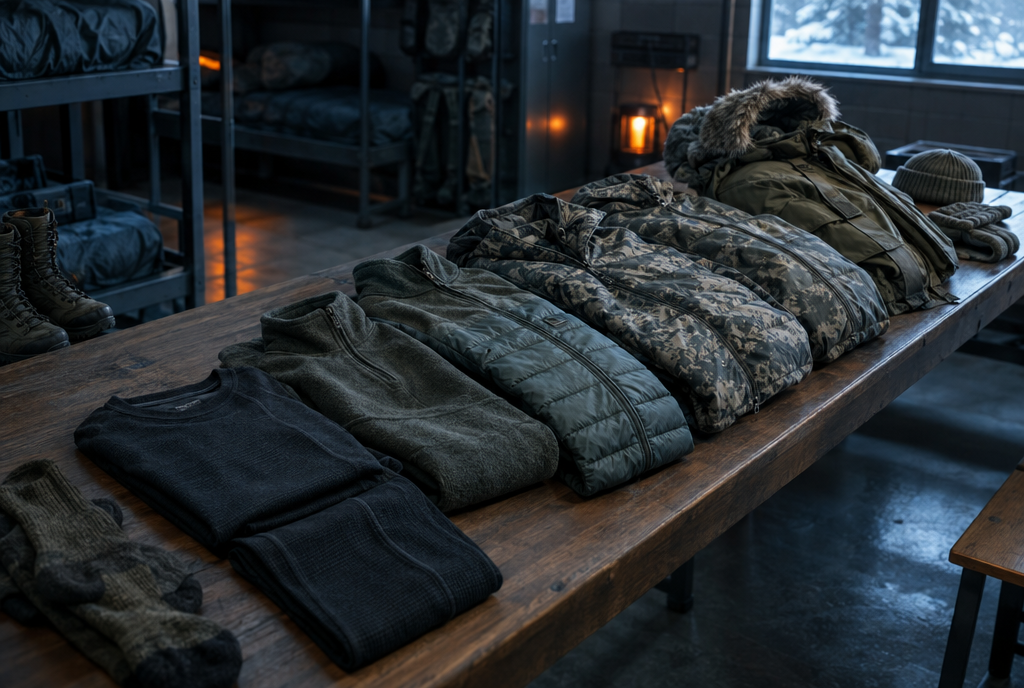
The Extended Cold Weather Clothing System (ECWCS) Generation III is the US Army's 12-piece, seven-level layering system. Levels 1 and 2 are base layers, Level 3 is fleece, Level 4 a wind jacket, Level 5 soft shell, Level 6 a waterproof shell and Level 7 an insulated parka and trousers. The Army rates the full system for about minus 40 to plus 60 °F.
What is ECWCS?
ECWCS is the Army's modular cold-weather clothing system. Instead of one heavy coat, it gives a soldier a set of garments that can be combined in different ways, so the same kit works for a march at 20 °F and a static guard post at minus 30 °F.
The current generation, Gen III, was designed around layering systems used by professional mountaineers. PEO Soldier describes it as a 12-piece, seven-layer system that lets soldiers dress up or down to their own comfort level across roughly minus 40 to plus 60 °F. The fact sheet lists the combined weight of all layers at 12.85 pounds.
The Army reported in 2008 that Gen III had been field tested with the 10th Mountain Division in Afghanistan during the fall of 2006 and winter of 2007, and described it as more compressible, lighter and more versatile than earlier ECWCS generations.
What are the seven ECWCS Gen III levels?
Each level has a specific job. Lower numbers sit next to the skin and manage moisture; higher numbers block wind and water or add bulk insulation for static periods.
| Level | Garment | Main job |
|---|---|---|
| Level 1 | Lightweight undershirt and drawers | Wicks sweat away from skin |
| Level 2 | Midweight shirt and drawers (grid fleece) | Adds light insulation while still wicking |
| Level 3 | Fleece jacket | Main mid-layer insulation |
| Level 4 | Wind jacket | Light, wind-resistant, water-repellent shell |
| Level 5 | Soft shell jacket and trousers | Wind resistance with high breathability; the workhorse outer layer |
| Level 6 | Extreme cold/wet weather jacket and trousers | Waterproof, breathable hard shell for rain and wet snow |
| Level 7 | Extreme cold weather parka and trousers | High-loft insulation for very cold, low-activity periods |
How does the Army combine ECWCS levels by temperature?
The system is meant to be worn in combinations, not all at once. The Gen III configuration guide splits recommendations by activity level, because a soldier moving under load produces far more heat than one standing still.
For active work in extreme cold (about minus 25 to 0 °F), the guide pairs Levels 1, 2, 3 and 5 on top. For static work in extreme cold (about minus 50 to 0 °F), it adds Level 7 over that stack. In cold and wet conditions around 30 to 45 °F, the waterproof Level 6 replaces the soft shell.
Active, extreme cold: L1, L2, L3 and L5 on top; L1, L2 and L5 on the legs.
Static, extreme cold: L1, L2, L3, L5 and L7 on top; L1, L2, L5 and L7 on the legs.
Static, cold/wet (30 to 45 °F): L1, L3 and L6 on top; L1 and L6 on the legs.
Why does ECWCS separate active and static configurations?
Sweat is the enemy of insulation. The Army's cold-injury bulletin, TB MED 508, notes that wet clothing can lose 50 percent or more of its insulation, and its COLD rule tells soldiers to keep clothing clean, avoid overheating, wear it loose and in layers, and keep it dry.
The practical result is a habit that experienced cold-weather troops share: strip down before moving so you do not soak your layers, then add Level 7 the moment you stop. The same logic is covered in our guide to military layering principles.
What replaced ECWCS for Arctic units?
In February 2023 the Army began fielding the Cold Temperature and Arctic Protection System (CTAPS) to the 11th Airborne Division in Alaska. The Army article on the fielding states plainly that ECWCS does not meet the unique extreme cold experienced there.
CTAPS keeps the ECWCS numbering but uses five layers: a base layer (L1), a lightweight insulated layer with vented armpits (L3), a softshell uniform (L5), a cold/wet shell (L6) and an extreme cold weather parka and trousers (L7). Trade coverage of the program noted the Army must be able to survive temperatures as low as minus 65 °F, and that hand, foot and head protection are handled by separate programs.
What should surplus buyers know about ECWCS levels?
Surplus ECWCS is popular with hunters, workers and campers because the pieces are durable and designed to layer. The level number tells you the garment's role, not its warmth rating on its own. A Level 7 parka worn over a sweaty cotton shirt will still leave you cold.
Match levels to your activity, start with a moisture-managing base, and treat Levels 5 and 7 as the core of a static cold-weather setup. If you are buying for work in freezers or outdoor trades, the same principles apply to civilian gear.
ECWCS Level 7 care and Level 7 vs 7A
The Army's operator manual for ECWCS Gen III (TM 10-8415-236-10, November 2014) gives one set of home laundering rules for every item and layer, including the Level 7 Extreme Cold Weather Parka and Trousers. Before washing, zip every zipper, fasten snaps and hooks, and tie the drawcords together. The manual warns that pressing, starching, dry cleaning, bleach and fabric softener degrade the system, and that it should not be stored in plastic bags that trap moisture.
The manual lists the Level 7 parka as the Extreme Cold Weather Parka (Loft) and describes it as highly water and wind resistant and sized to fit over body armor. It does not use a Level 7A designation. If you are comparing a garment sold as "7" with one sold as "7A", read the sewn-in label: a government-issue piece carries its national stock number (NSN), and the care symbols on that label are the instructions that apply to that exact garment, including commercial versions made by private brands.
| Step | What the Army manual says |
|---|---|
| Wash | Machine wash on a delicate or gentle cycle, or by hand, in lukewarm water, 90 °F (32 °C), with a cold water detergent |
| Rinse | Rinse in clean, cold water |
| Dry | Tumble dry at no more than 130 °F (54 °C) and avoid over-drying, or drip dry on a rust-proof hanger |
| Never | Press, starch, dry clean, bleach or use fabric softener |
| Water repellency | Repeated washing wears down the outer shell's water repellency; the manual lists a spray-on and a wash-in restorer, used per the product directions |
| Storage | Do not store in plastic bags that can trap moisture |
Key takeaways
ECWCS Gen III is a 12-piece, seven-level system rated by the Army for about minus 40 to plus 60 °F.
Levels 1 and 2 manage moisture, 3 insulates, 4 to 6 are shells, and 7 is a high-loft parka and trousers for static cold.
The Army publishes separate active and static configurations because sweat can cut clothing insulation by half or more.
Arctic units began receiving the five-layer CTAPS system in 2023.
Frequently asked questions
What is ECWCS Level 7?
Level 7 is the extreme cold weather parka and trousers, a high-loft insulated layer. It is designed for very cold, low-activity periods such as halts, guard duty or waiting, and is usually worn over the base, fleece and soft shell layers.
What temperature is ECWCS rated for?
PEO Soldier describes Gen III ECWCS as covering environmental conditions from about minus 40 to plus 60 °F when layers are combined correctly. No single level carries a temperature rating on its own.
What is the difference between ECWCS Level 5 and Level 6?
Level 5 is a soft shell that resists wind and light moisture while breathing well, making it the everyday outer layer. Level 6 is a waterproof, breathable hard shell for rain, sleet and wet snow.
Is ECWCS still issued?
ECWCS remains the Army's general cold-weather layering system, while Arctic units in Alaska began receiving CTAPS in 2023. Issue varies by unit and mission.
How much does a full ECWCS Gen III set weigh?
The PEO Soldier fact sheet lists 12.85 pounds for all layers combined. In practice soldiers rarely wear every layer at the same time.
What does ECWCS stand for?
ECWCS stands for Extended Cold Weather Clothing System, the US Army's modular cold-weather layering system. The current Generation III version has 12 pieces arranged in seven levels, numbered from the skin outward.
What is ECWCS Level 1?
Level 1 is the lightweight undershirt and drawers, the base layer worn next to the skin. Its job is to move sweat away from the skin so the layers above stay dry and keep their insulation.
What is the Army level 3 top?
The Level 3 top is the ECWCS Gen III fleece jacket, the main mid-layer insulation. It is usually worn over Levels 1 and 2 and under a shell such as the Level 5 soft shell when it is cold or windy.
What are the Army cold weather gear layers 1 to 7?
Level 1 is a lightweight undershirt and drawers, Level 2 a midweight shirt and drawers, Level 3 a fleece jacket and Level 4 a wind jacket. Level 5 is a soft shell jacket and trousers, Level 6 an extreme cold/wet weather jacket and trousers, and Level 7 an extreme cold weather parka and trousers.
Is there an ECWCS temperature guide?
Yes. The Army's Gen III configuration chart groups layers by activity and conditions, for example active extreme cold at minus 25 to 0°F (minus 32 to minus 18°C) and static extreme cold at minus 50 to 0°F (minus 46 to minus 18°C). Cold conditions span 0 to 30°F (minus 18 to minus 1°C), and the full system covers about minus 40 to plus 60°F (minus 40 to plus 16°C).
How do you wash a Gen 2 ECWCS Level 7 parka?
Follow the sewn-in care label first, because parkas sold as "Gen 2" Level 7 are commercial products whose materials and care can differ from Army issue. For the Army-issue Gen III Level 7, the operator manual says to wash on a gentle cycle in lukewarm water, 90 °F (32 °C), with a cold water detergent, rinse in cold water and tumble dry at no more than 130 °F (54 °C). It also says never to bleach, dry clean, press, starch or use fabric softener.
What is the difference between ECWCS Level 7 and Level 7A?
The Army's 2014 Gen III operator manual lists a single Level 7 item, the Extreme Cold Weather Parka (Loft) and matching trousers, and does not use a 7A designation. We could not find an official Army or Defense Logistics Agency source defining Level 7A. Compare the garment labels, which list the national stock number on issued items, along with fill, shell fabric and care instructions.
Can you put an ECWCS Level 7 parka in the dryer?
Yes, on low heat. The Army manual says to tumble dry ECWCS Gen III items at no more than 130 °F (54 °C) and to avoid over-drying, because higher heat degrades the materials. Drip drying on a rust-proof hanger is the alternative.
Why should you not use fabric softener on ECWCS gear?
The Army manual warns that fabric softener, bleach, starch, pressing and dry cleaning degrade ECWCS Gen III and can destroy its integrity. The same manual cautions that solvents and lubricants can ruin the silicone finish on the soft shell. Use a plain cold water detergent instead.
From HEATJAC
We design low-profile thermal garments: a heat-reflective vest and a thermal harness with pockets for warmers or cold packs.
Choosing gear? Cold-weather gear for EMS crews · Cold-weather gear for police and security officers
Related reading
Sources
Generation III Extended Cold Weather Clothing System (ECWCS) fact sheet, PEO Soldier, US Army (archived by CIE Hub)
Generation III Extended Cold Weather Clothing System, CIE Hub
Cold-Weather Clothing System Increases Survivability, Comfort, US Army
Arctic Angels equipped with newest extreme cold weather gear, US Army
PEO Soldier Works with Industry To Rapidly Field New Cold Weather Clothing to 11th Abn Div, Soldier Systems Daily
TB MED 508: Prevention and Management of Cold-Weather Injuries (April 2005), US Army / USARIEM
TM 10-8415-236-10: Operator Manual for Extended Cold Weather Clothing System Generation III (1 November 2014), Headquarters, Department of the Army (archived by CIE Hub)
About HEATJAC. HEATJAC is a thermal architecture company founded by an anesthesiologist. We design patented garment systems that capture, conduct and broaden warmth across the body, and we publish this knowledge hub because the science of staying warm should be public. HEATJAC products are not medical devices and are not intended to diagnose, treat, cure or prevent any disease.