
Cold-weather readiness: thermal systems for military, tactical and EMS teams
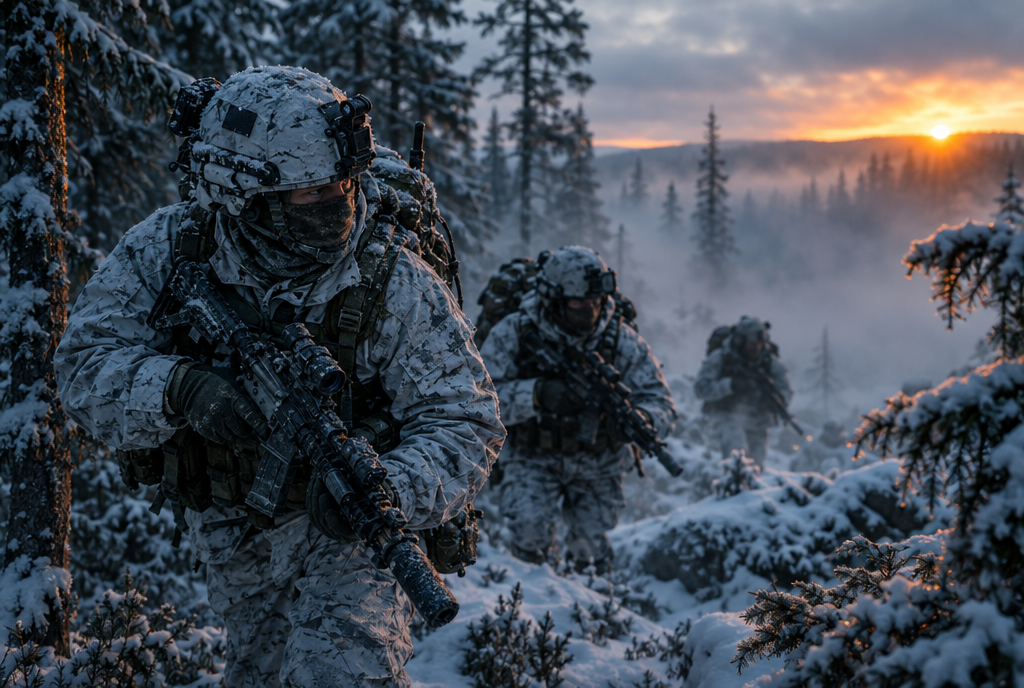
Cold-weather readiness means solving two thermal problems at once: keeping the team warm, dry and able to use their hands, and keeping casualties from losing heat. Military practice relies on adjustable layering such as the Army's seven-level ECWCS, strict moisture control to avoid cold injuries, and casualty warming kits like the HPMK. Batteries, body armor and procurement rules shape every choice.
What does cold-weather readiness mean for military, tactical and EMS teams?
For a unit or crew, cold is not a single hazard. It degrades the people doing the work, through cold injury and lost dexterity, and it threatens the people they care for, through hypothermia after injury. It also degrades equipment, especially anything that runs on batteries.
The US Army has studied these problems for decades through the US Army Research Institute of Environmental Medicine (USARIEM), which describes itself as the Department of Defense leader in cold physiology research. Its guidance, together with Joint Trauma System (JTS) and Tactical Combat Casualty Care (TCCC) guidelines, forms the backbone of this guide. The same principles apply to police, search and rescue, utility crews and EMS agencies working in winter.
How does the Army's ECWCS layering system work?
The Extended Cold Weather Clothing System (ECWCS) Generation III is a 12-piece, seven-level system. PEO Soldier describes it as letting soldiers dress up or down to their comfort across roughly minus 40 to plus 60 °F. Levels 1 and 2 are base layers, Level 3 is fleece, Levels 4 to 6 are wind, soft shell and waterproof shells, and Level 7 is an insulated parka and trousers.
In 2023 the Army began fielding a five-layer system called CTAPS to Arctic units in Alaska, stating that ECWCS does not meet the unique extreme cold experienced there. Our explainer on ECWCS levels 1 to 7 covers each garment, its role and the Army's configuration guide.
Which layering principles carry over to any cold job?
The Army's cold-injury bulletin, TB MED 508, distills clothing discipline into the COLD rule: keep it Clean, avoid Overheating, wear it Loose and in layers, and keep it Dry. It notes that wet clothing can lose 50 percent or more of its insulation, which is why managing sweat matters as much as adding warmth.
The most transferable lesson is dressing differently for active and static work. The ECWCS guide adds an insulated parka for static work at temperatures where active soldiers wear only base, fleece and soft shell. Our guide to military cold-weather layering principles translates these rules for freezer, utility, security and EMS work.
What cold injuries threaten troops, responders and workers?
TB MED 508 defines hypothermia as a core temperature below 95 °F (35 °C) and notes that skin freezes at 32 °F. It also warns that non-freezing cold injury (NFCI), including trench foot, occurs when conditions are cold and wet, with air temperatures between 32 and 55 °F, and that wet feet for more than 12 hours raise the risk.
NFCI is easy to miss because nothing freezes, and its worst symptoms often begin after rewarming. Prevention is mostly moisture discipline: the bulletin calls changing socks two to three times a day mandatory in cold-wet environments. Our article on non-freezing cold injury explains the conditions, signs and prevention in detail.
| Threat | What it is | Primary countermeasure |
|---|---|---|
| Hypothermia | Core temperature below 35 °C (95 °F) | Layering, dry clothing, shelter, early warming |
| Frostbite | Freezing of skin and tissue | Covering exposed skin, wind protection, warm hands and feet |
| Non-freezing cold injury | Nerve and vessel damage from cold, wet exposure above freezing | Dry socks, foot checks, movement |
| Trauma-induced hypothermia | Heat loss in injured patients, part of the lethal triad | Insulate, remove wet clothing, add heat to torso |
| Lost dexterity | Cold hands and fingers | Warm core and forearms, gloves, dry liners |
| Battery failure | Reduced capacity and power in cold | Carry packs close to the body, warm before charging |
Why does hypothermia matter so much in trauma?
Injured patients cannot produce heat well, and cold impairs the enzymes that make blood clot. Hypothermia, acidosis and coagulopathy reinforce each other in what trauma care calls the lethal triad. The JTS guideline reports that hypothermic trauma patients die at about twice the rate of similarly injured patients with normal temperature.
The JTS defines trauma-induced hypothermia as mild at 34 to 36 °C, moderate at 32 to 34 °C and severe below 32 °C, stricter thresholds than for accidental hypothermia. Our article on hypothermia in trauma and the lethal triad explains the physiology and the evidence.
How do medics and EMS crews keep casualties warm?
TCCC guidelines put hypothermia prevention in Tactical Field Care: minimize exposure to cold ground, wind and air; insulate the casualty from cold surfaces; replace wet clothing; place an active heating blanket on the front of the torso and under the arms, never directly on skin; and enclose the casualty in an impermeable outer shell.
The best-known tool is the Hypothermia Prevention and Management Kit (HPMK), which pairs an air-activated heating liner with a hooded reflective vapor-barrier shell. The JTS guideline notes it is non-insulated and suitable only for short-term prevention in cold climates, so longer evacuations call for insulation such as a sleeping bag inside the shell. Our HPMK explainer and our comparison of prehospital blankets, wraps and active warmers cover the options, from space blankets to warmed IV fluids.
How do body armor and duty gear change the thermal picture?
Armor covers the torso, traps sweat during exertion and leaves little room for insulation underneath. The result is a wearer who overheats while moving and chills quickly at a halt. The practical fix is a thin, dry base layer under the armor, insulation that goes on over the kit when movement stops, and careful use of heat sources under compression.
Hands matter as much as the core. TB MED 508 reports that manual dexterity declines once finger skin temperature drops to about 60 °F, and Army researchers report that warming the forearm significantly increases hand and finger temperatures. Our guide to staying warm under body armor and duty gear covers layering, heated vests and hot-spot risks.
How does cold affect batteries in field gear?
Radios, lights, GPS units, medical devices and heated garments all depend on batteries that lose capacity in the cold. Battery University reports that a battery delivering full capacity at 27 °C typically delivers about half at minus 18 °C, and that consumer lithium-ion cells should not be charged at freezing temperatures because of lithium plating.
Carrying packs close to the body, rotating warm spares and planning runtime for the cold are basic readiness habits. Our article on how cold affects batteries explains the chemistry and practical steps.
What rules govern textiles bought for the military?
The Berry Amendment, first passed in 1941 and now codified at 10 U.S.C. 4862 (formerly 2533a), bars the Department of Defense from using its funds to buy covered clothing, textiles and certain other items unless they are grown, reprocessed, reused or produced in the United States. It reaches through fabric to fibers and yarns, and flows into contracts through DFARS 252.225-7012.
For suppliers, this means documenting origin across the whole textile chain. A product marketed as Berry compliant is making a claim, not carrying a government certification. Our Berry Amendment explainer covers the covered items, exceptions and supplier steps.
Where do wearable thermal systems fit in cold-weather readiness?
Wearable heat is a supplement to good layering, not a replacement. Passive insulation, wind protection and dry base layers work at any temperature without power. Active sources, whether air-activated warmers or battery heating panels, add warmth where the body needs it most, typically the torso, but bring burn, battery and fit considerations.
Civilian products increasingly combine these approaches. HEATJAC, for example, designs a vest and harness platform with pockets that accept air-activated warmers, battery heating inserts or cold packs; it is a civilian wellness product, not military-issue equipment and not a medical device. Whatever a team chooses, the principles in this guide apply: stay dry, dress for activity, protect hands and feet, and keep batteries warm.
This guide is educational. Anyone with symptoms of cold injury or hypothermia should seek care and talk to a clinician.
Key takeaways
Cold readiness covers the team, the casualty and the equipment.
ECWCS and CTAPS show the military model: adjustable layers, dressed differently for active and static work.
Moisture control, including frequent sock changes, is the core defense against cold injury.
In trauma, stopping heat loss early matters because hypothermia feeds the lethal triad.
Keep batteries close to the body and never charge lithium-ion cells below freezing.
Frequently asked questions
What cold weather gear does the US Army use?
The Army's general cold-weather system is the Generation III Extended Cold Weather Clothing System (ECWCS), a 12-piece, seven-level layering system. Arctic units in Alaska began receiving the five-layer CTAPS system in 2023.
What is the military layering system for cold weather?
It combines a wicking base, insulating mid-layers, wind and waterproof shells, and a heavy insulated parka for static periods. The Army's COLD rule, keep it clean, avoid overheating, wear it loose and in layers, keep it dry, guides how it is worn.
What is in a military hypothermia prevention kit?
The Hypothermia Prevention and Management Kit (HPMK) contains a hooded heat-reflective shell, an air-activated self-heating liner and a vacuum storage bag. Guidelines treat it as a short-term tool that needs added insulation for long evacuations in the cold.
What temperature causes trench foot?
Army guidance places non-freezing cold injury risk at air temperatures of 32 to 55 °F when feet stay cold and wet. CDC/NIOSH notes trench foot can occur up to 60 °F if feet are constantly wet.
Why is hypothermia dangerous for injured people?
Cold impairs blood clotting and worsens acidosis, creating a cycle known as the lethal triad. Military trauma guidance reports that hypothermic trauma patients die at about twice the rate of similarly injured patients with normal temperature.
Does military cold weather gear have to be made in the USA?
Clothing and textiles bought with Department of Defense funds are generally subject to the Berry Amendment, which requires US origin, with listed exceptions. Commercial gear sold to the public is not subject to that rule.
From HEATJAC
We design low-profile thermal garments: a heat-reflective vest and a thermal harness with pockets for warmers or cold packs.
Choosing gear? Cold-weather gear for EMS crews · Cold-weather gear for police and security officers
Related reading
cold-weather gear for police and security officers: a buyer's guide
cold-weather gear for EMS crews: what to buy for winter calls
Sources
Generation III Extended Cold Weather Clothing System (ECWCS) fact sheet, PEO Soldier, US Army (archived by CIE Hub)
Arctic Angels equipped with newest extreme cold weather gear, US Army
TB MED 508: Prevention and Management of Cold-Weather Injuries (April 2005), US Army / USARIEM
Hypothermia: Prevention and Treatment, CPG ID 23 (07 Jun 2023), Joint Trauma System, DoD Center of Excellence for Trauma
Tactical Combat Casualty Care (TCCC) Guidelines, 25 January 2024, Committee on Tactical Combat Casualty Care, via Deployed Medicine
BU-502: Discharging at High and Low Temperatures, Battery University
Berry Amendment (10 U.S.C. 2533a), Defense Pricing and Contracting, Office of the Under Secretary of Defense (A&S)
Cold-related Illnesses in Workers, CDC / NIOSH
About HEATJAC. HEATJAC is a thermal architecture company founded by an anesthesiologist. We design patented garment systems that capture, conduct and broaden warmth across the body, and we publish this knowledge hub because the science of staying warm should be public. HEATJAC products are not medical devices and are not intended to diagnose, treat, cure or prevent any disease.