
Working in the cold: a guide for employers and crews
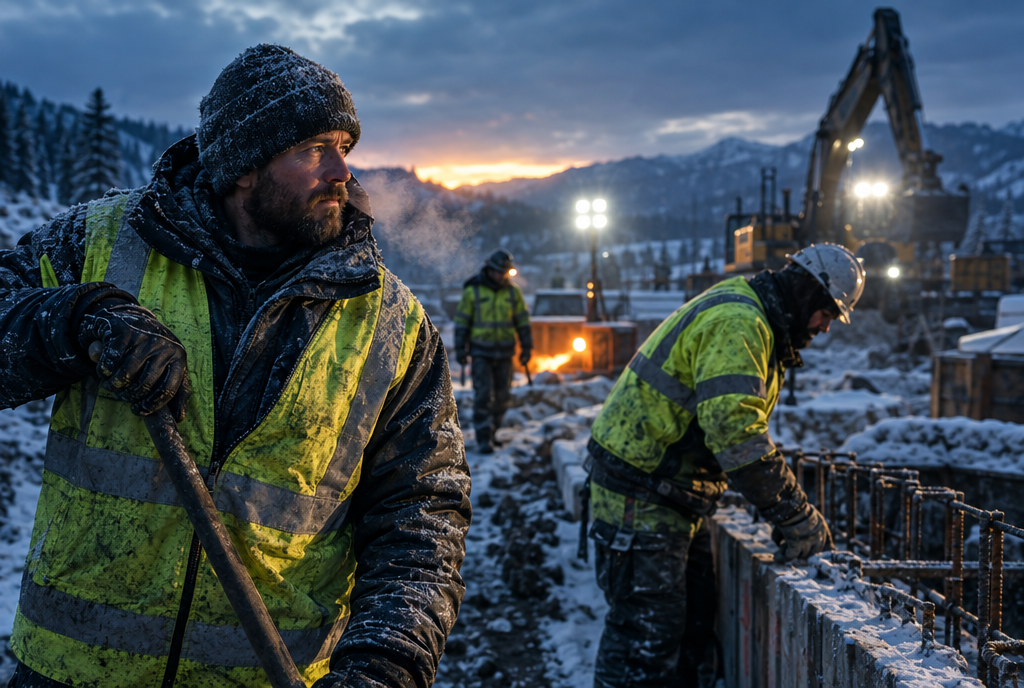
Cold stress happens when the body loses heat faster than it can replace it, cooling the skin, the hands and feet, and eventually the core. Low temperature, wind and wetness all drive it. In the United States OSHA has no specific cold standard, so employers manage the hazard under the General Duty Clause with engineering controls, warm-up breaks, training and suitable clothing.
What is cold stress?
OSHA describes cold stress as what happens when body heat is lost faster than it can be replaced during prolonged exposure to low temperatures. Skin and extremities cool first, which raises the risk of frostbite, and continued heat loss can lower core temperature and lead to hypothermia.
There is no single temperature that defines a cold environment. OSHA and NIOSH both note that what counts as extreme cold varies by region: in areas unaccustomed to winter weather, near-freezing temperatures are treated as a cold stress factor. Wind and wet clothing make any temperature more dangerous, which is why a damp 40°F job site can injure workers who would be comfortable on a dry, still day at the same temperature.
What does OSHA require for cold stress?
OSHA states that it does not have a specific standard for working in cold environments. Instead, Section 5(a)(1) of the Occupational Safety and Health Act, the General Duty Clause, requires employers to provide a workplace free from recognized hazards that are causing or likely to cause death or serious physical harm, and OSHA lists winter weather hazards among them.
The general personal protective equipment standard, 29 CFR 1910.132, still applies. It requires a hazard assessment and training, and it sets out who pays for PPE. It also contains an exception: ordinary clothing and items used solely for protection from weather, such as winter coats, gloves and parkas, do not have to be provided at no cost. Our article on OSHA cold stress guidance explains where that line sits and what it leaves open.
In Canada, occupational health and safety is set by each province and territory. The Canadian Centre for Occupational Health and Safety (CCOHS) publishes widely used guidance on cold environments, including control measures and the ACGIH work and warm-up schedule.
Which workers face the most cold stress risk?
CCOHS lists outdoor construction workers, linemen, emergency responders, transport workers, fishers, divers and refrigerated warehouse employees among the groups exposed to cold stress hazards. NIOSH adds workers in poorly insulated or unheated areas and those without access to shelter.
Individual factors matter too. OSHA identifies wetness, improper clothing, exhaustion, poor physical conditioning and predisposing health conditions such as hypertension, hypothyroidism and diabetes as risk factors. Workers with a health condition that affects how they tolerate cold should talk to a clinician about their symptoms and any limits that apply to them.
How does wind chill change the risk?
Wind strips away the thin layer of warm air next to the skin. The National Weather Service defines wind chill as how cold people feel outside, based on the rate of heat loss from exposed skin caused by wind and cold. Its example: at an air temperature of 0°F with a 15 mph wind, the wind chill is -19°F, cold enough for exposed skin to freeze in 30 minutes.
OSHA gives a milder example that still matters for planning: 40°F air with a 35 mph wind feels like 28°F. Crews working at height, on open decks or near moving vehicles and equipment often experience more wind than the forecast suggests, so supervisors should plan around wind chill rather than air temperature alone.
What are the warning signs of cold stress?
NIOSH groups cold-related illness into four main conditions. Early recognition is the most useful skill a crew can have, because the person affected often does not notice their own confusion or numbness. Our guide to cold stress symptoms and first aid covers each condition in detail, and a separate article explains how to tell frostbite, frostnip and chilblains apart.
| Condition | What it is | Early signs |
|---|---|---|
| Hypothermia | Core temperature below 95°F (35°C) | Shivering, fatigue, loss of coordination, confusion |
| Frostbite | Freezing of skin and underlying tissue | Numbness, tingling or stinging, pale or waxy skin |
| Trench foot | Non-freezing injury from wet, cold feet; possible at up to 60°F | Red skin, numbness, swelling, leg cramps |
| Chilblains | Inflammation from repeated exposure just above freezing to 60°F | Redness, itching, possible blistering |
How should employers build a cold stress program?
The most reliable programs work through the hierarchy of controls rather than relying on clothing alone. OSHA points to engineering controls such as radiant heaters at outdoor stations and shielding work areas from drafts and wind. CCOHS adds heated warming shelters and insulating metal handles on equipment used below freezing.
Administrative controls come next. NIOSH recommends scheduling cold work during warmer parts of the day, using relief workers on long jobs, providing warm areas and warm beverages, and monitoring workers with a buddy system. Work and warm-up schedules, such as the ACGIH schedule for a four-hour shift, turn those ideas into specific break intervals.
Training ties the program together. OSHA expects workers to learn how to recognize and prevent cold stress, how to self-monitor and watch coworkers, basic first aid and how to select proper clothing. NIOSH advises delivering that training in a language and vocabulary workers understand.
Assess the hazard: temperature, wind, wetness, duration and workload for each task
Engineer it down: heaters, windbreaks, warming shelters, insulated tool handles
Schedule it: warm-up breaks, relief workers, warmest hours for the coldest tasks
Protect the person: layered clothing, dry spares, suitable gloves and boots
Train and monitor: symptom recognition, buddy checks, clear first aid steps
What is different about freezers and cold storage?
Refrigerated and frozen warehouses create a year-round cold hazard with a distinctive pattern: repeated entries and exits, contact with cold surfaces, and heavy work that makes people sweat inside their insulation. Field studies of cold storage forklift operators have recorded frequent entries per shift and common complaints of cold, painful hands, which is why glove choice and warm-up access matter so much in these buildings.
Our articles on the health risks of working in a freezer and on what to wear in a freezer warehouse cover that environment specifically, including glove selection and how to manage moisture between cold and warm zones.
How should outdoor crews handle winter work?
Construction, utility and road crews face cold stress alongside other winter hazards that OSHA highlights: slips on ice, winter driving, strenuous snow removal, snow-covered skylights on roofs and downed power lines. Cold hands make every one of those tasks harder.
Our guide to winter work in utilities and construction covers layering under hard hats and harnesses, high-visibility compatibility and how to plan breaks when a job cannot simply stop.
How does cold affect dexterity and productivity?
CCOHS notes that the sensitivity and dexterity of the fingers fall in the cold, and that reduced muscle strength and stiff joints raise incident risk. A 2025 study in Physiological Reports found precipitous drops in manual dexterity when finger skin temperature fell to about 23°C, well before skin feels painfully cold.
The effect shows up in injury data as well. A nationwide Italian study of more than 2.2 million occupational injuries estimated roughly 6,000 injuries per year attributable to cold temperatures. Our article on cold and worker productivity reviews this research and what it means for planning.
What should a cold stress training session cover?
OSHA expects cold stress training to cover how to recognize the conditions that lead to cold stress, the symptoms of cold-related illness, prevention, first aid and how to select proper clothing. NIOSH adds that training should be delivered in a language and vocabulary workers understand, and that supervisors need the same training as crews.
The most useful sessions are practical. Walk through the site's warm-up schedule and where the warm areas are, show what a correctly layered outfit looks like for each job, practice the buddy check, and explain exactly who to call and what to do if someone shows signs of hypothermia or frostbite. Refresh the training before each cold season and after any cold injury.
Where do heated and thermal PPE fit?
Heated and thermal garments are one layer of a cold stress program, not a replacement for heaters, schedules or training. Battery-heated vests and gloves add active warmth, while passive options such as reflective linings and air-activated warmers add warmth without charging. HEATJAC, for example, makes low-profile thermal vests with interior pockets that accept air-activated warmers or battery heating inserts.
Before buying at scale, employers should check battery safety, washing instructions, sizing, dexterity, compatibility with high-visibility apparel and cost per shift. Our employer checklist for building a heated and thermal PPE program walks through each of those points, including how to run a pilot.
Key takeaways
Cold stress is driven by temperature, wind and wetness together; plan around wind chill, not air temperature alone.
OSHA has no specific cold standard, but the General Duty Clause and the PPE standard's assessment and training duties still apply.
Hypothermia, frostbite, trench foot and chilblains each have early signs that crews can learn to spot in each other.
Engineering controls and warm-up schedules come first; clothing and heated PPE complete the program.
Cold hands lose dexterity early, which affects both safety and output.
Frequently asked questions
At what temperature does OSHA say it is too cold to work?
OSHA does not set a minimum working temperature. Employers must address cold as a recognized hazard under the General Duty Clause. Many employers use the ACGIH work and warm-up schedule, which shortens work periods as temperature drops and wind rises, and ends with stopping non-emergency work in the most extreme conditions.
What are the four types of cold stress?
NIOSH lists hypothermia, frostbite, trench foot and chilblains. Hypothermia affects core temperature, while the other three are local injuries to the skin and extremities. Trench foot and chilblains can occur well above freezing.
Do employers have to provide winter clothing?
Under 29 CFR 1910.132, ordinary clothing used solely for protection from weather, such as winter coats, gloves and parkas, is excepted from the employer payment requirement. Employers still must assess the hazard, train workers and address cold under the General Duty Clause. Many choose to supply specialized cold gear anyway.
Is cold stress the same as hypothermia?
No. Cold stress is the broader condition of losing heat faster than the body can replace it. Hypothermia is one outcome, defined as a core temperature below 95°F, alongside local injuries such as frostbite and trench foot.
What should a worker do if a coworker shows signs of hypothermia?
NIOSH advises alerting a supervisor and requesting medical help, moving the person to a warm place, removing wet clothing and warming them. Give warm drinks only if the person is conscious, and never alcohol. Anyone with symptoms should be assessed by a clinician.
From HEATJAC
We design low-profile thermal garments: a heat-reflective vest and a thermal harness with pockets for warmers or cold packs.
Choosing gear? Cold storage and freezer gear by zone · Winter gear for construction and utility crews
Related reading
How to stay warm at a static post: security, checkpoints and traffic control
cold storage and freezer worker gear: a buyer's guide by zone
buying thermal gear for a team: an employer's bulk purchasing guide
Sources
Winter Weather: Preparedness, Occupational Safety and Health Administration
Cold Stress Guide, Occupational Safety and Health Administration
Cold-related Illnesses in Workers, CDC, National Institute for Occupational Safety and Health
29 CFR 1910.132, General requirements (Personal Protective Equipment), Electronic Code of Federal Regulations
Cold Environments: Overview, Canadian Centre for Occupational Health and Safety
Wind Chill Chart, National Weather Service
About HEATJAC. HEATJAC is a thermal architecture company founded by an anesthesiologist. We design patented garment systems that capture, conduct and broaden warmth across the body, and we publish this knowledge hub because the science of staying warm should be public. HEATJAC products are not medical devices and are not intended to diagnose, treat, cure or prevent any disease.