
How to stay warm at a static post: security, checkpoints and traffic control
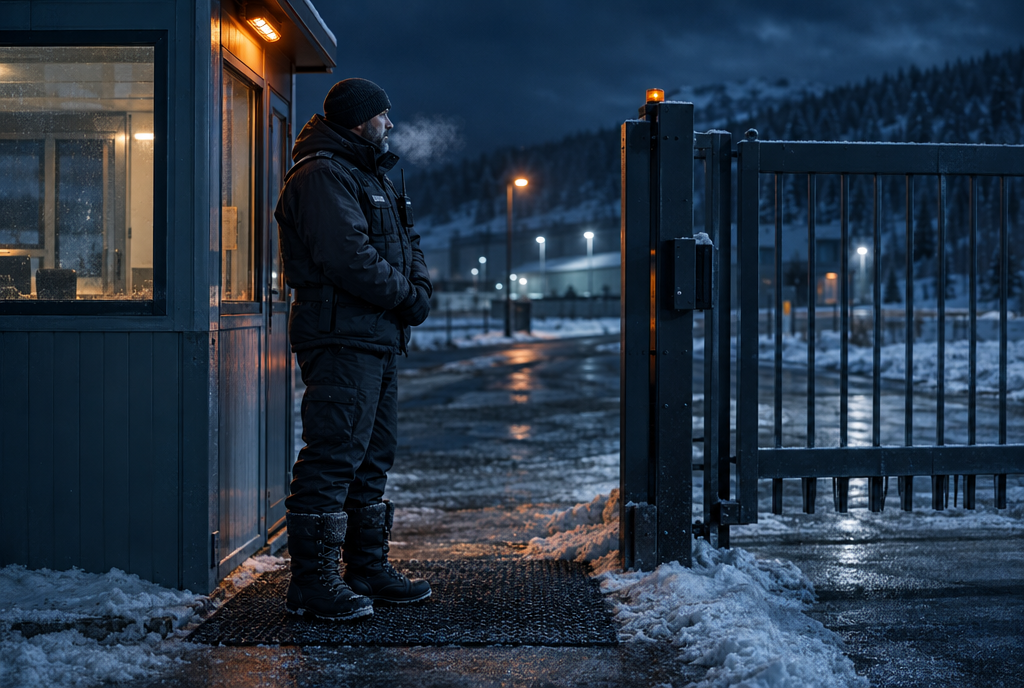
To stay warm standing outside all day, insulate yourself from the ground first with insulated boots and a mat, then block the wind with shelter or a windproof layer. Wear adjustable layers that fit under your uniform and duty gear, add a heat source if your post allows it, take scheduled warm-up breaks, and eat and drink warm, non-alcoholic fluids through the shift.
Why is standing still in the cold harder than moving?
Your body makes heat in proportion to how hard it works. The Compendium of Physical Activities rates standing quietly at about 1.3 METs, barely above sitting, while walking at a moderate pace is about 3.5 METs. A guard who patrols produces far more heat than one who holds a gate, even in the same clothes.
That gap is why static posts feel colder than the thermometer suggests. Clothing that is comfortable on a walk to the post can feel thin after an hour in place. CCOHS lists arrangements to minimize long periods of sitting and standing among its control measures for cold work, and planning for low heat production is the starting point for everything below.
How do you keep your feet warm when standing outside?
Feet lose heat by conduction into cold pavement, concrete or steel, and standing in one spot gives that contact no break. Insulated, waterproof boots are the core fix; NIOSH and OSHA both name them among basic cold-weather protection. Fit matters: boots that are tight over thick socks compress insulation and feel colder.
The second fix is putting something between you and the ground. A rubber anti-fatigue mat, an insulated standing pad or even a section of wood decking under the post reduces conductive loss and helps comfort over a long shift. Keep a dry pair of socks in a sealed bag, because damp socks cool quickly.
Step 1: Choose insulated, waterproof boots sized for your winter socks.
Step 2: Wear wool or synthetic socks, never cotton.
Step 3: Stand on an insulating mat or platform rather than bare concrete or metal.
Step 4: Shift weight and walk a few steps regularly if your post allows it.
Step 5: Change into dry socks at the first sign of dampness.
How much does wind and shelter matter at a post?
Wind strips warmth from exposed skin and pushes through loose clothing. The National Weather Service gives a clear example: at 0°F with a 15 mph wind, the wind chill is -19°F and exposed skin can freeze in 30 minutes.
OSHA advises employers to shield work areas from drafts or wind and notes that radiant heaters may be used to warm workplaces. At a checkpoint that can mean a booth, a windbreak panel or orienting the post out of the prevailing wind. When shelter is not possible, CCOHS recommends an easily removable windbreak garment.
How do you layer under a uniform and duty gear?
OSHA recommends at least three loose layers: a moisture-wicking base, an insulating middle layer and an outer layer that blocks wind and rain. At a static post, the challenge is fitting those layers under a uniform shirt, duty belt, radio harness or body armor carrier while keeping the required look and hi-vis on the outside.
Thin, close-fitting insulation at the torso works best, because it keeps the core warm without bulk at the arms and waist where gear sits. Cover the head, ears and neck with a liner or gaiter that fits under a uniform cap, and keep gloves thin enough to operate a radio or hand scanner. Traffic control staff should keep certified hi-vis as the outermost layer.
Should you use battery-heated or battery-free warmth at a static post?
Both are legitimate choices, and many officers combine them. Battery-heated vests, gloves and insoles give steady, adjustable heat and suit long, low-activity shifts. The tradeoff is power: Battery University notes that most lithium-ion batteries deliver about half their capacity at -4°F, and charging below freezing is not advised, so plan spare batteries and indoor charging.
Battery-free options, such as air-activated warmers, insulated vests and reflective linings, need no charging and have no electronics to manage, but most warmers are single-use and their heat output is not adjustable. HEATJAC CORE is one example of a hybrid, with pockets that accept either air-activated warmers or battery heating inserts.
| Option | Strengths at a static post | Tradeoffs |
|---|---|---|
| Battery-heated vest, gloves or insoles | Steady, adjustable heat for long, still shifts | Shorter runtime in deep cold; charging and spare batteries to manage |
| Air-activated warmers | No power needed; small and easy to carry | Single use; fixed heat; keep off bare skin per instructions |
| Insulated or reflective vest | No power; thin under a uniform | Retains heat but adds none of its own |
| Insulating mat or booth | Cuts conductive and wind loss for everyone at the post | Depends on employer setup |
How often should you take warm-up breaks, and what should you eat and drink?
Warm-up breaks matter more at a static post because you cannot generate much heat on the job. CCOHS says heated warming shelters should be available nearby and used at regular intervals, and our guide to work and warm-up schedules explains how break frequency changes with temperature and wind. Relief officers make this practical.
OSHA recommends providing warm liquids with no alcohol. CCOHS suggests warm non-alcoholic drinks or soup, advises limiting caffeinated drinks because they increase urine production, and warns that alcohol produces a deceptive feeling of warmth. Regular meals and snacks give the body fuel to make heat.
How do you recognize cold stress on a post?
NIOSH lists shivering, fatigue, loss of coordination and confusion as early hypothermia signs, and numbness, tingling, aching and pale, waxy skin as frostbite signs. Wet feet with redness, numbness, swelling or cramps can signal trench foot. Solo posts make this harder, so check in by radio on a schedule and use a buddy system where possible.
If someone shows these signs, alert a supervisor, request medical assistance and move them to a warm shelter. Anyone with lingering numbness, color changes or pain after cold exposure should talk to a clinician.
What are employers responsible for?
OSHA expects employers to train workers on cold stress symptoms, prevention, first aid and clothing selection, to provide warm break areas and warm liquids, to limit time outdoors on extremely cold days and to monitor workers at risk. For static posts, that translates into booths or windbreaks, insulating mats, scheduled relief and a clear policy on which heated or thermal layers fit the uniform.
Key takeaways
Standing still produces little body heat, so a static post needs more insulation than a patrol route.
Insulate from the ground first: insulated, waterproof boots plus a mat or platform.
Block wind with a booth, windbreak or windproof layer that fits under the uniform.
Battery-heated and battery-free warmth both work; weigh runtime and charging against no-power simplicity.
Schedule warm-up breaks with relief staff and watch for early signs of cold stress.
Frequently asked questions
How do security guards stay warm standing outside?
Most combine insulated boots, a mat or booth to cut ground and wind exposure, thin layers under the uniform and a heat source such as warmers or a heated vest. Scheduled relief so they can warm up indoors is just as important.
Why do my feet get cold first when standing outside?
Standing on cold ground conducts heat away from your feet continuously, and feet are far from the warm core. Insulated boots, dry wool or synthetic socks and an insulating mat underfoot make the biggest difference.
Are heated vests allowed under a security uniform?
That depends on the employer's uniform and equipment policy. Thin heated or insulated vests often fit under a uniform shirt, but check fit with the duty belt, radio and any body armor, and follow company rules on batteries.
Do hand warmers work in boots?
Toe warmers designed for footwear can add warmth, but follow the package directions on placement and keep them off bare skin. Boots that are too tight with a warmer inside can restrict circulation and feel colder.
Does drinking coffee help you stay warm outside?
A warm drink is comforting, but CCOHS advises limiting caffeinated drinks because they increase urine production. Warm water, soup or other non-alcoholic, low-caffeine drinks are better choices, and alcohol should be avoided.
From HEATJAC
We design low-profile thermal garments: a heat-reflective vest and a thermal harness with pockets for warmers or cold packs.
Choosing gear? Cold storage and freezer gear by zone · Winter gear for construction and utility crews
Related reading
Sources
Winter Weather: Preparedness, Occupational Safety and Health Administration
Cold Stress: Cold-Related Illnesses, National Institute for Occupational Safety and Health (CDC)
Cold Environments: Working in the Cold, Canadian Centre for Occupational Health and Safety
2011 Compendium of Physical Activities (supplemental activity table), Medicine and Science in Sports and Exercise
Wind Chill Chart, National Weather Service
BU-502: Discharging at High and Low Temperatures, Battery University
About HEATJAC. HEATJAC is a thermal architecture company founded by an anesthesiologist. We design patented garment systems that capture, conduct and broaden warmth across the body, and we publish this knowledge hub because the science of staying warm should be public. HEATJAC products are not medical devices and are not intended to diagnose, treat, cure or prevent any disease.