
Winter gear for construction and utility crews: what to buy
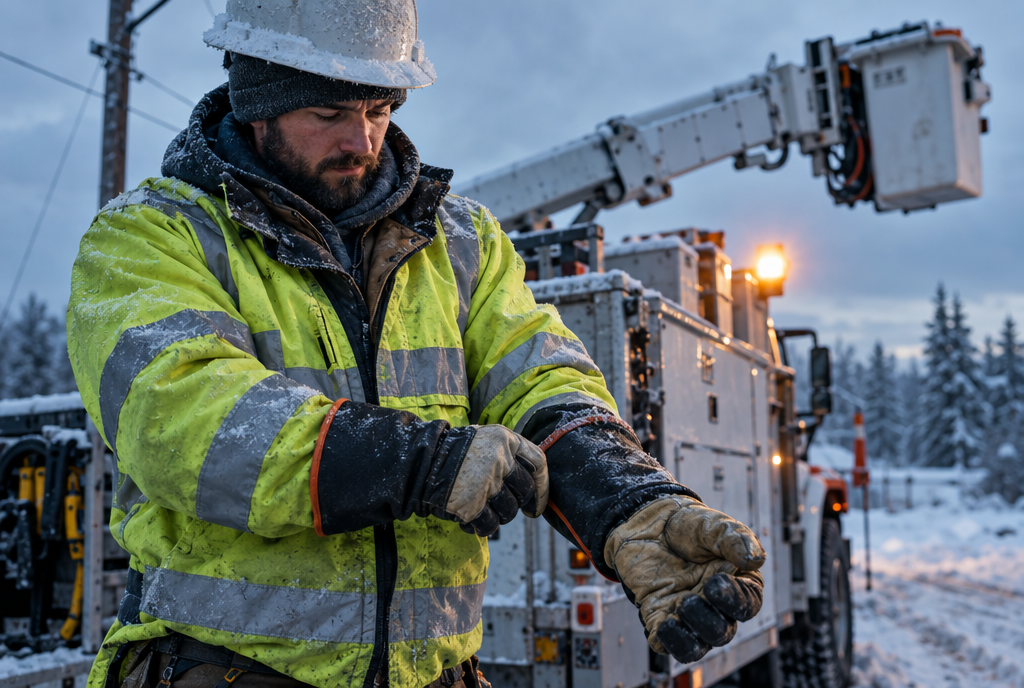
Buy winter work gear around the rules your outer layer must meet. Hi-vis stays outermost wherever traffic or equipment is present. Where arc flash is a hazard, every layer must be non-melting and the outer layer arc-rated. Within those limits, choose thin core warmth that fits under a harness, gloves matched to each task, and batteries you can charge somewhere warm.
Which rules decide what winter layers you can wear?
Two sets of rules shape most purchases. For visibility, the federal Manual on Uniform Traffic Control Devices requires workers in the right-of-way who are exposed to traffic or construction equipment to wear high-visibility apparel meeting Performance Class 2 or 3 of ANSI/ISEA 107. A warm jacket worn over a hi-vis vest defeats it, so buy jackets that are themselves certified hi-vis, or hi-vis sized to go over winter layers. Our winter work guide covers the site hazards; this page covers buying.
For electrical work, OSHA's standard for power generation, transmission and distribution, 29 CFR 1910.269, requires employers to ensure that workers exposed to flames or electric arcs do not wear clothing that could melt onto the skin or ignite and keep burning. Its note lists acetate, nylon, polyester, rayon and polypropylene as fabrics to avoid unless the hazard is eliminated. The outer layer must be flame-resistant in defined cases, including when incident heat energy exceeds 2.0 cal/cm², and arc-rated protection must equal or exceed the estimated heat energy.
What should utility workers wear under FR clothing in winter?
NFPA 70E, as summarized by electrical safety consultants, states that meltable fibers such as acetate, nylon, polyester, polypropylene and spandex are not permitted in fabric underlayers. That rules out most synthetic performance base layers, which are exactly what many workers reach for in cold weather. Choose non-melting fibers such as cotton, or base layers sold as flame-resistant, and read the fiber content on every tag.
ASTM F1506 is the performance specification for flame-resistant and arc-rated protective clothing, and it applies to the finished garment. When a winter jacket is the outer layer during electrical work, it needs an arc rating at or above the hazard for that task.
Heated garments deserve the same scrutiny. Many use synthetic shells and liners, so check fiber content and whether the maker lists an arc rating before one goes into an arc-exposed layer system.
Which winter setup fits your crew?
Match the purchase to the rule that binds the job, then to the activity level.
| If your crew... | Buy | Avoid |
|---|---|---|
| Works near traffic with no arc exposure | Insulated jacket that is certified hi-vis, or hi-vis sized over layers | A hi-vis vest worn under a jacket |
| Works on or near energized lines | Arc-rated outer layers at or above the hazard, non-melting underlayers | Polyester or polypropylene base layers, unrated heated vests |
| Climbs or wears fall protection | Thin core layers and vests rather than bulky jackets | Thick layers under leg and shoulder straps |
| Operates equipment or flags with little movement | Heated or passive core warmth, insulated boots | Relying on one heavy coat |
| Needs fine finger work | Liner glove plus a removable insulated shell or mitt | One heavy glove for every task |
Heated or passive under a harness?
Heated vests give adjustable warmth to people who stand still for long periods, such as operators and flaggers. Under a harness, check where the battery pocket, cable and controller sit, and keep them clear of webbing, buckles and the tool belt. Passive layers, such as insulated or heat-reflective vests, have nothing to charge or route, which is simpler for climbers and bucket work.
Either way, fit and inspect the harness over the full winter layer system, and readjust it whenever layers come off. Thin core layers change harness fit less than bulky jackets.
On cost, OSHA's 2007 payment rule says ordinary weather clothing such as winter coats, gloves and hats need not be employer-paid, but special equipment for unusually severe conditions must be. The exception covers ordinary clothing only, so confirm with your safety office how the rule applies to arc-rated and other required protective clothing.
Which gloves keep dexterity in the cold?
No single glove handles every winter task. A thin liner keeps fingers working for fasteners and meters, and an insulated shell or mitt goes over it between tasks. Carry a dry spare pair in a sealed bag, since damp gloves lose warmth fast.
For energized work, rubber insulating gloves and their protectors follow their own electrical rules, so any liner must be one your electrical safety program allows. Heated gloves add warmth but put battery bulk at the cuff, which can snag on gauntlets and sleeves; see our comparison of heated gloves, liners and mittens.
How should crews care for batteries on site?
OSHA's bulletin on wearable lithium battery devices advises batteries and chargers tested to an appropriate standard such as UL 2054, removing batteries from the charger once full, storing them in dry, cool places, and inspecting for bulging, cracking, hissing, leaking, rising temperature or smoking before use. Damaged units come out of service at once.
Cold changes charging. Battery University notes that lithium-ion cells should not be charged below freezing, because metallic lithium can plate on the anode and permanently degrade performance and safety, and gives 5°C to 45°C (41°F to 113°F) as the fast-charge range. Charge in a heated cab or trailer, and carry spares inside a jacket. Our article on batteries in extreme cold goes further.
Numbness, color changes in fingers or toes, or confusion after cold exposure should be reported at once; talk to a clinician about symptoms that persist.
Where HEATJAC fits
HEATJAC CORE is a low-profile thermal harness platform with integrated heat-reflective thermal inserts and pockets for supplemental warming elements such as air-activated warmers (sold separately). It is passive, with nothing to charge, and can sit under a hi-vis outer layer for general construction work. HEATJAC does not list an arc rating for CORE, so it is not an option for layer systems that must be arc-rated or non-melting.
Key takeaways
Hi-vis stays outermost; buy jackets that are certified hi-vis or hi-vis that fits over layers.
Where arc flash is a hazard, underlayers must be non-melting and outer layers arc-rated.
Thin core warmth changes harness fit less than bulky jackets; refit the harness over winter layers.
Charge lithium-ion batteries somewhere warm and retire any that look or feel damaged.
Frequently asked questions
Can I wear a regular base layer under FR clothing?
Not if it contains meltable fibers. NFPA 70E does not permit fibers such as polyester, nylon, polypropylene and spandex in underlayers where arc-rated clothing is required. Cotton or flame-resistant base layers are the usual choices.
Can I wear a heated vest under a harness?
Often yes, if the battery pocket, cable and controller stay clear of the webbing and buckles. Fit and inspect the harness over the full layer system, and readjust when layers come off.
Can I wear a jacket over my hi-vis vest?
Not in a traffic work zone if it covers the vest. The hi-vis garment must stay visible, so choose a jacket that is itself certified hi-vis or a hi-vis garment sized to go over it.
Does my employer have to pay for winter gear?
OSHA does not require employers to pay for ordinary weather clothing such as winter coats, gloves and hats. Special gear for unusually severe conditions is different, and required protective clothing should be checked with your safety office.
Why won't my heated gear battery charge in the truck?
Many lithium-ion chargers and packs block charging when the cells are too cold, because charging below freezing can damage them. Warm the battery in a heated space before charging.
Related reading
Sources
29 CFR 1910.269, Electric Power Generation, Transmission, and Distribution, Electronic Code of Federal Regulations
Selection of Appropriate PPE, Part 2: Arc-Rated Daily Wear (NFPA 70E underlayer rule), Rozel / 70E Consultants
Manual on Uniform Traffic Control Devices, Part 6D: Pedestrian and Worker Safety, Federal Highway Administration
Employer Payment for Personal Protective Equipment; Final Rule (2007), Occupational Safety and Health Administration
Preventing Fire and/or Explosion Injury from Small and Wearable Lithium Battery Powered Devices (SHIB 06-20-2019), Occupational Safety and Health Administration
BU-410: Charging at High and Low Temperatures, Battery University
About HEATJAC. HEATJAC is a thermal architecture company founded by an anesthesiologist. We design patented garment systems that capture, conduct and broaden warmth across the body, and we publish this knowledge hub because the science of staying warm should be public. HEATJAC products are not medical devices and are not intended to diagnose, treat, cure or prevent any disease.