
Staying warm on a crossing guard or traffic control post
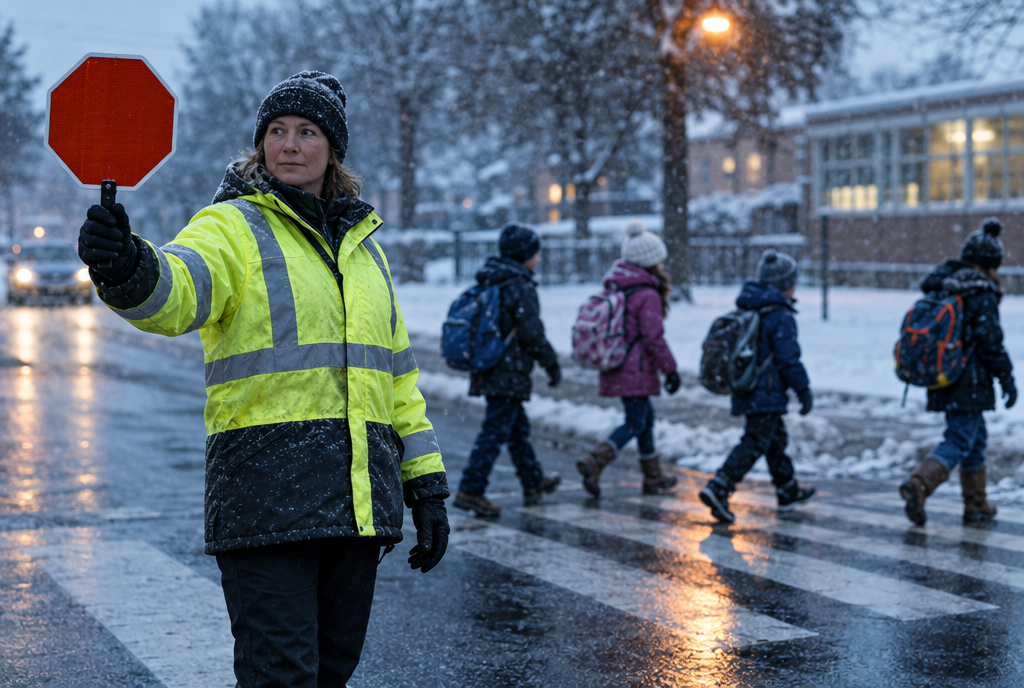
For crossing guard duty in winter, wear a thin wicking base layer, an insulating mid layer and a windproof coat, then put a correctly sized high-visibility garment on top so nothing covers it. Add a hat that covers the ears, gloves that still grip a stop paddle, and insulated waterproof boots, and step off the post to warm up when you can.
Why do crossing guards and traffic posts get so cold?
These jobs combine two things the body handles badly: standing still and standing exposed. A crossing guard holds a curb or crosswalk in the same spot for the whole rush, often at the coldest time of the morning. Parking enforcement and traffic control staff spend long stretches on sidewalks and road edges with little shelter from wind.
Standing still produces little body heat, so clothing has to do more of the work. CCOHS lists arrangements to minimize long periods of standing among its measures for cold work. When the post cannot move, the plan has to cover wind, feet and warm-up time instead.
What should a crossing guard wear in winter?
Layering is the core of any cold-weather uniform. NIOSH recommends several layers of loose clothing because layers insulate better and can be removed before you overheat. CCOHS adds that the outer layer should be waterproof when it is wet out and windproof where wind is a factor, and that jackets should close at the waist, neck and wrists to hold heat in.
On a static post, sweat is less of a problem than on a walking beat, so you can dress warmer. Parking enforcement officers who walk long beats face the opposite pattern and should favor thinner layers they can vent. Either way, avoid cotton next to the skin; CCOHS warns that damp clothing next to the body loses much of its insulation.
Step 1: Thin wicking base layer top and bottom.
Step 2: Fleece or synthetic insulating mid layer, plus insulated pants or liners for the legs.
Step 3: Windproof, waterproof coat that closes at the neck, wrists and waist.
Step 4: High-visibility garment on the outside, sized to fit over the coat.
Step 5: Hat covering the ears, neck gaiter, gloves and insulated boots.
How do you layer under a hi-vis vest and stay compliant?
Visibility is the rule that cannot bend. The federal MUTCD (2009 edition, Section 7D.04) requires law enforcement officers doing school crossing supervision and adult crossing guards to wear high-visibility retroreflective apparel meeting ANSI 107 Performance Class 2. States adopt their own editions, so check which version your agency follows.
ANSI/ISEA 107 sets requirements for background and retroreflective material that make workers visible by day and at night. The International Safety Equipment Association describes Type R garments for roadway workers exposed to traffic, in Class 2 or 3, and Type P for public safety. In practice, that means the certified garment goes on last. A vest sized for summer shirts will not close over a winter coat, so order a larger size for winter or use a hi-vis winter jacket that is itself labeled to the standard. Never wear a scarf, backpack or unzipped coat flap over the reflective bands.
How do you keep your feet warm on cold pavement?
Feet sit on concrete and asphalt for the entire shift, and cold ground draws heat through the soles. NIOSH advises waterproof, insulated boots in good condition, because cracks and tears let in water and cold. Choose boots with room for thick wool or synthetic socks, since boots that pinch compress the insulation.
Wet feet are the bigger risk on slushy corners. NIOSH notes trench foot can occur at temperatures as high as 60°F when feet stay wet, so keep a dry pair of socks in a bag and change at the first sign of dampness. Shifting weight and walking a few steps between crossings helps keep feet from going numb.
How much does wind matter at a traffic post?
Wind multiplies the cold on an open corner. The National Weather Service gives the example that at 0°F with a 15 mph wind, the wind chill is minus 19°F and exposed skin can freeze in 30 minutes. Check the wind chill, not just the temperature, before a shift.
Cover the face and ears on windy days. CCOHS recommends a hat that keeps the ears warm and eyewear that protects against glare from snow and blowing ice crystals, with face coverings kept clear of glasses so they do not fog.
How do you keep hands warm while holding a stop paddle?
Holding a paddle or signaling traffic leaves hands raised and exposed. CCOHS guidance is that where fine dexterity is not needed, gloves should be worn below 4°C (39°F) for light work and mittens below minus 17°C (about 1°F). A practical approach is an insulated glove or mitten on the paddle hand, switching hands between crossings. Choose light-colored or hi-vis gloves if your agency uses hand signals.
What are the warning signs of cold stress, and when should you get help?
Agencies should plan warm-up breaks in a vehicle or building and a way to reach a supervisor. If you warm up in an idling vehicle, keep the exhaust clear of snow and never idle in a garage. Watch for the NIOSH warning signs below in yourself and coworkers. Talk to a clinician about numbness, skin color changes or pain that persists after you warm up.
| Warning sign | Possible problem | What to do |
|---|---|---|
| Shivering, fatigue, loss of coordination, confusion | Early hypothermia | Leave the post, get warm and dry, alert a supervisor |
| No shivering, blue skin, slowed breathing, loss of consciousness | Severe hypothermia | Call 911 or emergency services now |
| Numbness, tingling, pale or waxy skin on fingers, ears, face | Frostbite | Get indoors, warm gently, do not rub, seek medical care |
| Red, swollen, numb feet after wet shoes | Trench foot | Remove wet boots and socks, dry feet, seek medical care |
Key takeaways
Layer under the uniform; the certified high-visibility garment always goes on top.
Size winter vests to fit over a coat, or use a hi-vis winter jacket labeled to ANSI/ISEA 107.
Insulated, waterproof boots and dry socks matter most on cold pavement.
Check wind chill before the shift and cover ears and face on windy days.
Know the signs of hypothermia and frostbite and step off the post to warm up.
Frequently asked questions
Can a crossing guard wear a winter coat over the safety vest?
No. The high-visibility garment must stay visible, so it goes over the coat. Order a larger vest for winter or use a hi-vis winter jacket that is labeled to the ANSI/ISEA 107 class your agency requires.
What class of hi-vis vest do crossing guards need?
The 2009 federal MUTCD requires adult crossing guards to wear ANSI 107 Performance Class 2 apparel. States and agencies may adopt later editions or stricter rules, so confirm the requirement with your employer.
How do crossing guards keep their feet warm?
Waterproof, insulated boots with room for thick wool or synthetic socks do most of the work. Keep a spare pair of socks, change them if they get damp, and move your feet between crossings.
How do parking enforcement officers stay warm on a walking beat?
Walking makes heat, so thinner adjustable layers with a vented outer shell work better than one heavy coat. Keep hi-vis on top, carry spare gloves, and warm up in a vehicle or building between blocks when conditions are severe.
Is there a temperature when crossing guards should stop working?
There is no single federal cutoff. Agencies set their own policies, and wind chill matters as much as air temperature. If you notice signs of cold stress, leave the post and warm up.
From HEATJAC
We design low-profile thermal garments: a heat-reflective vest and a thermal harness with pockets for warmers or cold packs.
Choosing gear? Cold storage and freezer gear by zone · Winter gear for construction and utility crews
Related reading
Sources
MUTCD 2009 Edition, Part 7, Chapter 7D: Crossing Supervision, Federal Highway Administration
FHWA Accepts Revised ANSI/ISEA 107 Standard for High-Visibility Safety Apparel in Workzones, International Safety Equipment Association
Cold Environments: Working in the Cold, Canadian Centre for Occupational Health and Safety
Cold Weather PPE (NIOSH Science Blog), CDC / NIOSH
Cold Stress: Related Illnesses, CDC / NIOSH
Wind Chill Chart, National Weather Service
About HEATJAC. HEATJAC is a thermal architecture company founded by an anesthesiologist. We design patented garment systems that capture, conduct and broaden warmth across the body, and we publish this knowledge hub because the science of staying warm should be public. HEATJAC products are not medical devices and are not intended to diagnose, treat, cure or prevent any disease.