
What OSHA says about cold stress (and what it does not)
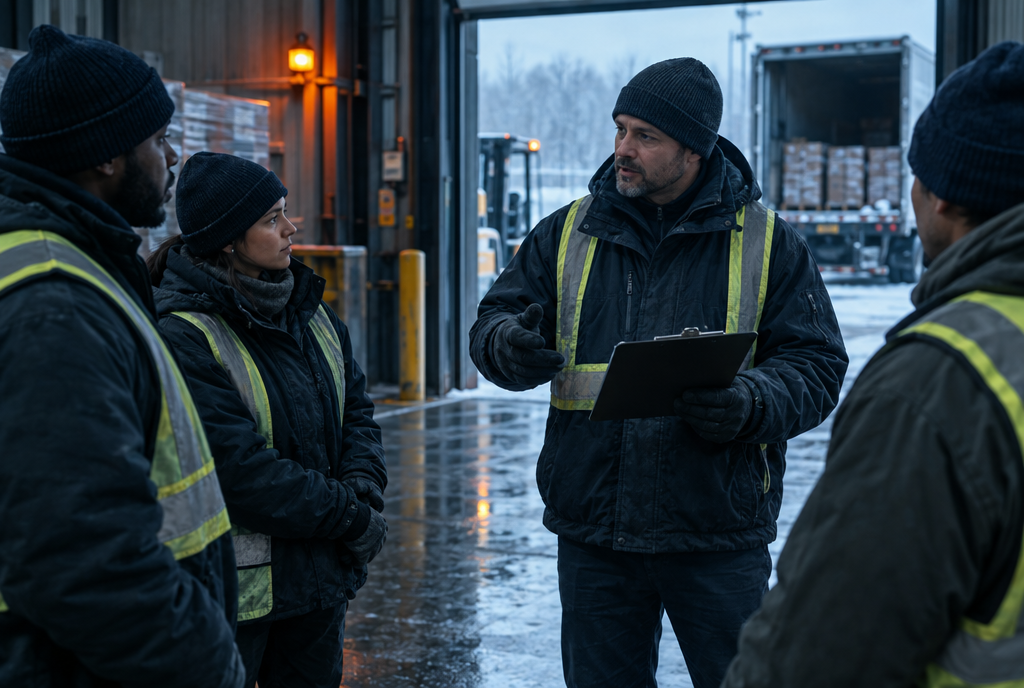
OSHA has no specific standard for cold stress and sets no minimum working temperature. Employers are covered by the General Duty Clause, Section 5(a)(1) of the OSH Act, which requires a workplace free from recognized hazards likely to cause death or serious harm, including cold. The PPE standard's hazard assessment and training duties also apply, while ordinary winter clothing is excepted from employer payment.
Does OSHA have a cold stress standard?
No. OSHA says plainly that it does not have a specific standard that covers working in cold environments. There is no federal rule that names a temperature at which work must stop, a required number of warm-up breaks, or a mandatory list of cold weather clothing.
That gap is often misread as the absence of any obligation. It is not. OSHA's own winter weather guidance states that employers have a responsibility to protect workers from recognized hazards, including winter weather related hazards, that are causing or are likely to cause death or serious physical harm.
How does the General Duty Clause apply to cold work?
Section 5(a)(1) of the Occupational Safety and Health Act of 1970, known as the General Duty Clause, is how OSHA reaches hazards that have no dedicated standard. OSHA has long explained in its interpretations that general duty provisions are used in inspections where no specific standard applies to the hazard involved.
For cold, the practical test is whether the hazard was recognized, whether it was likely to cause serious harm, and whether feasible means existed to reduce it. Because OSHA, NIOSH and industry groups publish extensive cold stress guidance, a cold hazard on a job site is rarely one an employer could credibly call unrecognized.
OSHA State Plans can adopt their own rules, so employers in state-plan states should check whether additional requirements apply locally.
What does the OSHA PPE standard say about cold weather clothing?
The general PPE standard, 29 CFR 1910.132, applies across general industry. Paragraph (d) requires employers to assess the workplace for hazards that call for PPE, select appropriate equipment, communicate the selection to affected employees and ensure proper fit. Paragraph (f) requires training on when PPE is necessary, what is needed, how to put it on and take it off, its limitations, and its care.
Paragraph (h) covers payment. Employers must generally provide required PPE at no cost to employees, but paragraph (h)(4)(iii) excepts ordinary clothing, skin creams or other items used solely for protection from weather, such as winter coats, jackets, gloves, parkas, rubber boots, hats and raincoats.
That exception is narrow. It addresses who pays for ordinary weather gear, not whether the cold hazard must be managed. Specialized items selected through a hazard assessment to protect against a workplace hazard are a separate question, and employers who are unsure how the exception applies to a particular garment should seek a formal interpretation or legal advice.
| Question | What OSHA provides | Where it comes from |
|---|---|---|
| Is there a cold stress standard? | No specific standard | OSHA Winter Weather guidance |
| Is cold a hazard employers must address? | Yes, as a recognized hazard | General Duty Clause, Section 5(a)(1) |
| Must PPE needs be assessed? | Yes | 29 CFR 1910.132(d) |
| Must workers be trained on PPE? | Yes | 29 CFR 1910.132(f) |
| Must employers pay for ordinary winter coats and gloves? | No, excepted from payment | 29 CFR 1910.132(h)(4)(iii) |
| Is there a minimum work temperature? | No | Not set by any OSHA rule |
What does OSHA's cold stress guidance recommend?
OSHA's Cold Stress Guide and its laminated Quick Card set out what the agency expects a reasonable program to include. Training comes first: workers should learn to recognize conditions that lead to cold stress, the symptoms of cold-related illness, how to prevent it, basic first aid and how to select proper clothing.
On controls, OSHA points to radiant heaters for outdoor stations and shielding work areas from drafts and wind. On clothing, it recommends three layers: an inner layer of wool, silk or synthetic fabric to keep moisture away from the body, a middle insulating layer, and an outer layer that blocks wind and rain while allowing some ventilation. It also recommends hats, insulated gloves, waterproof boots, frequent breaks in warm areas, a buddy system and avoiding alcohol.
Train workers on symptoms, prevention, first aid and clothing
Use engineering controls such as radiant heaters and windbreaks
Schedule frequent breaks in warm, dry areas
Pair workers so each can watch the other for early signs
Recommend three clothing layers plus head, hand and foot protection
What does OSHA not tell you?
OSHA's guidance is qualitative. It does not give a numeric work and warm-up schedule, a wind chill at which outdoor work should stop, or performance specifications for cold weather garments. Employers typically fill those gaps with the ACGIH Threshold Limit Value for cold stress, which includes a work and warm-up schedule for a four-hour shift, and with manufacturer data for clothing and heated PPE.
OSHA also does not address heated clothing directly. Battery-powered garments fall under general guidance on lithium batteries, which OSHA covered in a 2019 safety and health information bulletin on small and wearable devices.
Individual health is another area the guidance leaves to others. OSHA notes that conditions such as hypertension, hypothyroidism and diabetes raise risk, but it does not tell employers how to accommodate them. Workers with a health condition affected by cold should talk to a clinician about their symptoms.
How should employers turn OSHA guidance into a program?
A defensible approach is to document the hazard assessment for each cold task, record the controls chosen and the reasons, adopt a written warm-up schedule, train supervisors and crews, and review incidents and near misses each season. That record shows the hazard was recognized and that feasible controls were used.
Canadian employers work under provincial and territorial rules rather than OSHA, but the same structure applies, and CCOHS guidance on cold environments is a useful companion to OSHA's materials on either side of the border.
Key takeaways
OSHA has no specific cold stress standard and no minimum working temperature.
Cold is still a recognized hazard under the General Duty Clause, and the PPE standard's assessment and training duties apply.
Ordinary weather clothing is excepted from the employer payment rule, but the hazard itself is not excepted.
OSHA guidance is qualitative; most employers add the ACGIH warm-up schedule for specific break intervals.
Frequently asked questions
Is there an OSHA temperature limit for working outside in winter?
No. OSHA has not set a minimum temperature for outdoor or indoor work. Employers must address the cold hazard under the General Duty Clause and often adopt the ACGIH work and warm-up schedule to decide when to shorten work periods or stop non-emergency work.
What is the OSHA cold stress quick card?
It is a short OSHA publication (OSHA 3156) that summarizes how cold stress happens, the signs of hypothermia, frostbite and trench foot, first aid, and prevention steps. It is designed to be posted or carried on site.
Can OSHA cite an employer for cold stress?
Yes. Where no specific standard applies, OSHA can use the General Duty Clause if a recognized hazard likely to cause death or serious harm existed and feasible means to reduce it were available. Violations of the PPE standard's assessment or training requirements can also be cited.
Do employers have to pay for heated jackets?
The PPE standard excepts ordinary clothing used solely for protection from weather, such as winter coats and gloves, from the payment requirement. Whether a specialized heated or insulated garment falls inside that exception depends on why it was selected. Employers should confirm with counsel or an OSHA interpretation.
From HEATJAC
We design low-profile thermal garments: a heat-reflective vest and a thermal harness with pockets for warmers or cold packs.
Choosing gear? Cold storage and freezer gear by zone · Winter gear for construction and utility crews
Related reading
Sources
Winter Weather: Preparedness, Occupational Safety and Health Administration
Cold Stress Guide, Occupational Safety and Health Administration
Protecting Workers from Cold Stress (Quick Card, OSHA 3156), Occupational Safety and Health Administration
29 CFR 1910.132, General requirements (Personal Protective Equipment), Electronic Code of Federal Regulations
General duty provisions are used in inspection only where there are no specific standards applicable to the particular hazard involved, Occupational Safety and Health Administration
Preventing Fire and/or Explosion Injury from Small and Wearable Lithium Battery Powered Devices (SHIB 06-20-2019), Occupational Safety and Health Administration
About HEATJAC. HEATJAC is a thermal architecture company founded by an anesthesiologist. We design patented garment systems that capture, conduct and broaden warmth across the body, and we publish this knowledge hub because the science of staying warm should be public. HEATJAC products are not medical devices and are not intended to diagnose, treat, cure or prevent any disease.