
Firefighting in winter: cold, wet gear and rehab
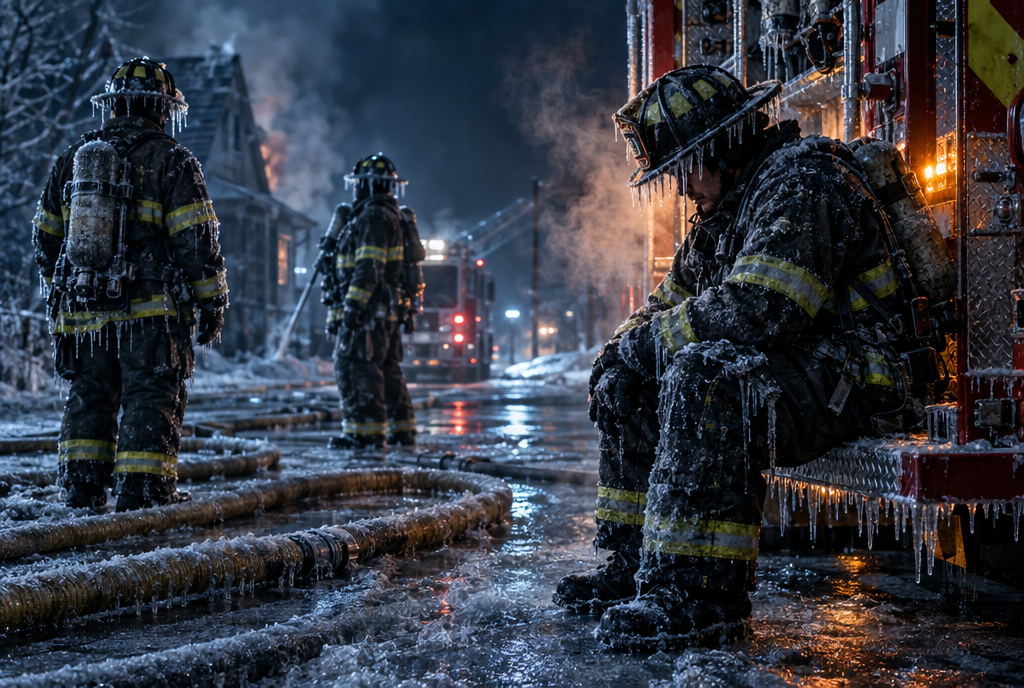
Winter fires combine two opposite threats. Interior work soaks crews in sweat inside heavy turnout gear, then exterior work, water spray and wind chill them fast. Safe cold weather operations rely on early crew rotation, a heated and sheltered rehab area with dry layers and warm fluids, medical monitoring as NFPA 1584 describes, and constant attention to ice underfoot.
Why are winter fires so hard on firefighters?
Everything on a winter fireground works against the crew at once. Turnout gear is built to hold heat out, so interior attack produces heavy sweating inside it. When a firefighter steps outside, that moisture sits against the body while wind, overspray and low air temperatures pull heat away.
Long defensive operations make it worse. Exterior crews may stand for hours on master streams or supply lines, generating little body heat while spray freezes on helmets, coats and hose. Fire Engineering notes that hoselines will freeze if they do not keep flowing, and that flowing water creates a slip-and-fall hazard. The same article describes hose frozen into rigid pipe that had to be hauled away on flatbed trucks.
Can firefighters face heat stress and cold stress at the same incident?
Yes, and often within minutes. A firefighter can finish an interior assignment overheated and dehydrated, then cool rapidly in rehab or on an exterior line while still wearing damp layers. Cold-related risks for crews include chilblains, trench foot, frostbite and hypothermia, which StatPearls defines as a core body temperature below 35 °C (95 °F).
Moisture inside gear also matters for protection, not only comfort. A modeling study in Fire Safety Journal found that water in the outer shell tended to lengthen time to a second-degree burn, while water in the inner thermal layer could reduce protection at high heat exposures, with the resulting burns largely scald-type. Wet gear is not simply colder gear; it behaves differently near fire.
Cold weather does not remove the need for fluids. Crews still lose water through sweat under gear and through breathing, even when they do not feel thirsty.
How should firefighter rehab work in cold weather?
NFPA 1584 frames rehab around relief from climate conditions, rest and recovery, rehydration, calorie replacement and medical monitoring, including active or passive warming when conditions call for it. JEMS notes that for cold operations this means wind shelter, warm fluids, extra calories and a way to thaw gear. StatPearls reports that the US Fire Administration recommends setting up rehab when the wind chill index is below 10 °F.
The Fire Corps rehab guide, produced with FEMA funding, describes the ideal cold weather rehab area as dry, protected and heated, with dry clothing available and beverages served lukewarm or warm. A heated apparatus cab, transit bus or nearby building often serves better than an open-air canopy.
Pull crews to rehab early and on a set rotation, before they are chilled or exhausted.
Get firefighters out of wet station layers and into dry ones inside the shelter.
Remove coats and hoods in the warm area so trapped sweat can escape, then re-dress in dry layers before returning.
Offer warm fluids and food; cold does not reduce fluid needs after heavy exertion.
Keep rehab out of wind and away from runoff and ice.
When does NFPA 1584 call for rehab and medical monitoring?
StatPearls summarizes NFPA 1584 triggers as use of a second 30- or 45-minute SCBA cylinder, a single 60-minute cylinder, or 40 minutes of intense work without SCBA. It cites a minimum of 10 minutes of rest for initial rehab, and at least 20 minutes after those triggers. Local SOPs may set longer periods, so follow your department's policy.
Medical monitoring checks temperature, heart rate, respiratory rate, blood pressure, oxygen saturation, and carboxyhemoglobin where smoke exposure is possible. In winter, rehab staff should also look for shivering, numb or pale fingers and toes, slurred speech and clumsiness. Anyone with symptoms of a cold injury, or who feels unwell after an incident, should talk to a clinician.
How do you manage ice and footing on a winter fireground?
Ice forms wherever runoff and overspray settle: around hydrants, under ladders, along supply lines and on apparatus steps. Treat footing as an ongoing hazard assigned to someone, not a one-time check.
Common practices include spreading salt or sand at ladder bases and paths, marking icy areas, keeping foot traffic away from runoff where possible, and staffing crews heavy enough to allow turnover. Fire Engineering recommends building fall prevention, crew turnover and rehab location into winter SOPs before the first cold call.
What should firefighters carry for winter operations?
Spare dry items are the simplest cold weather tool. NIOSH advises workers in the cold to carry extra socks, gloves, hats, jackets and clothing, and to use warm areas during breaks. For firefighters, that translates to a small winter kit on the apparatus or in a personal bag.
Spare structural gloves and hoods, since wet gloves and hoods lose warmth quickly.
Dry station layers: base layer top, socks and a warm mid layer.
A warm hat and work gloves for exterior roles and overhaul.
A plastic bag to keep wet items away from dry ones.
How should turnout gear be cared for after a winter fire?
Frozen gear should thaw at room temperature before it is flexed hard or inspected, since stiff layers and closures are difficult to check. Clean and dry gear following the manufacturer's instructions and your department's program; do not apply direct high heat to speed drying.
Once thawed, inspect closures, reflective trim, liners and moisture barriers, and send gear with damage for advanced inspection. Keep spare gear in rotation so no one returns to service in damp layers. Do not modify certified PPE or add items inside it that the manufacturer has not approved.
Key takeaways
Winter fires expose crews to heat stress and cold stress at the same incident.
Sweat-soaked gear is the main driver of chilling once interior work ends.
Cold weather rehab needs heated shelter, dry layers, warm fluids and medical monitoring.
Assign ice and footing as an ongoing hazard, not a one-time check.
Carry spare gloves, hoods and dry station layers, and thaw gear before inspection.
Frequently asked questions
What does NFPA 1584 say about rehab in cold weather?
NFPA 1584 calls for relief from climate conditions, with active or passive warming as needed. In cold operations that typically means a sheltered, heated rehab area, warm fluids, extra calories and dry clothing.
When should rehab be set up for cold conditions?
StatPearls reports that the US Fire Administration recommends establishing rehab when the wind chill index is below 10 °F. Many departments set up rehab at any working fire in cold weather.
How do you keep turnout gear from freezing?
You cannot fully prevent it during long exterior operations. Rotate crews into a warm rehab area, keep spare gloves and hoods on the apparatus, and let frozen gear thaw at room temperature before inspection and cleaning.
Can firefighters get hypothermia at a fire?
Yes. Sweat trapped in gear, water spray, wind and long static exterior assignments can drive body temperature down. Watch for shivering, confusion, slurred speech and clumsiness, and get medical help for anyone with symptoms.
Should firefighters drink water in cold weather?
Yes. Crews sweat heavily under turnout gear regardless of air temperature. Rehab guidance recommends lukewarm or warm fluids in cold conditions.
From HEATJAC
We design low-profile thermal garments: a heat-reflective vest and a thermal harness with pockets for warmers or cold packs.
Choosing gear? Cold-weather gear for EMS crews · Cold-weather gear for police and security officers
Related reading
Sources
EMS Emergency Incident Rehabilitation (StatPearls), NCBI Bookshelf, National Library of Medicine
More Than Just a Standard: NFPA 1584 defines the rehab process, JEMS
Fire Corps Guide to Providing Rehab, National Volunteer Fire Council / Fire Corps
The Challenges of Fire Operations in Extreme Cold, Fire Engineering
The impact of water on firefighter protective clothing thermal performance and steam burn occurrence in firefighters, Fire Safety Journal
Cold and Work: Types, Causes, Preparation, CDC / NIOSH
About HEATJAC. HEATJAC is a thermal architecture company founded by an anesthesiologist. We design patented garment systems that capture, conduct and broaden warmth across the body, and we publish this knowledge hub because the science of staying warm should be public. HEATJAC products are not medical devices and are not intended to diagnose, treat, cure or prevent any disease.