
Gifts for nurses who work cold shifts
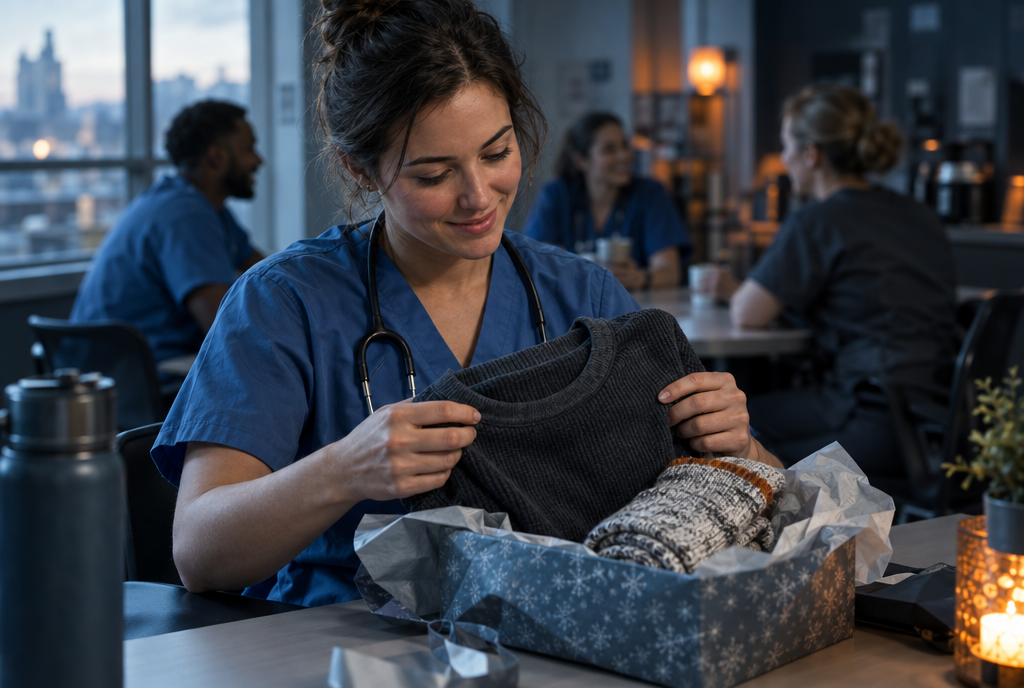
The best warm gifts for nurses split into two groups: items they can actually wear at work within their facility's attire policy, such as a low-lint base layer, warm socks in approved colors or a thin core layer under scrubs, and items for off shift, such as a warm commute layer or bedding for daytime sleep. Avoid bulky, hard-to-launder or battery-powered items unless their unit allows them.
Why is buying warm gifts for nurses tricky?
Many clinical areas are kept cool on purpose. ASHRAE Standard 170-2008 set operating room temperatures at 68 to 75 degrees Fahrenheit, and staff in scrubs who stand still at a bedside or scrub sink feel it. The catch is that nurses cannot wear whatever they like. Infection-control rules, laundering requirements and unit policies decide what goes under or over scrubs.
In perioperative areas, AORN describes surgical attire as a scrub top, pants or dress, with or without a long-sleeve scrub jacket, also called a warm-up jacket. Its 2019 guideline made no recommendation on personal clothing under scrubs and instead asks each organization to set a process covering fabric type, such as nonlinting, and laundering. So the first rule of gifting is simple: when in doubt, ask what their unit allows.
What can nurses actually wear at work to stay warm?
Gifts that usually work within attire policies are thin, smooth and fully covered by scrubs. A close-fitting, low-lint long-sleeve base layer, warm socks in approved colors and a thin core layer that sits flat under the scrub top are the safest bets. Check whether their facility issues its own warm-up jackets; if it does, a personal jacket may not be permitted in restricted areas.
For a full explanation of how policies handle warm layers, see our guides to warm layers and OR attire and to staying warm in the operating room.
| Work setting | Gift types that often fit | Check first |
|---|---|---|
| Operating room and procedure areas | Low-lint base layer, thin core layer under scrubs, warm socks | Fabric and laundering rules; whether personal layers are allowed |
| Inpatient units and ICU | Base layer, approved-color socks, lightweight vest if permitted | Uniform color rules; sleeves and hand hygiene |
| Cold labs, pharmacies, cath labs | Base layers, core layer, insulated socks | Lab coat and PPE requirements |
| Home health and community nursing | Packable layers, insulated tumbler, car-friendly gloves | Time spent outdoors and in cars |
| Night shift | Commute layer, blackout eye mask, warm bedding for daytime sleep | Personal preference; these stay home |
What should you avoid giving a nurse for work?
Good intentions can produce gifts that stay in a locker. These categories cause the most trouble at work, even if they are welcome at home.
Bulky fleece, sherpa or loose knits, which shed lint and may not fit under or over scrubs
Anything that cannot go through the facility's laundering process or a hot wash
Battery-heated garments or rechargeable warmers, which some units restrict and which bring charging and inspection duties
Loose scarves, long sleeves that interfere with hand hygiene, and dangling items
Personalized items in colors that break the uniform code
Are heated vests or rechargeable warmers a good gift for nurses?
For the commute or outdoor time, often yes. At work, check first. AORN recommends cleaning personal electronics according to the manufacturer's instructions before they enter the OR, and many facilities classify battery devices as personal electronics that need approval. OSHA's bulletin on wearable lithium battery devices also recommends tested batteries and chargers, removing devices from chargers once charged and inspecting packs for damage before use.
Passive options avoid that question. A thin layer that insulates the torso, or a vest that holds air-activated warmers, adds warmth with nothing to charge, though the recipient should still confirm it is allowed in their area.
What warm gifts do nurses use off shift?
Off shift is where you can be generous with warmth. A packable insulated jacket or vest for the walk from the parking garage, gloves and a hat, and an insulated tumbler for a hot drink on the way home all get used. For night-shift nurses, daytime sleep can be cold and interrupted, so warm bedding, bed socks and a good eye mask are thoughtful choices.
Heated throws and mattress pads can be comforting after a long shift. Choose models with automatic shut-off, and use them to pre-warm the bed rather than while asleep.
How do you choose the right size and style?
Under-scrub layers must fit close to the body without restricting movement, because nurses lift, bend and reach all shift. If you do not know their size, choose items with forgiving sizing, such as socks, or include a gift receipt. Neutral colors that match common uniform codes, such as navy, black, white or gray, are the safest choice for anything worn at work.
If a nurse mentions cold hands that turn white or blue, or numbness that lasts after warming, encourage them to talk to a clinician.
Where HEATJAC fits
HEATJAC CORE is a low-profile thermal harness platform with integrated heat-reflective thermal inserts, designed by an anesthesiologist to sit under clothing. It has no built-in battery, and its pockets accept supplemental warming elements such as air-activated warmers (sold separately). It comes in colors including Medical Blue, Navy and Black, in S/M and L/XL. Whether it can be worn in a given unit depends on that facility's attire policy.
Key takeaways
Nurses' warm layers are governed by facility attire and laundering policies, so ask what their unit allows.
Thin, low-lint layers that sit fully under scrubs are the safest work gifts.
Avoid bulky, hard-to-launder and battery-powered items for work use unless approved.
Off-shift gifts such as commute layers and warm bedding for daytime sleep are easy wins.
Frequently asked questions
What is a good gift for a nurse who is always cold?
A thin, low-lint base layer or core layer that fits under scrubs is often the most useful, if their unit allows it. Warm socks in approved colors and a warm commute layer are safe choices when you are unsure of the policy.
Can nurses wear a jacket over scrubs?
Many facilities allow a long-sleeve scrub jacket, also called a warm-up jacket, and AORN includes it in surgical attire. Some require facility-issued, facility-laundered jackets, so a personal jacket may not be permitted in restricted areas.
Can nurses wear heated vests at work?
It depends on the facility. Battery-powered garments may need approval as personal electronics, and some units do not allow them. A passive layer avoids charging and approval questions but should still meet attire rules.
What can nurses wear under scrubs to stay warm?
Close-fitting, smooth, low-lint base layers are the usual choice. AORN makes no recommendation on personal clothing under scrubs and asks facilities to set rules on fabric and laundering, so the local policy decides.
What are good gifts for night shift nurses?
Items that support daytime sleep and the cold commute are well used: warm bedding, bed socks, an eye mask, an insulated tumbler and a packable jacket. These stay outside the workplace, so attire rules do not apply.
Related reading
Sources
Guideline for Surgical Attire (2019 edition), Association of periOperative Registered Nurses (AORN)
Surgical Attire, Stethoscopes and Personal Items, Association of periOperative Registered Nurses (AORN)
Environmental Conditions for Operating Rooms (ASHRAE Standard 170-2008 summary), BA Inc.
Preventing Fire and/or Explosion Injury from Small and Wearable Lithium Battery Powered Devices (SHIB 06-20-2019), Occupational Safety and Health Administration
About HEATJAC. HEATJAC is a thermal architecture company founded by an anesthesiologist. We design patented garment systems that capture, conduct and broaden warmth across the body, and we publish this knowledge hub because the science of staying warm should be public. HEATJAC products are not medical devices and are not intended to diagnose, treat, cure or prevent any disease.