
What is a clo? Clothing warmth ratings explained
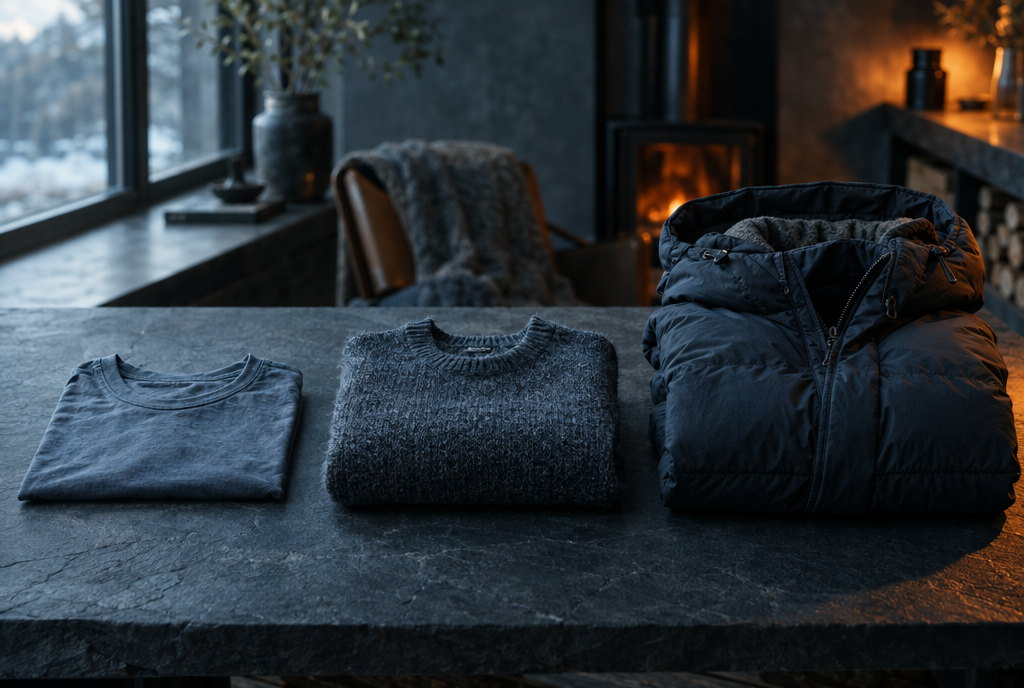
A clo is the standard unit of clothing insulation. One clo equals a thermal resistance of 0.155 square meter kelvin per watt, roughly the insulation of a typical business suit, and a nude body is 0 clo. Higher clo means more resistance to dry heat loss. Values are measured on heated manikins and are used in comfort standards such as ASHRAE 55.
What does clo value mean?
Clo is a measure of thermal resistance: how strongly clothing slows the flow of dry heat from skin to the environment. It covers conduction, convection and radiation through the clothing and the air trapped in it. It does not describe how clothing handles sweat and vapor, which is measured separately as evaporative resistance.
The unit was introduced by Gagge and colleagues in 1941 to make comfort calculations intuitive. Their reference was a seated person who feels comfortable in a ventilated room at 21 °C, with air movement of 0.1 meter per second and relative humidity under 50%, while wearing ordinary business clothing. That ensemble was defined as 1 clo.
In SI terms, ASHRAE Standard 55 defines 1 clo as 0.155 square meter degree Celsius per watt. The number describes the whole body, not a single fabric swatch.
What are typical clo values for clothing? (clo value chart)
ASHRAE 55 lists insulation values for common indoor garments and ensembles. The figures below are for whole ensembles or single garments measured on manikins, and they show how quickly ordinary indoor clothing reaches about 1 clo.
| Ensemble or garment | Clo value (ASHRAE 55-2013) |
|---|---|
| Walking shorts and short-sleeve shirt | 0.36 |
| Knee-length skirt and short-sleeve shirt | 0.54 |
| Trousers and long-sleeve shirt | 0.61 |
| Trousers, long-sleeve shirt and suit jacket | 0.96 |
| Thin long-sleeve sweater (single garment) | 0.25 |
| Thin single-breasted suit jacket (single garment) | 0.36 |
| Thin straight trousers (single garment) | 0.15 |
| Ankle-length socks (single garment) | 0.02 |
How is clo value measured?
Clothing insulation is measured on a heated thermal manikin under standards such as ASTM F1291 and ISO 15831. The manikin is kept at skin-like temperature in a calm, cool chamber, and the power needed to hold that temperature reveals the ensemble's resistance to heat flow.
The standard ASTM F1291 test uses a standing, static manikin. It does not capture the effects of walking, sitting or wind, which can lower real-world insulation. Fabrics alone are tested on sweating guarded hotplates under ISO 11092, which report thermal resistance in square meter kelvin per watt rather than clo.
Can you add clo values together?
Standards allow designers to estimate an ensemble by summing single-garment values, which is how the garment list in ASHRAE 55 is meant to be used. The estimate is approximate because layers compress each other and change the air gaps between them.
Layering can also add more than expected. A 2020 manikin study of detachable thermal inserts for a protective jacket measured individual inserts at 0.37 to 0.50 clo and found that insulation rose markedly when an inner layer was paired with an outer fabric layer, largely because of the air trapped between them.
How does clo compare with R-value and evaporative resistance?
Clo and building R-values measure the same physical quantity, resistance to heat flow, on different scales. Because 1 clo equals 0.155 square meter kelvin per watt, it corresponds to an SI thermal resistance (RSI) of 0.155. Sleeping pads now carry their own R-value under ASTM F3340, which measures heat flow from a warm plate down through the pad.
Evaporative resistance is a separate number. It describes how easily water vapor from the skin passes through clothing, and it is measured on sweating hotplates or sweating manikins under ISO 11092 or ASTM F2370. A garment can have high clo and poor vapor transfer, which is why heavy, impermeable outfits can feel clammy during work even when they insulate well.
Why don't most jackets list a clo value?
Manikin testing is expensive and results depend on size, fit and test conditions, so most consumer brands publish fill power, fill weight or temperature ratings instead. Those ratings are not interchangeable with clo.
Clo values are most common in military specifications, protective clothing, sleeping systems research and building comfort standards. Where a brand does quote clo, ask which standard was used and whether the figure is for the fabric or the whole garment.
What clo value do I need for cold weather?
The insulation needed depends heavily on activity. Walking or working produces far more metabolic heat than sitting, so the same outfit can feel warm on a hike and cold at a bus stop. Wind and wet clothing also cut effective insulation.
For practical buying, compare garments by the same measure, build in layers you can remove, and remember that hands and feet need their own protection. A high whole-body clo number does not keep fingers warm if gloves are thin.
Key takeaways
One clo equals 0.155 m²·K/W, roughly a typical business suit; a nude body is 0 clo.
Common indoor outfits range from about 0.36 clo (shorts and T-shirt) to 0.96 clo (trousers, shirt and suit jacket).
Clo is measured on heated manikins under ASTM F1291 or ISO 15831, usually standing still in calm air.
Clo describes dry heat resistance only; vapor and sweat handling are measured separately.
Movement, wind and moisture lower the insulation you actually get.
Frequently asked questions
What is 1 clo equal to?
One clo equals a thermal resistance of 0.155 square meter kelvin per watt. In everyday terms, it is about the insulation of a typical business suit worn indoors.
Is a higher clo value warmer?
Yes, a higher clo means more resistance to dry heat loss. It does not account for sweat management, wind penetration during movement or wet conditions, all of which can reduce real warmth.
What is the difference between clo and tog?
Both describe thermal resistance, but tog is used mostly for duvets and bedding while clo is used for clothing and comfort standards. They are different scales, so the numbers are not directly comparable.
What is the clo value of a down jacket?
It depends on fill amount, fill power, design and fit, and few brands publish manikin-tested clo values. Ask for the test standard if a figure is quoted, and compare garments measured the same way.
Where are clo values used?
Clo values feed into building comfort calculations under ASHRAE 55, protective and military clothing specifications, and cold-weather clothing research. Engineers use them to predict when people will feel comfortable at a given temperature.
What is a clo number?
A clo number is a clothing insulation rating on a scale where 0 clo is a nude body and 1 clo is roughly a typical business suit. The higher the number, the more the clothing slows dry heat loss from the skin. It is measured for whole garments or ensembles on heated manikins.
What units is clo measured in?
Clo is its own unit, defined as a thermal resistance of 0.155 square meter degree Celsius per watt in ASHRAE Standard 55. That makes 1 clo equal to an SI thermal resistance (RSI) of 0.155, the same kind of quantity used for building insulation.
What clo value is typical for indoor clothing?
ASHRAE 55 uses clothing between 0.5 and 1.0 clo for its standard comfort zone and describes those levels as typical of clothing worn when it is warm and cool outdoors, respectively. Trousers and a long-sleeve shirt come to about 0.61 clo in the standard's table.
Is there a clo rating chart for clothing?
Yes. ASHRAE Standard 55 lists clo values for common indoor ensembles and single garments, such as 0.36 clo for walking shorts and a short-sleeve shirt and 0.96 clo for trousers, a long-sleeve shirt and a suit jacket. Outdoor and cold-weather gear is rarely rated in clo by consumer brands.
From HEATJAC
We design low-profile thermal garments: a heat-reflective vest and a thermal harness with pockets for warmers or cold packs.
Choosing gear? Heated vest vs heat-reflective vest · The thermal gear buying, safety and care guide
Related reading
Sources
Comparative Analysis of the Thermal Insulation of Multi-Layer Thermal Inserts in a Protective Jacket, Materials (MDPI), via PubMed Central
ANSI/ASHRAE Standard 55-2013, Thermal Environmental Conditions for Human Occupancy, ASHRAE
ASTM F1291: Measuring the Thermal Insulation of Clothing Using a Heated Manikin, ASTM International
ISO 11092: Textiles, Physiological effects, Measurement of thermal and water-vapour resistance (sweating guarded-hotplate test), International Organization for Standardization
ASTM F2370: Measuring the Evaporative Resistance of Clothing Using a Sweating Manikin, ASTM International
New standardized R-value: ASTM F3340, NEMO Equipment Journal
About HEATJAC. HEATJAC is a thermal architecture company founded by an anesthesiologist. We design patented garment systems that capture, conduct and broaden warmth across the body, and we publish this knowledge hub because the science of staying warm should be public. HEATJAC products are not medical devices and are not intended to diagnose, treat, cure or prevent any disease.