
Clo values of common clothing: a reference table
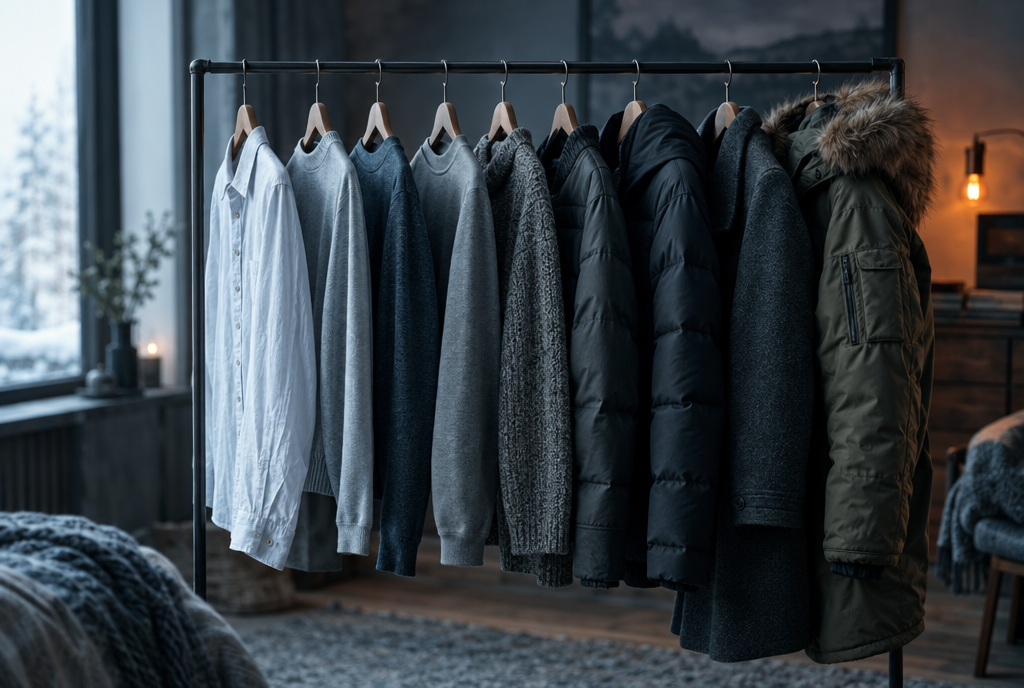
One clo equals 0.155 m²·K/W of clothing insulation. In ASHRAE Standard 55-2013, trousers with a short-sleeve shirt rate 0.57 clo, trousers, long-sleeve shirt and suit jacket 0.96 clo, and insulated coveralls over thermal underwear 1.37 clo. To estimate any outfit, add the garment values; ISO 9920 refines that sum as 0.161 + 0.835 × the total.
What does 1 clo mean?
A clo is a unit of thermal resistance for clothing. ASHRAE Standard 55-2013 defines 1 clo as 0.155 m²·°C/W, which is the same as 0.155 m²·K/W. A 2 clo outfit therefore resists dry heat loss twice as strongly, at 0.31 m²·K/W.
The values below describe basic insulation of the clothing itself, measured on a standing, stationary manikin in still air. The history of the unit and how manikin tests work are covered in our clo explainer, so this page sticks to the numbers and how to use them.
Clo values of typical outfits (ASHRAE 55 ensemble table)
ASHRAE Standard 55-2013, Table 5.2.2.2A, lists measured insulation for common indoor ensembles. Per the table note, every ensemble includes shoes, socks and briefs or panties unless shown in parentheses, and skirt or dress ensembles include pantyhose with no extra socks.
| Ensemble | Icl (clo) |
|---|---|
| Trousers, short-sleeve shirt | 0.57 |
| Trousers, long-sleeve shirt | 0.61 |
| Trousers, long-sleeve shirt, suit jacket | 0.96 |
| Trousers, long-sleeve shirt, suit jacket, vest, T-shirt | 1.14 |
| Trousers, long-sleeve shirt, long-sleeve sweater, T-shirt | 1.01 |
| As above plus suit jacket and long underwear bottoms | 1.30 |
| Knee-length skirt, short-sleeve shirt (sandals) | 0.54 |
| Knee-length skirt, long-sleeve shirt, full slip | 0.67 |
| Knee-length skirt, long-sleeve shirt, half slip, long-sleeve sweater | 1.10 |
| Knee-length skirt, long-sleeve shirt, half slip, suit jacket | 1.04 |
| Ankle-length skirt, long-sleeve shirt, suit jacket | 1.10 |
| Walking shorts, short-sleeve shirt | 0.36 |
| Long-sleeve coveralls, T-shirt | 0.72 |
| Overalls, long-sleeve shirt, T-shirt | 0.89 |
| Insulated coveralls, long-sleeve thermal underwear tops and bottoms | 1.37 |
| Sweatpants, long-sleeve sweatshirt | 0.74 |
| Long-sleeve pajama top and trousers, short robe (slippers, no socks) | 0.96 |
Clo values of individual garments
Table 5.2.2.2B of the same standard gives insulation for single garments, written Iclu. The selection below covers the items most outfits are built from; thin and thick versions of the same garment can differ by half again or more.
| Category | Garment | Iclu (clo) |
|---|---|---|
| Underwear | Men's briefs | 0.04 |
| Underwear | T-shirt | 0.08 |
| Underwear | Long underwear bottoms | 0.15 |
| Underwear | Long underwear top | 0.20 |
| Footwear | Ankle-length athletic socks | 0.02 |
| Footwear | Shoes | 0.02 |
| Footwear | Calf-length socks | 0.03 |
| Footwear | Thick knee socks | 0.06 |
| Footwear | Boots | 0.10 |
| Shirts | Short-sleeve knit sport shirt | 0.17 |
| Shirts | Short-sleeve dress shirt | 0.19 |
| Shirts | Long-sleeve dress shirt | 0.25 |
| Shirts | Long-sleeve flannel shirt | 0.34 |
| Shirts | Long-sleeve sweatshirt | 0.34 |
| Trousers | Walking shorts | 0.08 |
| Trousers | Thin straight trousers | 0.15 |
| Trousers | Thick straight trousers | 0.24 |
| Trousers | Sweatpants | 0.28 |
| Trousers | Overalls | 0.30 |
| Trousers | Coveralls | 0.49 |
| Dresses and skirts | Thin skirt | 0.14 |
| Dresses and skirts | Thick skirt | 0.23 |
| Dresses and skirts | Long-sleeve shirtdress, thick | 0.47 |
| Sweaters | Thin sleeveless vest | 0.13 |
| Sweaters | Thick sleeveless vest | 0.22 |
| Sweaters | Thin long-sleeve sweater | 0.25 |
| Sweaters | Thick long-sleeve sweater | 0.36 |
| Jackets and vests | Thick sleeveless suit vest | 0.17 |
| Jackets and vests | Thin single-breasted suit jacket | 0.36 |
| Jackets and vests | Thick double-breasted suit jacket | 0.48 |
| Sleepwear | Short-sleeve hospital gown | 0.31 |
| Sleepwear | Thick long-sleeve pajamas | 0.57 |
| Sleepwear | Thick long-sleeve long wrap robe | 0.69 |
What about winter jackets, gloves and hats?
The ASHRAE garment list is written for indoor comfort, so it has no parkas, insulated jackets, gloves or hats. Published manikin data for outdoor items are scattered across research papers and depend heavily on the specific product.
A 2021 study in Industrial Health by Kuklane and Toma measured the parts of an ambulance crew clothing system on a thermal manikin. The figures below are for those specific garments, not generic categories, but they show the order of magnitude for workwear layers.
| Garment measured (2021 study) | Iclu (clo) |
|---|---|
| Waterproof high-visibility work jacket | 0.52 |
| Uniform jacket | 0.47 |
| Insulating base jacket | 0.56 |
| Fleece sweater (two versions) | 0.29 to 0.35 |
| Winter shoes | 0.12 |
| Suede sneakers | 0.05 |
| Knit cap | 0.03 |
| Fleece gloves | 0.02 |
How do you add clo values to estimate an outfit?
ASHRAE 55 lets you estimate an ensemble not in its table by adding the garment values: Icl equals the sum of the individual Iclu values. ISO 9920 gives the same simple sum and a corrected version, Icl = 0.161 + 0.835 × ΣIclu, which raises light outfits slightly and trims heavy ones.
Kuklane and Toma tested both rules against measured ensembles in 2021. The corrected equation landed within minus 18% to plus 12% of the measured values, with an average difference near zero and absolute errors of about 0.17 to 0.18 clo at most. The simple sum increasingly overestimated heavier outfits but worked reasonably well up to about 2 clo.
Seating adds insulation as well. ASHRAE 55 gives zero for a net, metal or wooden side-arm chair and up to 0.15 clo for an executive chair. The worked examples below use garment values from the ASHRAE table.
| Outfit (garments summed) | Simple sum | ISO 9920 corrected |
|---|---|---|
| Summer casual: briefs, knit sport shirt, walking shorts, sandals (0.04 + 0.17 + 0.08 + 0.02) | 0.31 clo | 0.42 clo |
| Winter office: briefs, T-shirt, long-sleeve dress shirt, thick trousers, thick sweater, calf socks, shoes (0.04 + 0.08 + 0.25 + 0.24 + 0.36 + 0.03 + 0.02) | 1.02 clo | 1.01 clo |
| Cold workshop: briefs, long underwear top and bottoms, flannel shirt, thick trousers, thick sweater, thick knee socks, boots (0.04 + 0.20 + 0.15 + 0.34 + 0.24 + 0.36 + 0.06 + 0.10) | 1.49 clo | 1.41 clo |
Why real clothing rarely delivers its table clo value
Table values come from a still manikin in calm air. Several everyday factors cut the insulation you actually get, and none of them appear in the tables.
Movement is the one ASHRAE 55 quantifies. For activity between 1.2 and 2.0 met, it multiplies the table value by (0.6 + 0.4 ÷ M), where M is the metabolic rate in met. At 2.0 met the factor is 0.8, so a 1.0 clo outfit behaves like 0.8 clo.
Wind: air forced through fabric and openings replaces warm trapped air, so permeable outer layers lose more insulation than windproof ones.
Moisture: sweat, rain or snowmelt fills the air spaces that provide insulation, and wet fibers conduct heat faster.
Compression: straps, harnesses, packs and tight layers crush loft, and a seat or bed compresses the parts in contact with it.
Fit and layering: very loose or very tight layers change the air gaps between garments, which is why summed values are estimates, not measurements.
Scope: ASHRAE 55 is not intended for sleeping people in contact with bedding, and its comfort model applies only up to 1.5 clo, a limit the CBE Thermal Comfort Tool also enforces.
How to use these numbers well
Use the tables to compare outfits, set indoor dress codes, or feed a comfort calculation, not to promise that a person will feel warm outdoors. For outdoor cold, adjust for wind and activity and protect hands, feet and head separately, since their small clo contributions hide large local heat losses.
If you notice numbness, color changes in fingers or toes, or unusual cold sensitivity even in reasonable clothing, talk to a clinician about the symptoms.
Key takeaways
1 clo equals 0.155 m²·K/W; typical indoor outfits in ASHRAE 55-2013 range from 0.36 to 1.37 clo.
Add garment values to estimate an outfit, or use the ISO 9920 correction: 0.161 + 0.835 × the sum.
The corrected sum came within minus 18% to plus 12% of manikin measurements in a 2021 validation study.
Walking at 2.0 met cuts effective insulation to 0.8 of the table value; wind, wet layers and compression cut it further.
The ASHRAE list covers indoor clothing; outdoor jackets, gloves and hats need product-specific data.
Frequently asked questions
What is the clo value of a T-shirt and jeans?
ASHRAE 55-2013 lists trousers with a short-sleeve shirt, shoes, socks and underwear at 0.57 clo. A T-shirt alone is 0.08 clo and thick straight trousers are 0.24 clo, so the garments on their own sum to about 0.32 clo before underwear, socks and shoes.
What clo value is a business suit?
Trousers, long-sleeve shirt and suit jacket rate 0.96 clo in ASHRAE 55-2013. Adding a vest and T-shirt raises the ensemble to 1.14 clo.
How do you calculate the clo of an outfit?
Add the insulation of each garment from a published table such as ASHRAE 55 Table 5.2.2.2B. For a closer estimate, ISO 9920 uses Icl = 0.161 + 0.835 × the sum, which a 2021 validation study found accurate to within minus 18% to plus 12%.
What is the clo value of a winter jacket?
It depends on the product and is rarely published. Work jackets measured in a 2021 manikin study rated about 0.47 to 0.56 clo on their own; heavily insulated parkas are higher, but only manufacturer or laboratory test data can say how much.
Does sitting change clo?
Yes. ASHRAE 55 adds nothing for a net, metal or wooden side-arm chair and up to 0.15 clo for an upholstered executive chair, because the chair itself insulates the body areas in contact with it.
From HEATJAC
We design low-profile thermal garments: a heat-reflective vest and a thermal harness with pockets for warmers or cold packs.
Choosing gear? The thermal gear buying, safety and care guide · What warmth costs per shift
Related reading
Sources
ANSI/ASHRAE Standard 55-2013, Thermal Environmental Conditions for Human Occupancy, ASHRAE
Validation of ISO 9920 clothing item insulation summation method based on an ambulance personnel clothing system (Kuklane and Toma, Industrial Health, 2021), Japan National Institute of Occupational Safety and Health
ISO 9920:2007 Ergonomics of the thermal environment, Estimation of thermal insulation and water vapour resistance of a clothing ensemble, International Organization for Standardization
CBE Thermal Comfort Tool for ASHRAE-55 (Tartarini et al., SoftwareX, 2020), Center for the Built Environment, University of California, Berkeley
About HEATJAC. HEATJAC is a thermal architecture company founded by an anesthesiologist. We design patented garment systems that capture, conduct and broaden warmth across the body, and we publish this knowledge hub because the science of staying warm should be public. HEATJAC products are not medical devices and are not intended to diagnose, treat, cure or prevent any disease.