
Perioperative hypothermia and patient warming: the complete guide
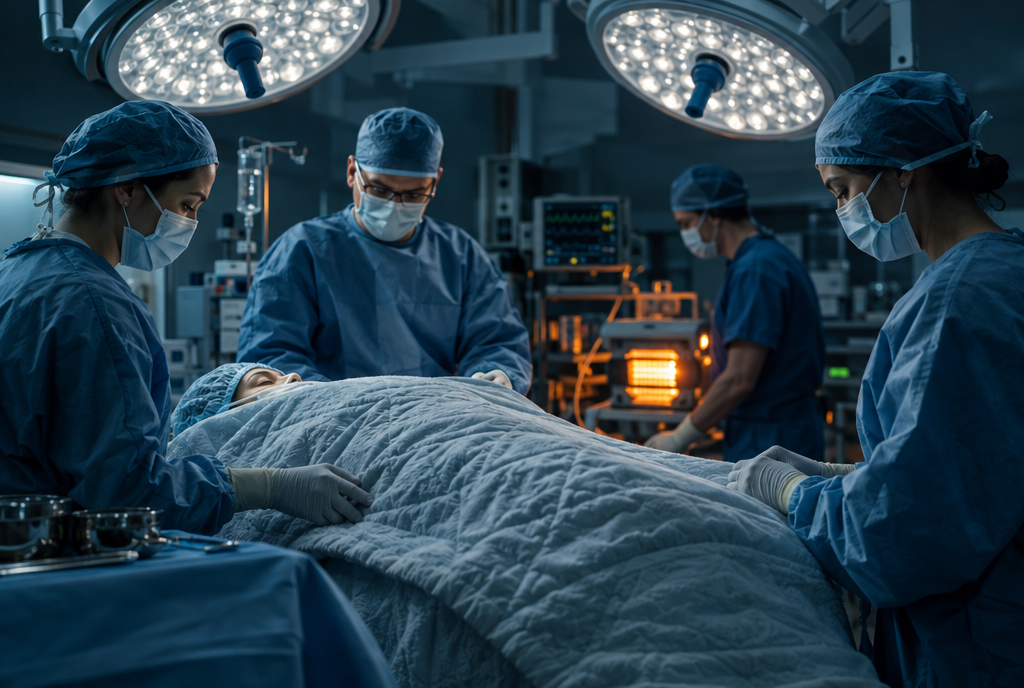
Patient warming is the set of practices that keep surgical patients at or above 36.0°C, the threshold for perioperative hypothermia. Anesthesia disables normal temperature control and operating rooms are cool, so most patients lose heat without help. Effective programs combine prewarming, active warming with forced-air or conductive devices, warmed fluids, sensible room settings and accurate core temperature monitoring.
What is patient warming and why does it matter?
Patient warming covers every measure used to maintain normothermia from the pre-op area to recovery. It includes passive insulation such as blankets, active devices that add heat, warmed intravenous and irrigation fluids, room temperature management and the monitoring that tells the team whether any of it is working.
The stakes are well established. Mild perioperative hypothermia is associated with impaired clotting and more blood loss, higher surgical site infection risk, slower drug clearance, cardiac stress from shivering and significant discomfort. Guidance from NICE, AORN and the American Society of Anesthesiologists treats temperature management as a routine part of safe anesthesia care rather than an optional comfort measure.
This guide summarizes each part of the topic and links to a detailed article on each. It is written for clinicians, value-analysis committees and informed patients, and it is educational rather than individual medical advice.
What is perioperative hypothermia?
NICE defines perioperative hypothermia as a core temperature below 36.0°C. AORN uses the same threshold, 96.8°F, across a window from one hour before induction to 24 hours after arrival in the postanesthesia care unit. An AORN clinical article reports that it occurs in 50 to 70 percent of patients having general anesthesia.
The main cause is physiological. Anesthesia lowers the thresholds for vasoconstriction and shivering, and it dilates peripheral vessels so that warm core blood moves into the cooler limbs. OpenAnesthesia describes a core temperature fall of about 1 to 1.5°C in the first hour from this redistribution alone, followed by a slower linear decline and eventually a plateau.
Our article on what perioperative hypothermia is explains the definition, the three phases, the main risk factors and the consequences in detail.
What do NICE, AORN and ASA recommend?
Three sources dominate practice. NICE clinical guideline CG65 gives the most specific protocol: measure temperature in the hour before the patient leaves the ward, prewarm actively for at least 30 minutes, do not start induction below 36.0°C unless the case is urgent, measure every 30 minutes during surgery, keep the room at least 21°C while the patient is exposed, warm intravenous fluids of 500 ml or more to 37°C, and check every 15 minutes in recovery.
AORN's Guideline for Patient Temperature Management is the US nursing standard. Its 2025 update reinforces active warming, such as forced air, over passive insulation and recommends pre-purchase evaluation of every device used for temperature management. The ASA Standards for Basic Anesthetic Monitoring require temperature monitoring whenever clinically significant changes in body temperature are intended, anticipated or suspected.
Our comparison of NICE, AORN and ASA guidance sets these recommendations side by side and explains how US hospitals typically combine them.
Why does prewarming before surgery matter?
Because most of the first-hour drop is heat moving from the core to the limbs, the most effective time to act is before induction. Prewarming loads heat into the peripheral tissues so there is less gradient for core heat to flow into. OpenAnesthesia reports that prewarmed patients stay about 0.4°C warmer than those who are not prewarmed.
NICE recommends starting active warming at least 30 minutes before induction when the patient's temperature is 36.0°C or above, and shorter periods still help. Our article on prewarming before surgery explains the physiology, the evidence and how to fit prewarming into a busy pre-op area.
What patient warming devices are used?
Warming methods fall into two families. Passive methods conserve the patient's own heat; active methods add heat from an external source. Under anesthesia, active warming does most of the work, and passive layers support it.
| Method | How it works | Typical role |
|---|---|---|
| Forced-air warming | Heated air through a perforated blanket or gown | Most widely used; NICE default for anesthesia over 30 minutes |
| Resistive (conductive) warming | Electrically heated fabric blankets and mattresses | Alternative when forced air is unsuitable; underbody warming |
| Circulating-water systems | Warm water pumped through pads or mattresses | Operating room and intensive care temperature management |
| Self-warming blankets | Air-activated chemical heat in a single-use blanket | Settings without powered warmers |
| Fluid and irrigation warmers | Warm fluids to body temperature before infusion | Prevents cooling from cold fluids |
| Passive insulation and reflective layers | Blankets and reflective materials that trap heat | Comfort, transport and support for active warming |
How does forced-air warming work?
A bedside unit heats and filters air and blows it through a hose into a single-patient blanket or gown, which releases it through small perforations over the skin. The warm air replaces cool air at the skin surface and the blanket shields the patient from radiant loss to the room. Bair Hugger is the best-known system, and several other manufacturers offer forced-air units.
OpenAnesthesia describes forced air as the most commonly used method because it is effective, inexpensive and easy to use. In 2017 the FDA stated that it continues to recommend thermoregulating devices, including forced-air systems, when clinically warranted. Our article on forced-air warming covers blanket types, effectiveness, limitations and safety.
How do conductive and resistive warming work?
Conductive systems warm by direct contact. Resistive products pass a low-voltage current through a conductive fabric in blankets and underbody mattresses, and circulating-water systems pump temperature-controlled water through pads. Underbody mattresses can warm the back, a large surface that overbody blankets cannot reach, and these systems add no airflow to the room.
NICE advises considering a resistive heating mattress or blanket when forced-air warming is unsuitable. Our article on conductive and resistive patient warming describes the main product types, including HotDog, Inditherm and Arctic Sun, and where each fits.
Is forced-air or conductive warming better?
The evidence does not name a clear winner. Some randomized trials find slightly better temperatures with forced air, others find resistive warming equivalent, and a 2025 trial found conductive warming with prewarming produced the lowest hypothermia burden of the strategies tested. Differences are often a few tenths of a degree, and the timing of warming appears to matter as much as the device.
Our evidence review of forced-air vs conductive warming summarizes the trials, the debate about airflow and infection control, and a framework value-analysis committees can use.
When is passive warming enough?
Passive insulation reduces heat loss but cannot add heat. OpenAnesthesia estimates that a single insulating blanket reduces heat loss by about 30 percent, which helps an awake patient who can shiver but rarely suffices under general anesthesia. NICE uses passive measures throughout its pathway and adds active warming at defined points, including forced-air warming for anesthesia longer than 30 minutes.
Our comparison of passive vs active warming explains where blankets, reflective layers and self-warming products fit, and why anesthesia tips the balance toward active devices.
What temperature and humidity should the operating room be?
In the US, ANSI/ASHRAE/ASHE Standard 170 sets operating room design conditions of 68°F to 75°F (20°C to 24°C) and 20 to 60 percent relative humidity in its 2021 edition. NICE adds a patient-focused rule of at least 21°C while the patient is exposed, and evidence cited by AORN supports setting the room for staff comfort once the patient is actively warmed.
Our article on operating room temperature and humidity standards covers ASHRAE 170, the 2013 CMS humidity waiver, the risks of very high and very low humidity, and how to write a room policy.
How is core temperature monitored?
Warming only works if the team knows the patient's real core temperature. Reference sites are the pulmonary artery, distal esophagus, nasopharynx and tympanic membrane. Bladder, oral, axillary and zero-heat-flux forehead sensors are practical near-core options, while infrared temporal and ear scanners are not accurate enough for perioperative care. NICE advises against indirect estimates of core temperature in adults having surgery.
Our article on core temperature monitoring methods compares each site's accuracy and practical limits.
How should a hospital build a patient warming program?
Even with active warming, hypothermia remains common. In a 2015 analysis of nearly 59,000 patients reported by the ASA, all warmed with forced air, 64 percent fell below 36°C in the first hour. A program therefore needs a bundle, clear ownership and measurement, not just equipment.
Screen and measure: record temperature before the patient leaves the ward or holding area and identify higher-risk patients.
Prewarm: start active warming on arrival in holding, targeting at least 30 minutes.
Warm continuously: use a reliable active method through surgery and into recovery, and warm fluids and irrigation.
Manage the room: keep it warmer while the patient is exposed, then set it for the team once warming is running.
Monitor accurately: use validated core or near-core methods on a defined schedule.
Evaluate devices: follow AORN's recommendation for pre-purchase evaluation and audit outcomes such as arrival temperature in recovery.
What about the clinicians who work in cold operating rooms?
The same cool room that challenges patients affects staff. Gowned surgeons under lights are often warm, while circulating nurses and anesthesia clinicians are often cold for an entire shift. HEATJAC, a physician-founded company focused on the thermal comfort of the people who work in these rooms, publishes a separate guide to clinician thermal comfort; it does not make patient-warming devices.
Patients with questions about how they will be kept warm during their own procedure should talk to a clinician on their surgical or anesthesia team.
Key takeaways
Perioperative hypothermia is a core temperature below 36.0°C and affects 50 to 70 percent of patients under general anesthesia.
Most first-hour cooling is redistribution, so prewarming for at least 30 minutes is one of the most effective steps.
Forced-air warming is the most widely used active method; conductive warming is an established alternative with mixed comparative evidence.
ASHRAE 170 sets OR design conditions of 68°F to 75°F and 20 to 60 percent humidity; NICE adds at least 21°C while the patient is exposed.
Accurate core monitoring, not infrared estimates, is what makes a warming program measurable.
Frequently asked questions
What is a patient warming system?
It is a device that adds heat to a patient to maintain normothermia, most often a forced-air unit with disposable blankets or a conductive system with heated blankets or mattresses. Circulating-water systems and fluid warmers are also used.
What temperature is perioperative hypothermia?
NICE and AORN define it as a core temperature below 36.0°C (96.8°F). AORN applies the definition from one hour before induction to 24 hours after arrival in recovery.
Why are patients warmed before surgery?
Prewarming raises the temperature of the arms and legs before anesthesia dilates blood vessels, which reduces the redistribution of core heat after induction. NICE recommends at least 30 minutes of active prewarming when the patient's temperature is 36.0°C or above.
Which is better, forced-air or conductive warming?
Neither is consistently superior. Trials show small differences in both directions, and starting warming before induction appears to matter as much as the device chosen.
How cold are operating rooms kept?
ASHRAE 170 requires operating rooms to be capable of 68°F to 75°F. Many teams run near the cooler end for gowned staff, which is why patients need active warming and NICE recommends at least 21°C while the patient is exposed.
How is temperature measured during surgery?
Under general anesthesia, teams typically use an esophageal or nasopharyngeal probe. Zero-heat-flux forehead sensors, bladder probes and careful oral or axillary readings are used in other settings, while infrared temporal and ear scanners are not recommended.
From HEATJAC
We design low-profile thermal garments: a heat-reflective vest and a thermal harness with pockets for warmers or cold packs.
Choosing gear? What nurses and OR staff should look for in thermal gear · Getting a thermal vest approved for clinical areas
Related reading
Sources
Hypothermia: prevention and management in adults having surgery (CG65), Recommendations, National Institute for Health and Care Excellence (NICE)
Maintaining Normothermia: Implementing AORN's Updated Patient Temperature Management Guideline, AORN
Standards for Basic Anesthetic Monitoring, American Society of Anesthesiologists
Intraoperative Hypothermia, OpenAnesthesia (International Anesthesia Research Society)
Many surgical patients experience hypothermia despite active warming (news release on Sessler et al., Anesthesiology, 2015), American Society of Anesthesiologists
Forced Air Thermal Regulating Systems: Healthcare Provider Letter, Information About Use (FDA, August 2017), American Society of Anesthesiologists (FDA alert)
ASHRAE 170 by Room: Air Changes, Pressure Relationships, Humidity, and Filter Minimums, Building and Air (summary of ANSI/ASHRAE/ASHE Standard 170)
About HEATJAC. HEATJAC is a thermal architecture company founded by an anesthesiologist. We design patented garment systems that capture, conduct and broaden warmth across the body, and we publish this knowledge hub because the science of staying warm should be public. HEATJAC products are not medical devices and are not intended to diagnose, treat, cure or prevent any disease.