
Prewarming before surgery: why 30 minutes matters
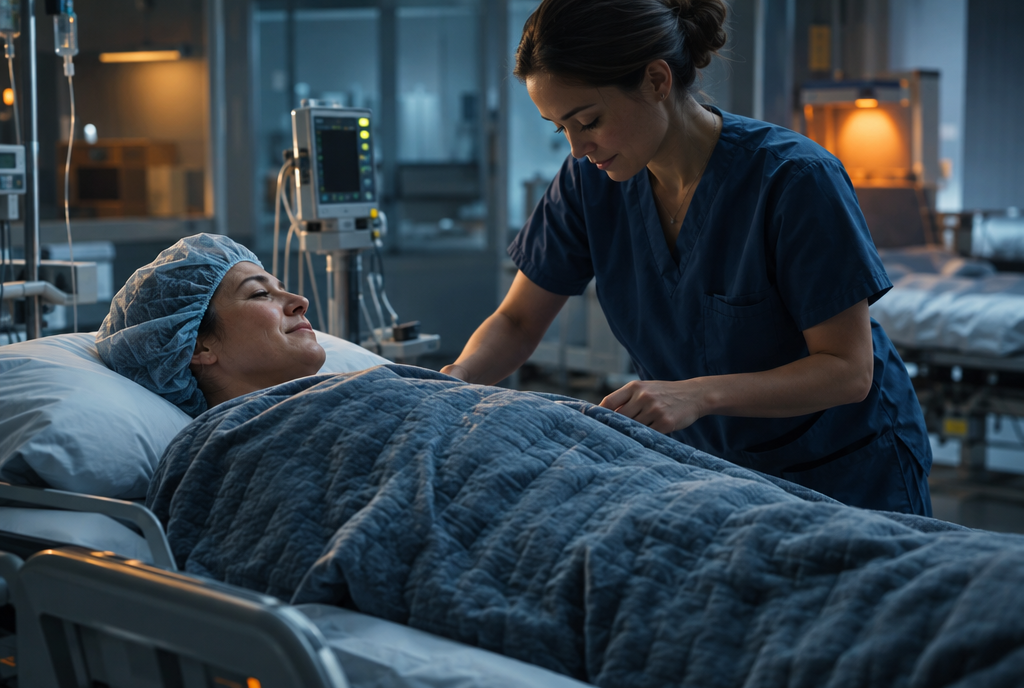
Prewarming means actively warming a patient's skin, usually with a forced-air or conductive device, before anesthesia starts. It loads heat into the arms and legs so that less core heat is lost when anesthesia dilates blood vessels. NICE recommends starting active warming at least 30 minutes before induction when the patient's temperature is 36.0°C or above.
What is prewarming?
Prewarming is active warming applied in the pre-op holding area, before the patient goes to the operating room. It is different from simply adding blankets: a warming device adds heat to the body rather than slowing its loss.
NICE explains it to patients in plain terms: they should be kept warm using a special warming blanket or mattress for at least 30 minutes before they are given their anesthetic, unless it is emergency surgery. The same guideline says induction should not begin unless the patient's temperature is 36.0°C or above, except when clinical urgency overrides that.
Why does prewarming work?
The biggest early drop in core temperature is not heat leaving the body. It is heat moving inside it. After induction, anesthetic drugs dilate peripheral blood vessels, and warm blood from the core mixes with the cooler tissues of the arms and legs. OpenAnesthesia describes a core temperature fall of about 1 to 1.5°C in the first hour from this redistribution alone.
Prewarming narrows that gap before it opens. By raising the heat content of the peripheral tissues first, it leaves less of a temperature gradient for core heat to flow into. OpenAnesthesia reports that prewarmed patients stay about 0.4°C warmer than patients who are not prewarmed. Intraoperative warming cannot easily achieve the same effect, because heat applied to the skin takes time to reach the core while redistribution happens quickly.
Why 30 minutes?
The 30-minute figure comes from NICE CG65, which recommends starting active warming at least 30 minutes before induction if the patient's temperature is 36.0°C or above, unless doing so would delay emergency surgery. It is the most widely repeated number in perioperative warming, and it appears in AORN clinical guidance as the optimal approach before the patient enters the operating room.
Shorter periods still help. An AORN clinical article notes that the literature supports starting prewarming 10 to 30 minutes before induction, and AORN's published evidence table includes a randomized trial concluding that forced-air prewarming at 43°C for at least 15 minutes reduced hypothermia and the decline in body temperature. In short, 30 minutes is the target, and something is better than nothing when schedules are tight.
What does the evidence show?
A 2025 randomized trial published in PLOS One compared four strategies in 182 surgical patients: conductive or forced-air warming, each with and without prewarming. Hypothermia remained common overall, at 74 percent of patients, but its burden differed sharply by strategy.
| Strategy (Desai et al., 2025) | Median hypothermia burden (AUC below 36°C) |
|---|---|
| Conductive prewarming, conductive intraoperative | 4.7 |
| Forced-air prewarming, forced-air intraoperative | 8.0 |
| No prewarming, conductive intraoperative | 7.4 |
| No prewarming, forced-air intraoperative | 19.9 |
How should the trial results be read?
The clearest signal was the gap between the prewarmed groups and the group that received forced-air warming only after induction. The authors concluded that conductive warming outperformed forced-air warming when forced air was used without prewarming, which points to timing as much as technology.
One trial does not settle device choice, and hypothermia burden is a surrogate rather than a clinical outcome such as infection. The consistent message across guidance and trials is simpler: warming that starts before induction beats warming that starts after it.
Which devices are used for prewarming?
Prewarming uses the same families of equipment as intraoperative warming. Forced-air gowns and blankets are the most common, conductive or resistive blankets and mattresses are alternatives, and single-use self-warming blankets are sometimes used where powered units are not available.
The best choice is often the one that can stay with the patient. A system that warms in holding, continues on the table and follows the patient to recovery avoids gaps where heat is lost during transfers.
How do hospitals make prewarming work in practice?
The barriers are practical rather than clinical: short pre-op stays, patients arriving late, and holding areas without enough warming units. Teams that succeed usually treat prewarming as part of the admission routine rather than an extra step.
Start warming as soon as the patient is gowned and the IV is placed, not when the room is ready.
Measure and document temperature in the hour before the patient leaves the ward or holding area, as NICE recommends.
Use a device that can travel with the patient, or that the same system can continue intraoperatively.
Ask patients whether they feel cold; NICE encourages patients to tell staff if they feel cold at any time.
Track prewarming minutes as a quality metric alongside end-of-case and arrival-in-recovery temperatures.
Who benefits most from prewarming?
Every adult having anesthesia loses heat through redistribution, so prewarming has broad value. The case is strongest for patients who meet the NICE higher-risk criteria, such as ASA grade II to V, combined general and regional anesthesia, major or intermediate surgery, or risk of cardiovascular complications, and for patients who arrive with a temperature already near 36.0°C.
Patients who know they feel the cold easily can ask about warming before surgery. Anyone with questions about how warming applies to their own procedure should talk to a clinician on their surgical team.
Key takeaways
Prewarming actively warms the arms and legs before anesthesia to reduce redistribution of core heat.
NICE recommends at least 30 minutes of active warming before induction when temperature is 36.0°C or above.
Shorter prewarming still helps; AORN's evidence includes benefit from 15 minutes of forced-air prewarming.
In a 2025 trial, skipping prewarming before forced-air warming produced the highest hypothermia burden.
Successful programs build prewarming into the admission routine and track it as a metric.
Frequently asked questions
How long should a patient be prewarmed before surgery?
NICE recommends at least 30 minutes of active warming before induction when the patient's temperature is 36.0°C or above. Shorter prewarming, such as 10 to 15 minutes, still reduces the temperature drop, so it is worth starting even when time is short.
Is a warm blanket the same as prewarming?
No. A warmed cotton blanket is passive insulation and cools quickly. Prewarming uses an active device, such as a forced-air or conductive warmer, that continuously adds heat to the skin.
Why does prewarming help more than warming during surgery?
Most of the first-hour drop comes from heat redistributing from the core to the limbs right after induction. Prewarming raises the temperature of the limbs beforehand, so there is less gradient for core heat to flow into when vessels dilate.
Can prewarming delay surgery?
NICE specifically says prewarming should not delay emergency surgery. For scheduled cases, starting warming on arrival in the holding area usually fits within normal pre-op preparation time.
Should I ask for prewarming before my operation?
It is reasonable to tell your team if you feel cold or are sensitive to cold. They can explain how warming is handled for your procedure, and any questions about your own care should go to your clinician.
From HEATJAC
We design low-profile thermal garments: a heat-reflective vest and a thermal harness with pockets for warmers or cold packs.
Choosing gear? What nurses and OR staff should look for in thermal gear · Getting a thermal vest approved for clinical areas
Related reading
Sources
Hypothermia: prevention and management in adults having surgery (CG65), Recommendations, National Institute for Health and Care Excellence (NICE)
During your operation: information for the public (CG65), National Institute for Health and Care Excellence (NICE)
Intraoperative Hypothermia, OpenAnesthesia (International Anesthesia Research Society)
AORN Guideline for Patient Temperature Management: Evidence Table, AORN
About HEATJAC. HEATJAC is a thermal architecture company founded by an anesthesiologist. We design patented garment systems that capture, conduct and broaden warmth across the body, and we publish this knowledge hub because the science of staying warm should be public. HEATJAC products are not medical devices and are not intended to diagnose, treat, cure or prevent any disease.