
Forced-air warming explained: how convective patient warming works
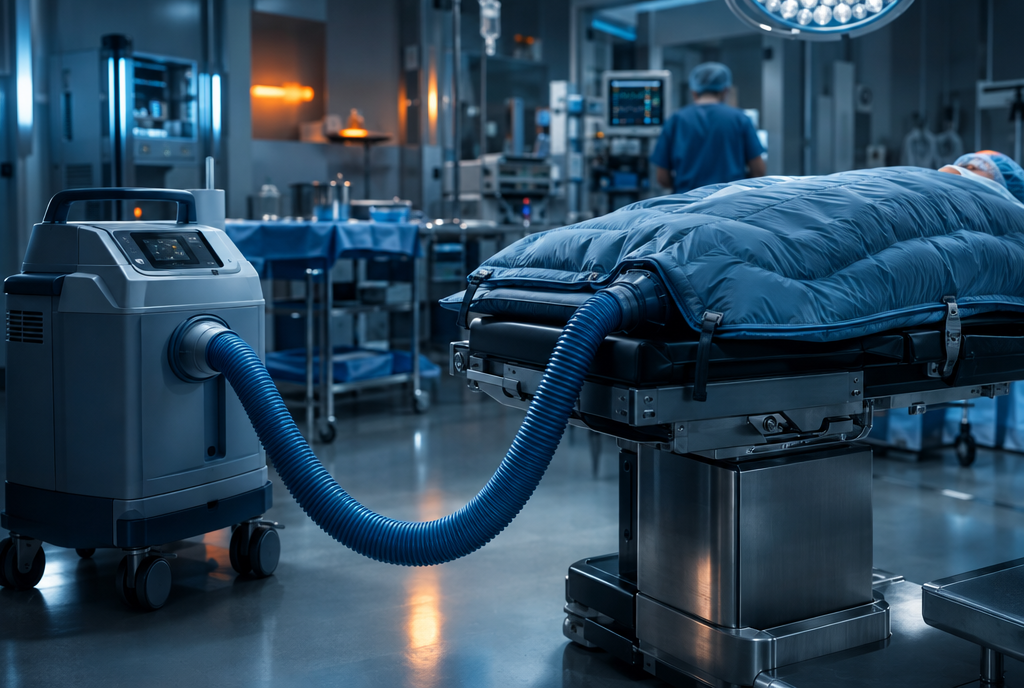
Forced-air warming blows heated, filtered air from a bedside unit through a hose into a disposable blanket or gown, which releases it through small perforations over the patient's skin. It warms by convection and also blocks radiant loss to the room. It is the most widely used active warming method in surgery and the default recommended by NICE for anesthesia longer than 30 minutes.
How does forced-air warming work?
A forced-air system has three parts: a reusable warming unit with a fan, heater and filter; a flexible hose; and a single-patient blanket or gown. Heated air passes through the hose into the blanket and exits through micro-perforations on the side facing the patient, bathing the skin in a layer of warm air.
The physics explain why it works well. In the operating room, heat is lost mainly by radiation, followed by convection. A forced-air blanket replaces the cool air next to the skin with warm air, reversing convective loss, and the blanket itself shields the skin from radiating to cold room surfaces. Depending on blanket design, up to 64 percent of body surface area can be involved in heat transfer, according to published descriptions of the most common system.
What types of forced-air blankets are there?
Blankets are designed around surgical access, because the more skin covered, the more heat delivered.
| Blanket type | Typical use |
|---|---|
| Upper-body | Lower abdominal, pelvic and lower-limb surgery |
| Lower-body | Upper abdominal, thoracic, head and neck surgery |
| Full-body or underbody | Cases where the top of the patient is inaccessible, or pediatric cases |
| Torso or specialty | Lateral positioning, cardiac or procedure-specific access |
| Warming gown | Prewarming in holding, then connected intraoperatively and in recovery |
Who makes forced-air warming systems?
The best-known system is Bair Hugger, designed by Minnesota anesthesiologist Scott Augustine and launched in 1987. It was produced by Arizant, later acquired by 3M, and the line is now held by Solventum following 3M's health care spin-off. Other forced-air systems include Mistral-Air, and several manufacturers offer compatible units and blankets.
Systems differ in blanket designs, temperature settings, noise, filtration and cost per case. Those differences matter to purchasing teams, but the underlying convective principle is the same across brands.
How effective is forced-air warming?
Forced-air warming has the largest evidence base of any active warming method. OpenAnesthesia describes it as the most commonly used approach because it is effective, inexpensive and easy to use, and NICE CG65 recommends it intraoperatively for anesthesia longer than 30 minutes, or shorter cases in higher-risk patients, and postoperatively for patients below 36.0°C.
Head-to-head data are mixed but generally favorable. In a 2016 randomized trial of 160 patients in the British Journal of Anaesthesia, forced-air warming produced a slightly higher final intraoperative temperature than resistive heating (36.1°C vs 35.9°C) and less hypothermia at the end of surgery (36 percent vs 54 percent). The authors also noted that hypothermia remained common in both groups.
That last point is important. Forced air reduces hypothermia but does not eliminate it, especially when warming starts only after induction. It works best combined with prewarming, warmed fluids and continuous monitoring.
How do teams get the most out of forced-air warming?
Most of the performance difference between good and poor results comes from how the system is used rather than which unit is on the cart. A few habits make the largest difference.
Start early: use a warming gown or blanket in pre-op holding rather than waiting for induction.
Maximize coverage: choose the blanket that exposes only what the surgeon needs, and keep uncovered skin covered by drapes or insulation.
Connect before draping: repositioning under drapes is difficult, so check placement and airflow first.
Keep it running: continue warming through the case and into recovery rather than stopping at closure.
Measure core temperature: set the unit according to the manufacturer's instructions and adjust to the patient's measured temperature, not to the feel of the blanket.
What are the practical limitations?
Every warming method involves trade-offs, and those of forced air are well described. They shape how and where it is used, and they are the main reasons hospitals keep conductive and passive options available alongside it.
Coverage: heat transfer depends on how much skin the blanket can cover, which surgical access may limit.
Setup: the blanket must be positioned and connected correctly before draping, and blankets are typically single-patient use.
Hose safety: device instructions require the hose to be used only with a connected blanket, because blowing hot air directly on skin can cause burns.
Noise and airflow: the blower adds noise, and its airflow in the room has been studied and debated in ultraclean orthopedic settings.
Staff comfort: warm exhaust air can make the surgical field area warmer for the team while other staff stay cold.
Is forced-air warming safe?
Forced-air warming has been the subject of product-liability litigation over a disputed theory that its airflow can contribute to surgical site infection, and in an August 2017 letter to health care providers the FDA said it could not identify a consistently reported association between forced-air thermal regulating systems and surgical site infection and that it continues to recommend thermoregulating devices, including forced-air systems, when clinically warranted.
Clinicians choose a warming method based on the procedure, patient, positioning and local evidence review. Patients with questions about which method will be used for them should talk to a clinician on their anesthesia team.
Key takeaways
Forced-air warming delivers heated air through a perforated blanket, reversing convective loss and blocking radiant loss.
It is the most widely used active warming method and the NICE default for anesthesia longer than 30 minutes.
Coverage area drives effectiveness, so blanket choice follows surgical access.
It reduces but does not eliminate hypothermia; prewarming and fluid warming still matter.
FDA stated in 2017 that it continues to recommend thermoregulating devices, including forced air, when clinically warranted.
Frequently asked questions
What is a forced-air warming blanket?
It is a single-patient blanket or gown with small perforations on the side facing the patient. A bedside unit blows heated air into it through a hose, and the air escapes over the skin to warm the patient.
How warm does a forced-air warmer get?
Units offer several set points, and the temperature at the skin depends on the blanket, airflow and coverage. Clinicians select settings according to the manufacturer's instructions and monitor the patient's core temperature throughout.
Is Bair Hugger the same as forced-air warming?
Bair Hugger is a brand of forced-air warming system, and it is the best-known one. Forced-air warming is the general method, and other manufacturers make systems that work on the same principle.
Can forced-air warming be used before and after surgery?
Yes. Warming gowns and blankets are used for prewarming in the holding area and for rewarming in recovery. NICE recommends forced-air warming in recovery for patients whose temperature is below 36.0°C.
What did the FDA say about forced-air warming?
In an August 2017 letter to health care providers, the FDA said it could not identify a consistently reported association between forced-air systems and surgical site infection. It said it continues to recommend thermoregulating devices, including forced air, when clinically warranted.
From HEATJAC
We design low-profile thermal garments: a heat-reflective vest and a thermal harness with pockets for warmers or cold packs.
Choosing gear? What nurses and OR staff should look for in thermal gear · Getting a thermal vest approved for clinical areas
Related reading
Sources
Bair Hugger, Wikipedia
Intraoperative Hypothermia, OpenAnesthesia (International Anesthesia Research Society)
Hypothermia: prevention and management in adults having surgery (CG65), Recommendations, National Institute for Health and Care Excellence (NICE)
Comparison of resistive heating and forced-air warming to prevent inadvertent perioperative hypothermia (John et al., British Journal of Anaesthesia, 2016), British Journal of Anaesthesia
Forced Air Thermal Regulating Systems: Healthcare Provider Letter, Information About Use (FDA, August 2017), American Society of Anesthesiologists (FDA alert)
Maintaining Normothermia: Implementing AORN's Updated Patient Temperature Management Guideline, AORN
About HEATJAC. HEATJAC is a thermal architecture company founded by an anesthesiologist. We design patented garment systems that capture, conduct and broaden warmth across the body, and we publish this knowledge hub because the science of staying warm should be public. HEATJAC products are not medical devices and are not intended to diagnose, treat, cure or prevent any disease.