
Conductive and resistive patient warming explained
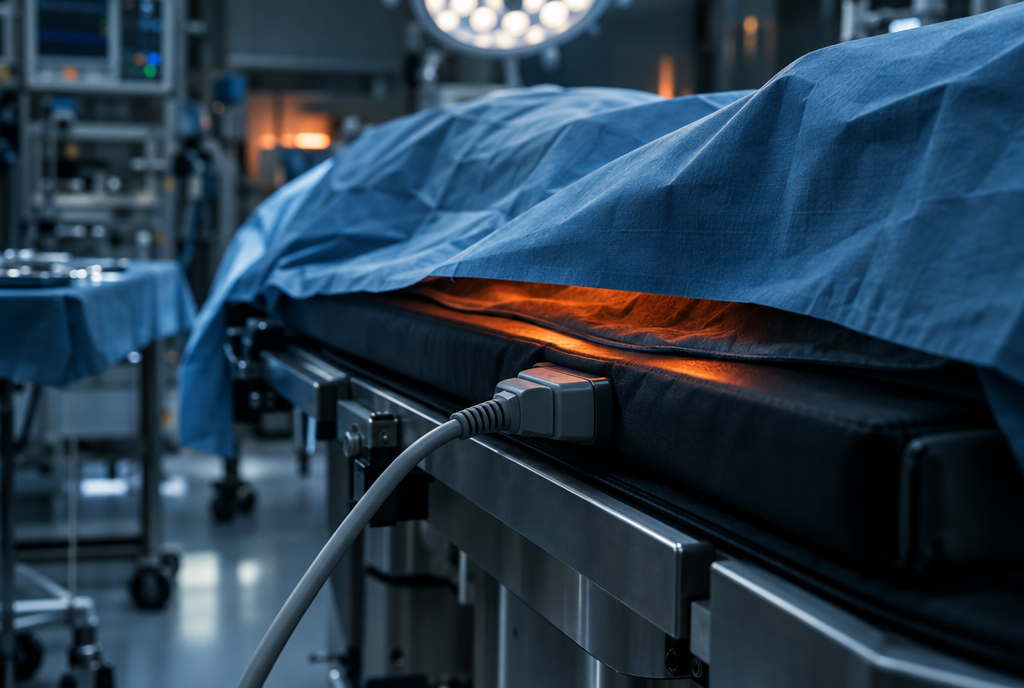
Conductive patient warming transfers heat through direct contact between a warm surface and the patient's skin. The two main forms are electric resistive systems, which pass a low-voltage current through a carbon or polymer fabric in blankets and mattresses, and circulating-water systems, which pump temperature-controlled water through pads or mattresses. NICE recommends considering resistive warming when forced air is unsuitable.
What is conductive warming?
Conduction is heat flow through direct contact. A conductive warming device holds a warm surface against the skin, and heat moves from the warmer material into the cooler tissue. Unlike forced-air warming, no air stream is involved, which is why manufacturers often describe these systems as air-free.
In clinical use, the term covers several technologies. What they share is a heated surface, a controller that regulates its temperature, and placement either over the patient, under the patient, or both.
How do resistive fabric blankets and mattresses work?
Resistive systems heat a flexible conductive material by passing a low-voltage electric current through it, much as a heated car seat does, but with medical temperature controls and sensors. The heating element is sealed inside a wipeable cover, so blankets and mattresses are typically reusable.
HotDog, made by Augustine Surgical, is one example: a controller sends low-voltage current to up to five warming devices made with a conductive polymer fabric, including overbody blankets and underbody mattresses that the manufacturer states can also serve as electrosurgical return electrodes. Inditherm is another brand of carbon-polymer warming mattress. Several other manufacturers offer comparable resistive products.
Controllers typically let staff choose a set point and use sensors in the device to hold it. That regulation is what separates a medical resistive warmer from a consumer heating pad, which lacks the temperature control and monitoring needed for anesthetized patients who cannot feel or report heat.
How do circulating-water systems work?
Circulating-water systems pump temperature-controlled water through mattresses, wraps or pads in contact with the skin. Because water carries heat efficiently, these systems can both warm and cool.
The Arctic Sun system from BD is a well-known high-acuity example. It uses hydrogel pads applied to the skin, with water circulating through them, and a closed feedback loop that monitors the patient's core temperature and makes automatic adjustments toward a target. BD lists uses such as post-cardiac arrest temperature management and fever control in critically ill patients, which places it mainly in intensive care rather than routine surgery.
How do the conductive options compare?
The three common forms differ mainly in where they are used and how they are controlled.
| Type | How heat is delivered | Typical setting |
|---|---|---|
| Resistive overbody blanket | Electrically heated fabric over the patient | Operating room, pre-op, recovery |
| Resistive underbody mattress | Heated pad under the patient on the table | Operating room, often combined with an overbody blanket |
| Circulating-water mattress or wrap | Warm water pumped through a contact surface | Operating room, cardiac surgery |
| Hydrogel pad systems with feedback | Circulating water through adhesive pads, controlled by core temperature | Intensive care, targeted temperature management |
What does the evidence show?
NICE CG65 names forced air as the default intraoperative method and advises clinicians to consider a resistive heating mattress or blanket if forced-air warming is unsuitable. That wording reflects a larger evidence base for forced air, not a finding that resistive warming does not work.
Trials point in different directions depending on design. A 2016 randomized trial of 160 patients in the British Journal of Anaesthesia found slightly better temperatures with forced air than with resistive heating. AORN's evidence table includes a 2021 randomized trial that found resistive fabric warming as effective as forced air in older adults having hip hemiarthroplasty. A 2025 trial in PLOS One found conductive prewarming plus conductive intraoperative warming produced the lowest hypothermia burden of four strategies tested.
Where does conductive warming fit in the perioperative pathway?
Conductive devices can cover every phase. Blankets can be applied in pre-op holding for prewarming, left in place through induction and surgery, and used again in recovery. An underbody mattress is placed on the table before the patient arrives, so it is already warm at transfer.
They do not replace the rest of the bundle. NICE still expects temperature to be measured before induction and every 30 minutes, intravenous fluids of 500 ml or more to be warmed to 37°C, and the room to be at least 21°C while the patient is exposed. A warming surface compensates for heat loss; it does not stop cold fluids or a cold room from drawing heat away.
What are the practical advantages and limits?
Underbody access: a mattress warms the back, a large surface that overbody blankets cannot reach.
No airflow: there is no air stream across the surgical field, which some teams prefer for ultraclean procedures.
Quiet operation and reusable pads can suit high-volume rooms, though cleaning between patients is required.
Contact matters: heat only transfers where the surface touches skin, so placement and positioning affect performance.
Heat and pressure: tissue under pressure has reduced blood flow to carry heat away, so device instructions set temperature and placement limits.
How should a hospital choose?
Most hospitals keep more than one method. Conductive systems are commonly selected for long procedures, positions that limit overbody coverage, and settings where teams prefer to avoid airflow near the field. The choice should rest on local evidence review, procedure mix and staff training rather than a single trial.
Patients with questions about which warming method will be used for them should talk to a clinician on their anesthesia team.
Key takeaways
Conductive warming moves heat by direct contact, with no air stream.
Resistive systems heat carbon or polymer fabric in blankets and mattresses; circulating-water systems pump warm water through pads.
NICE advises considering resistive warming when forced air is unsuitable.
Trials comparing conductive and forced-air warming reach different conclusions depending on design and timing.
Underbody warming reaches the back, but contact and pressure make placement critical.
Frequently asked questions
What is the difference between conductive and resistive warming?
Conductive describes how heat reaches the patient, through direct contact. Resistive describes how the surface is heated, by electric current through a resistive material. Most resistive blankets and mattresses therefore warm the patient conductively.
Is conductive warming as effective as forced-air warming?
Evidence is mixed. Some trials found slightly better temperatures with forced air, while others found resistive warming equivalent, and a 2025 trial found conductive warming with prewarming performed best among the strategies tested.
What is an underbody warming mattress?
It is a heated pad placed on the operating table beneath the patient. It warms the back and buttocks, which are covered and inaccessible to overbody blankets during most procedures.
Is Arctic Sun used for surgical warming?
Arctic Sun is a circulating-water system with hydrogel pads and closed-loop temperature control. BD positions it mainly for targeted temperature management, such as after cardiac arrest and for fever control, rather than routine surgical warming.
Are conductive warming blankets reusable?
Many resistive blankets and mattresses have sealed, wipeable covers and are cleaned between patients. Hydrogel pads for circulating-water systems are typically single-patient items. Always follow the manufacturer's instructions.
From HEATJAC
We design low-profile thermal garments: a heat-reflective vest and a thermal harness with pockets for warmers or cold packs.
Choosing gear? What nurses and OR staff should look for in thermal gear · Getting a thermal vest approved for clinical areas
Related reading
Sources
Hypothermia: prevention and management in adults having surgery (CG65), Recommendations, National Institute for Health and Care Excellence (NICE)
HotDog Patient Warming System, Augustine Surgical
Comparison of resistive heating and forced-air warming to prevent inadvertent perioperative hypothermia (John et al., British Journal of Anaesthesia, 2016), British Journal of Anaesthesia
AORN Guideline for Patient Temperature Management: Evidence Table, AORN
About HEATJAC. HEATJAC is a thermal architecture company founded by an anesthesiologist. We design patented garment systems that capture, conduct and broaden warmth across the body, and we publish this knowledge hub because the science of staying warm should be public. HEATJAC products are not medical devices and are not intended to diagnose, treat, cure or prevent any disease.