
Passive vs active warming: when each is used
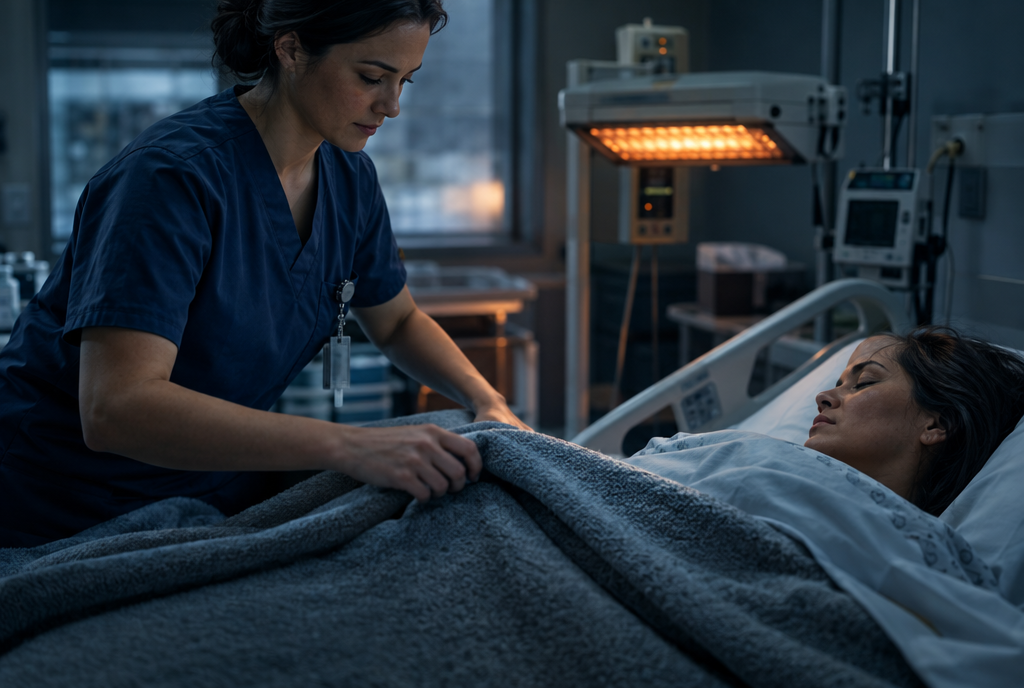
Passive warming reduces heat loss by insulating the patient with blankets, heat-reflective layers or clothing, but relies on the body's own heat. Active warming adds external heat through devices such as forced-air, resistive or circulating-water systems. In surgery, anesthesia blunts the body's heat production and defenses, so guidelines favor active warming for most anesthetized patients and use passive measures as support.
What is passive warming?
Passive warming, often called passive insulation, slows heat loss without adding heat. Cotton blankets, warmed blankets, head coverings, socks, reflective blankets and simply keeping skin covered all fall into this category. They trap a layer of still air next to the body and reduce radiant and convective loss to the room.
The limitation is built in: passive methods can only conserve the heat a person produces. OpenAnesthesia estimates that a single layer of insulating blanket reduces heat loss by about 30 percent. That is meaningful for an awake patient who can shiver and constrict blood vessels, but under anesthesia those defenses are suppressed.
What is active warming?
Active warming uses an external energy source to add heat to the body. In perioperative care the main options are forced-air blankets and gowns, resistive fabric blankets and mattresses, circulating-water pads, and single-use self-warming blankets. Mölnlycke's Barrier EasyWarm, for example, is described as a single-use active self-warming blanket whose heat is generated when its pads are exposed to air.
Fluid warming is also classed as active, but it works differently. OpenAnesthesia notes that warming intravenous fluids does not significantly warm patients; it prevents cooling, since each liter of unwarmed fluid lowers mean body temperature in an adult by about 0.25°C.
How do passive and active warming compare?
The table summarizes the main options by category.
| Method | Category | Where it fits |
|---|---|---|
| Cotton or warmed blankets | Passive | Comfort, pre-op, recovery, adjunct to active warming |
| Reflective blankets and gowns | Passive | Transport, holding areas, trauma and EMS |
| Forced-air blankets and gowns | Active | Prewarming, intraoperative, recovery |
| Resistive blankets and mattresses | Active | Intraoperative, prewarming, recovery |
| Circulating-water pads | Active | Intraoperative and intensive care |
| Self-warming chemical blankets | Active | Settings without powered warmers |
| IV and irrigation fluid warmers | Active (prevents cooling) | Any case with significant fluid volumes |
Why does anesthesia tip the balance toward active warming?
An awake, cold person defends core temperature in three ways: behavior, such as asking for a blanket; vasoconstriction, which keeps warm blood away from the skin; and shivering, which multiplies heat production. General anesthesia removes the first and blunts the other two. OpenAnesthesia notes that the vasoconstriction threshold falls to about 34.5°C under anesthesia, with shivering about a degree lower.
Anesthesia also causes redistribution: vessels in the limbs dilate and warm core blood moves outward, lowering core temperature by about 1 to 1.5°C in the first hour. Insulation cannot reverse a shift of heat that happens inside the body. Only heat added from outside, ideally before induction, offsets it, which is why guidance moves from passive to active measures at exactly this point in the pathway.
What do the guidelines recommend?
AORN's 2025 guideline update reinforces the importance of active warming methods, such as forced-air warming, over passive insulation. AORN's evidence table includes a 2019 randomized trial in which forced-air warming was significantly more effective than a passive thermal suit at re-establishing normothermia.
NICE CG65 uses passive measures throughout the pathway and adds active warming at defined points. Patients are encouraged to bring warm clothing such as a dressing gown before surgery, active warming starts at least 30 minutes before induction, forced-air warming is used for anesthesia longer than 30 minutes or for higher-risk patients, and in recovery patients should have at least one cotton sheet plus two blankets, or a duvet. Patients below 36.0°C in recovery are actively warmed with forced air until comfortably warm.
When is passive warming enough?
Passive warming can be sufficient for short procedures in lower-risk patients, for awake patients with intact thermoregulation, and for comfort once a patient is normothermic. NICE limits intraoperative active warming to anesthesia longer than 30 minutes unless the patient is at higher risk, which implies that some short, low-risk cases can be managed with insulation and monitoring.
Passive methods also matter wherever active devices are unavailable: during transport between units, in emergency and prehospital care, and in low-resource settings.
How do heat-reflective blankets fit in?
Reflective products are a form of passive warming that targets radiant loss, the main route of heat loss in cool rooms. Encompass Group's Thermoflect line, for example, combines a vaporized aluminum layer that reflects body heat with a quilted insulating layer and a protective outer film, and is made as reusable blankets and gowns.
Reflective layers work best when they also trap still air and stay dry, which is why well-designed products pair a reflective surface with insulation. Like all passive methods, they conserve heat rather than adding it.
How do the two work together?
The most effective perioperative programs treat passive and active methods as layers. Passive insulation covers skin the active device cannot reach and keeps patients comfortable in transport, while active devices supply heat during the period when anesthesia disables the body's own defenses.
In recovery, the layers reverse. Once a patient is awake and at or above 36.0°C, insulation and warm blankets are usually enough, and active warming is reserved for patients who arrive below that threshold, as NICE recommends.
Patients with questions about how they will be kept warm should talk to a clinician on their surgical or anesthesia team.
Key takeaways
Passive warming conserves the body's own heat; active warming adds heat from outside.
A single insulating blanket reduces heat loss by roughly 30 percent, which is not enough under anesthesia for most cases.
AORN's 2025 update favors active warming over passive insulation.
NICE uses passive measures throughout and adds active warming before, during and after surgery at defined points.
Reflective blankets are passive and target radiant loss, the largest route of heat loss in cool rooms.
Frequently asked questions
What is the difference between passive and active warming?
Passive warming reduces heat loss with insulation such as blankets or reflective layers. Active warming adds heat from an external source, such as a forced-air, resistive or circulating-water device.
Are warm blankets passive or active warming?
Warmed cotton blankets are considered passive. They deliver a brief amount of heat from the warming cabinet but then act as insulation and cool to room temperature.
Is a space blanket active warming?
No. Reflective blankets are passive. They reduce radiant heat loss but do not add heat, so the person must still be producing heat for them to help.
When is active warming required during surgery?
NICE recommends active warming for anesthesia longer than 30 minutes, and for shorter cases in patients at higher risk of hypothermia. It also recommends active prewarming for at least 30 minutes before induction.
Does warming IV fluids warm the patient?
Not significantly. Fluid warming prevents the cooling that cold fluids would cause, about 0.25°C per liter in an adult, so it is essential but must be combined with surface warming.
From HEATJAC
We design low-profile thermal garments: a heat-reflective vest and a thermal harness with pockets for warmers or cold packs.
Choosing gear? What nurses and OR staff should look for in thermal gear · Getting a thermal vest approved for clinical areas
Related reading
Sources
Intraoperative Hypothermia, OpenAnesthesia (International Anesthesia Research Society)
Maintaining Normothermia: Implementing AORN's Updated Patient Temperature Management Guideline, AORN
AORN Guideline for Patient Temperature Management: Evidence Table, AORN
Hypothermia: prevention and management in adults having surgery (CG65), Recommendations, National Institute for Health and Care Excellence (NICE)
Thermoflect Heat Reflective Technology, Encompass Group
Barrier EasyWarm active self-warming blanket (product listing), MedicalExpo / Molnlycke Health Care
About HEATJAC. HEATJAC is a thermal architecture company founded by an anesthesiologist. We design patented garment systems that capture, conduct and broaden warmth across the body, and we publish this knowledge hub because the science of staying warm should be public. HEATJAC products are not medical devices and are not intended to diagnose, treat, cure or prevent any disease.