
Normal body temperature by age and method (°F and °C)
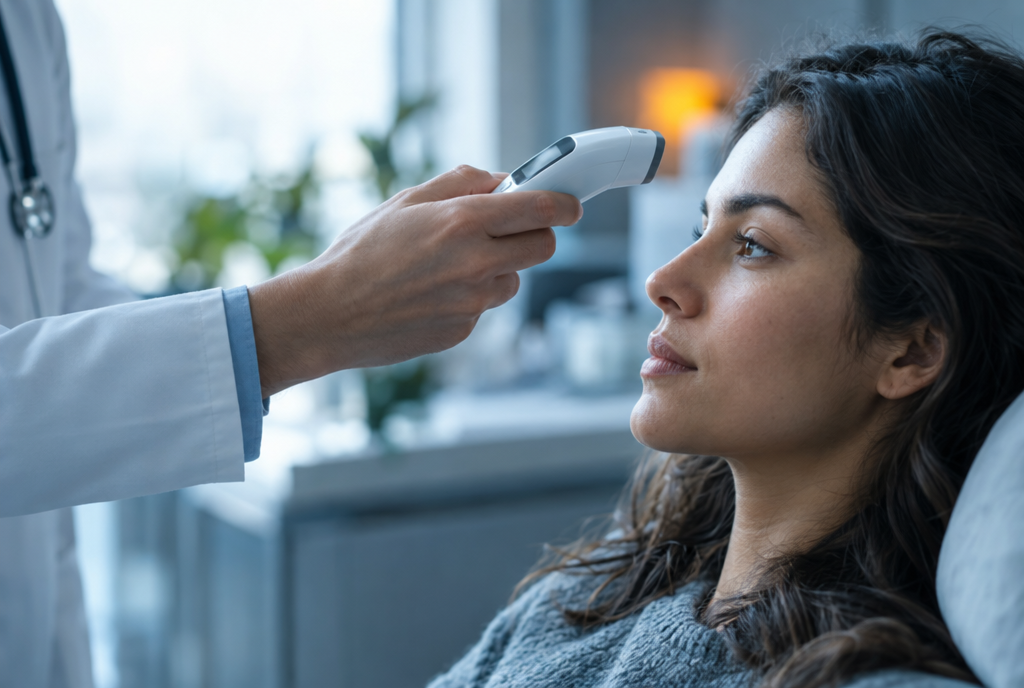
Normal adult body temperature is a range, roughly 97 to 99 °F (36.1 to 37.2 °C), not a single number. It is lowest in the early morning, around 4 AM, and highest in the late afternoon. Rectal readings run a little higher than oral ones, and armpit readings lower. Below 95 °F (35 °C) is hypothermia; above 100.4 °F (38 °C) generally means fever.
What is a normal temperature by measurement method?
Where you take a reading changes the number. Johns Hopkins Medicine gives a normal adult range of 97.8 to 99 °F (36.5 to 37.2 °C), with rectal readings about 0.5 to 0.7 °F (0.3 to 0.4 °C) higher than oral ones and armpit readings about 0.3 to 0.4 °F (about 0.2 °C) lower. The fever thresholds below are those Seattle Children's Hospital uses for each method. Compare readings taken the same way, and talk to a clinician about a fever that worries you.
| Method | Typical normal range | Fever at or above |
|---|---|---|
| Oral (under the tongue) | 97.8 to 99 °F (36.5 to 37.2 °C) | 100 °F (37.8 °C) |
| Rectal | About 0.5 to 0.7 °F (0.3 to 0.4 °C) higher than oral | 100.4 °F (38 °C) |
| Ear | Measures the eardrum, which reflects core temperature | 100.4 °F (38 °C) |
| Armpit | About 0.3 to 0.4 °F (about 0.2 °C) lower than oral | 99 °F (37.2 °C) |
| Forehead | Can be less accurate in direct sun, cold or on a sweaty forehead | 100.4 °F (38 °C) |
What is the normal body temperature range?
Clinical references describe healthy core temperature as about 37°C, plus or minus 0.5°C, which is roughly 97.7 to 99.5°F. Cleveland Clinic gives a broader everyday window of 97 to 99°F and a range of 97.6 to 99.6°F for adults aged 11 to 65. A standard physiology text puts the range at 36.1 to 37.2°C.
Age matters. Cleveland Clinic lists 96.4 to 98.5°F as typical for adults over 65, which is one reason a mild fever can be easy to miss in older people.
| Threshold | Fahrenheit | Celsius |
|---|---|---|
| Typical adult range | 97 to 99°F | 36.1 to 37.2°C |
| Typical range, adults over 65 | 96.4 to 98.5°F | 35.8 to 36.9°C |
| Fever (generally) | Above 100.4°F | Above 38°C |
| Hypothermia | Below 95°F | Below 35°C |
Is 98.6°F still normal?
The 98.6°F (37°C) figure comes from the 19th-century German physician Carl Wunderlich, who based it on measurements from thousands of patients. It became the textbook number, but it describes an average, not a target every healthy person should hit.
Modern data suggest average temperatures are lower. A 2020 study in eLife analyzing U.S. records spanning the 19th and 20th centuries found temperatures falling by about 0.03°C per birth decade, and cited a large British study with a mean oral temperature of 36.6°C (about 97.9°F). The authors linked the decline to lower resting metabolism and less chronic inflammation.
Why does body temperature change during the day?
Core temperature follows a circadian rhythm. It is usually lowest in the early morning, around 4 AM, and highest in the late afternoon or early evening, around 6 PM. Meals, exercise, sleep, hormones and illness shift it further.
Measurement site also matters. Cleveland Clinic notes that an under-the-tongue reading will likely be slightly higher than a forehead or armpit reading. Compare readings from the same method and time of day rather than against a single universal number.
How does thermoregulation work?
Thermoregulation is a feedback loop. Temperature sensors in the skin, spinal cord and brain report to the hypothalamus, which acts like a thermostat with a set point. When temperature drifts, it triggers responses to push it back.
In the cold, the sympathetic nervous system constricts skin arterioles so blood bypasses the skin and less heat escapes. If that is not enough, the body raises heat production through shivering, involuntary muscle contractions controlled from the posterior hypothalamus. Infants also rely on brown fat for non-shivering heat production.
In the heat, skin vessels widen to carry warm blood to the surface, and sweat glands release fluid that cools the skin as it evaporates. Behavior completes the loop: adding or removing layers, seeking shade or shelter and changing activity are all part of thermoregulation.
Sense: skin and core thermoreceptors detect change.
Integrate: the hypothalamus compares input with its set point.
Conserve heat: skin vasoconstriction, then shivering.
Shed heat: skin vasodilation and sweating.
Behave: clothing, shelter, activity and posture.
How does the body lose heat?
Heat leaves the body mostly through the skin by four routes. A standard physiology reference estimates radiation at about 60% of total body heat loss, evaporation at about 22% and conduction and convection together at about 15%, with the skin accounting for roughly 90% of total loss. Wind, water and cold surfaces can change those shares dramatically.
The body tolerates only a small drop in core temperature before function suffers. Hypothermia begins below 95°F (35°C). Older adults, young children and people with conditions such as hypothyroidism or diabetes are at higher risk, according to Mayo Clinic.
Why can you feel cold with a normal temperature?
Feeling cold is driven largely by skin temperature, not core temperature. When the body narrows skin vessels to conserve heat, the skin of the hands, feet and face cools even though the core stays normal. A thermometer reading of 98°F can sit alongside icy fingers.
Body size, muscle mass, activity, sleep, meals and some medical conditions all influence how warm people feel at the same room temperature. Frequent or new cold intolerance that others around you do not share is worth mentioning to a clinician, because thyroid problems and other conditions can play a role.
When should you worry about a low or high temperature?
A single reading slightly above or below average is usually not a concern if you feel well. Persistent low readings, readings that come with confusion, heavy shivering, drowsiness or slurred speech, or a fever with worrying symptoms need attention.
This page is educational and not a substitute for professional care. Talk to a clinician about symptoms, especially for infants, older adults and anyone with a chronic condition.
Key takeaways
Normal adult temperature is a range, about 97 to 99°F (36.1 to 37.2°C), not a fixed 98.6°F.
Temperature is lowest in the early morning and highest in the late afternoon or early evening.
The hypothalamus manages temperature through skin blood flow, shivering and sweating.
Radiation is the largest route of heat loss; the skin handles about 90% of it.
Hypothermia starts below 95°F (35°C); fever generally means above 100.4°F (38°C).
Frequently asked questions
What is a normal body temperature for adults?
Most healthy adults run between about 97 and 99°F (36.1 to 37.2°C). Individual baselines differ, and readings shift through the day and with the measurement method.
Is 97°F a normal temperature?
For many adults, yes, especially in the morning or with an armpit or forehead reading. If a low reading comes with symptoms such as confusion, drowsiness or heavy shivering, seek medical advice.
What temperature is hypothermia?
Hypothermia is a core body temperature below 95°F (35°C). It is a medical emergency when accompanied by confusion, slurred speech or drowsiness.
Why is my temperature lower in the morning?
Core temperature follows a daily rhythm and usually reaches its low point in the early morning. It rises through the day and peaks in the late afternoon or early evening.
Why do older adults run cooler?
Cleveland Clinic lists a typical range of 96.4 to 98.5°F for adults over 65. Changes in metabolism, muscle mass and temperature regulation with age can lower baseline temperature and blunt responses to cold.
Is 35.8 a fever?
No. 35.8 °C is 96.4 °F, which is at or slightly below the low end of normal, and Cleveland Clinic lists it as the bottom of the typical range for adults over 65. Hypothermia starts below 35 °C (95 °F). A low reading with confusion, drowsiness or heavy shivering needs medical attention.
When does body temperature reach its lowest point in a 24-hour cycle?
Core temperature is usually lowest around 4 AM and highest around 6 PM, according to StatPearls. Morning readings can therefore be a few tenths of a degree below afternoon readings in the same healthy person.
What is normal core body temperature?
Healthy core temperature is about 37 °C (98.6 °F), within about half a degree Celsius either way, which is roughly 97.7 to 99.5 °F (36.5 to 37.5 °C). Mayo Clinic says rectal readings are the most accurate, and oral readings are similar in accuracy and less invasive.
What is the set point for body temperature?
The set point is the temperature the hypothalamus works to maintain, about 37 °C (98.6 °F) in most people. StatPearls explains that during a fever, substances called pyrogens act on the hypothalamus and raise the set point, so the body works to hold a higher temperature.
Is 36.1 a normal temperature for an adult?
Yes. 36.1 °C is about 97 °F, the low end of the normal adult range of 97 to 99 °F (36.1 to 37.2 °C) given by Cleveland Clinic and MedlinePlus. Readings this low are common in the early morning and with armpit or forehead thermometers. If you feel well, it is not a concern.
Is 97.4 °F a high temperature?
No. 97.4 °F is about 36.3 °C, which sits inside the normal adult range and is slightly below the familiar 98.6 °F (37 °C) average. Seattle Children's puts the fever threshold at 100.4 °F (38 °C) for a rectal, ear or forehead reading and 100 °F (37.8 °C) taken by mouth.
Is 92.6 °F a normal temperature?
No. 92.6 °F is about 33.7 °C, below the 95 °F (35 °C) threshold for hypothermia if it were a true core reading. A reading this low in a person who seems well is often a measurement error: Mayo Clinic notes that forehead thermometers can be less accurate in cold temperatures, and that you should wait about 15 minutes after coming in from the cold before using an ear thermometer. Recheck with an oral or rectal thermometer, and get emergency care if the low reading is confirmed or comes with shivering, confusion, slurred speech, drowsiness or slow breathing.
From HEATJAC
We design low-profile thermal garments: a heat-reflective vest and a thermal harness with pockets for warmers or cold packs.
Choosing gear? Heated vest vs heat-reflective vest · The thermal gear buying, safety and care guide
Related reading
Sources
Physiology, Temperature Regulation (StatPearls), NCBI Bookshelf, National Library of Medicine
Physiology, Thermal Regulation (StatPearls), NCBI Bookshelf, National Library of Medicine
Physiology, Heat Loss (StatPearls), NCBI Bookshelf, National Library of Medicine
What Is a Normal Body Temperature?, Cleveland Clinic
Decreasing human body temperature in the United States since the Industrial Revolution, eLife (Protsiv et al., 2020)
Hypothermia: Symptoms and causes, Mayo Clinic
Vital Signs (Body Temperature, Pulse Rate, Respiration Rate, Blood Pressure), Johns Hopkins Medicine
Body temperature norms, MedlinePlus, National Library of Medicine
Fever: How to Take the Temperature, Seattle Children's Hospital
Fever: Symptoms and causes, Mayo Clinic
Thermometers: Understand the options, Mayo Clinic
About HEATJAC. HEATJAC is a thermal architecture company founded by an anesthesiologist. We design patented garment systems that capture, conduct and broaden warmth across the body, and we publish this knowledge hub because the science of staying warm should be public. HEATJAC products are not medical devices and are not intended to diagnose, treat, cure or prevent any disease.