
Thermal gear for anesthesia providers: what works at the head of the bed
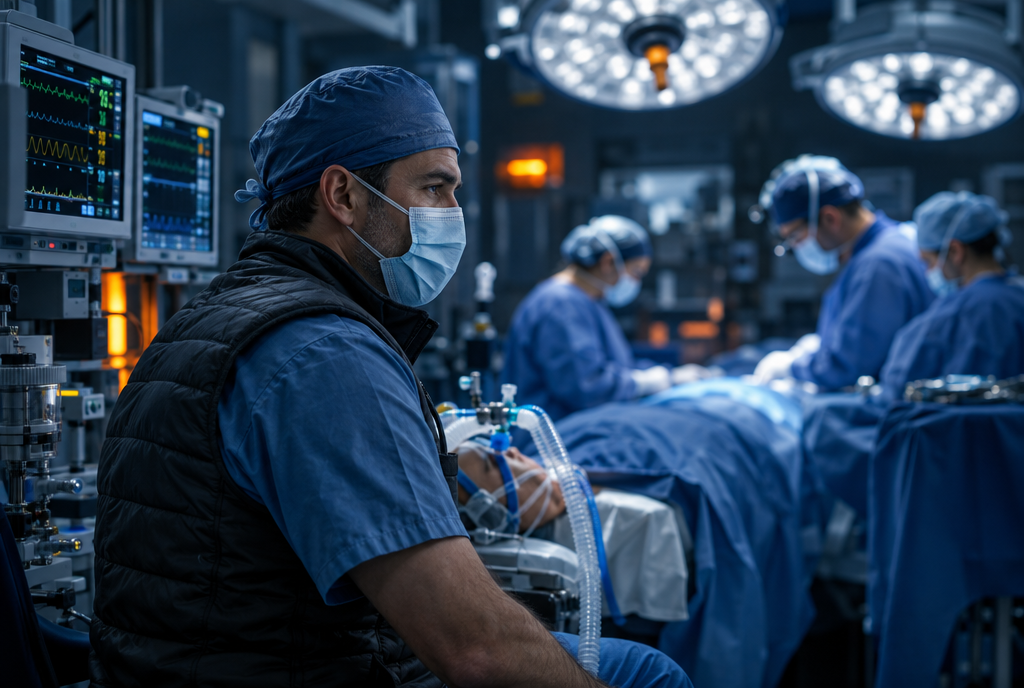
Anesthesia providers are often the coldest people in the operating room: seated, in scrubs alone, near the supply airflow, for hours. Buy for that position. Prioritize core warmth, sleeves that stay clear of lines and monitors, low bulk at the chest and shoulders, quiet fabrics and closures, and heat you can adjust without leaving the patient. Passive layers avoid most battery policy questions.
Why is the head of the bed the coldest seat in the room?
Anesthesia work combines low physical activity with a position close to the patient's head and the ventilation stream. A 2026 study in Atmosphere measured 20.1°C to 20.7°C and air speeds near 0.28 meters per second in a working operating room, and estimated that about 22% of female anesthesiologists would experience predominantly cold discomfort. The authors recommended clothing-based insulation and localized heating for anesthesia staff.
Our article on the OR thermal comfort gap covers the research in depth. This guide turns it into buying criteria for the person at the drapes.
What should anesthesia providers look for in thermal gear?
Forum threads from CRNAs and residents asking how to stay warm in surgery tend to land on the same fixes: layers under scrubs, a jacket, and warm blankets borrowed from the warmer. A purpose-bought layer should do better than improvising, and it has to pass these checks.
Low bulk at the chest and shoulders, so you can lean in for the airway and reach the far arm board.
Sleeves and cuffs that stay back from IV lines, arterial lines and the anesthesia circuit.
No loose cords, straps or toggles that can catch on tubing, monitor cables or cart handles.
Quiet fabrics and closures that do not rustle or rip loudly near a patient or during critical communication.
Front access, so you can add or remove heat without leaving the head of the bed.
A fabric and care label that meet your facility's attire and laundering policy.
Sleeves or core: where should the warmth go?
A warm-up jacket covers the arms, which sit closest to the airflow and the cold surfaces of the cart. AORN describes the long-sleeve scrub jacket, also called a warm-up jacket, as part of attire in semi-restricted and restricted areas. The downside is cuff management around lines and during hand hygiene.
A core vest keeps the torso warm with the arms free. When the body cools, it prioritizes the core, so a warm torso supports warmer hands for fine work; see our article on cold hands and dexterity. For most providers the answer is both: a thin vest under the scrub top and a jacket that goes on and off with the phase of the case.
When you gown for a central line or a nerve block, whatever you wear has to fit under the sterile gown without bunching at the cuffs, which favors a thin vest over thick sleeves.
Which setup fits your situation?
Use this as a starting point, then adjust to your rooms and your facility's rules.
| If you... | Choose | Watch for |
|---|---|---|
| Feel cold mainly in the arms and shoulders | Facility warm-up jacket over a thin long-sleeve base layer | Cuffs that ride up or snag on lines |
| Get cold hands on long, quiet cases | Core vest plus jacket, hands warmed between tasks | Warming hands on equipment surfaces |
| Feel cold through the whole body | Base layer, core vest and jacket together | Overheating when the case gets busy |
| Gown often for lines or blocks | Thin vest with no sleeve bulk | Layers that bunch under gown cuffs |
| Want adjustable heat | Vest with pockets for air-activated warmers, or battery inserts where allowed | Battery policy in restricted areas |
What about battery-heated vests near the anesthesia machine?
The Anesthesia Patient Safety Foundation frames operating room fire around three elements: an oxidizer, an ignition source and fuel. Anesthesia providers control the oxidizers, oxygen and nitrous oxide, and gowns and drapes are among the fuels. That context is why many facilities review or restrict personal electrical items in restricted areas.
If your facility allows a battery vest, OSHA's bulletin on wearable lithium battery devices advises batteries and chargers tested to an appropriate standard such as UL 2054, inspection for bulging, cracking, leaking, rising temperature or smoking, and removing a device from clothing quickly if it feels hot. Charge outside clinical rooms, and see our guide to battery devices in clinical areas before you buy.
How do you fit-check a layer before a long case?
The ASA Statement on Surgical Attire asks for clean scrub attire that fits well in restricted and semi-restricted areas, and leaves many details to local policy. Fit is also practical: a layer that works standing in a store can bind when you sit for hours.
Wear it through one full case on a quiet day before buying more.
Lean in as if managing the airway and reach to the far arm board.
Perform hand hygiene with the sleeves on and check the cuffs stay dry.
Confirm pockets and inserts sit where they will not press when you sit.
Where HEATJAC fits
HEATJAC CORE was designed by an anesthesiologist for this seat. It is a low-profile thermal harness platform with integrated heat-reflective thermal inserts, and its pockets accept supplemental warming elements such as air-activated warmers (sold separately). It is passive, with no built-in battery, so it sidesteps the battery questions above, though your facility's attire policy still applies.
When is feeling cold a health question?
Cold in a cool room is expected. Fingers that change color, numbness that persists, or feeling cold where others are comfortable can have medical causes, so talk to a clinician about those symptoms.
Key takeaways
Anesthesia providers sit still near the airflow, so they often need more insulation than colleagues in the same room.
Combine a thin core vest with a warm-up jacket, and keep cuffs clear of lines.
Choose quiet, low-bulk layers you can adjust without leaving the head of the bed.
Passive layers avoid most device reviews; battery vests need certified packs and facility approval.
Frequently asked questions
Why are anesthesiologists so cold in the OR?
They are often seated with low activity, in scrubs alone, near the supply airflow. Research on operating room comfort finds anesthesia staff among the groups most likely to feel cold, while gowned surgeons feel warm.
Can CRNAs wear a jacket in the OR?
Usually yes when it meets facility policy. AORN describes the long-sleeve scrub jacket, or warm-up jacket, as part of attire in restricted and semi-restricted areas; laundering rules vary by facility.
Is a vest or a jacket better at the head of the bed?
They solve different problems. A jacket warms the arms near the airflow, and a vest warms the core with the arms free. Many providers use both and remove one as the case changes.
Can I wear a heated vest while doing anesthesia?
Only if your facility allows personal battery devices in that area. Operating rooms contain oxidizers and fuels, so many facilities review these items first. Passive vests avoid that question.
What should I avoid wearing near the anesthesia workstation?
Avoid loose cords, dangling straps and bulky cuffs that can catch on tubing and cables. Also avoid lofty fabrics your attire policy restricts.
Related reading
Sources
One Operating Room, Two Thermal Worlds: Determinants and Limits of Thermal Comfort for Surgical Staff, Atmosphere (MDPI), 2026
Statement on Surgical Attire, American Society of Anesthesiologists
Surgical Attire, Stethoscopes and Personal Items, AORN Periop Today
Fire Safety Resources, Anesthesia Patient Safety Foundation
Preventing Fire and/or Explosion Injury from Small and Wearable Lithium Battery Powered Devices (SHIB 06-20-2019), Occupational Safety and Health Administration
How to stay warm in the OR? (CRNA forum discussion), allnurses
About HEATJAC. HEATJAC is a thermal architecture company founded by an anesthesiologist. We design patented garment systems that capture, conduct and broaden warmth across the body, and we publish this knowledge hub because the science of staying warm should be public. HEATJAC products are not medical devices and are not intended to diagnose, treat, cure or prevent any disease.