
Hypothermia blankets compared: HPMK, Blizzard, Ready-Heat and space blankets
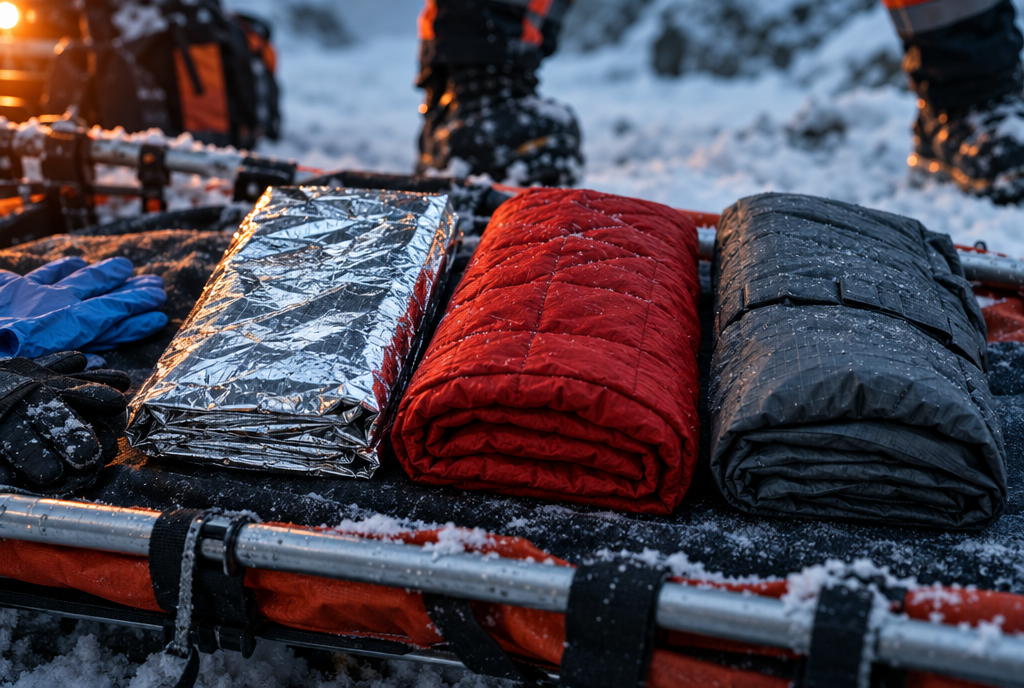
Active systems that add heat, such as the HPMK and Ready-Heat blankets, generally lost the least heat in fluid-model lab studies, and the Blizzard insulated blanket was the best passive option in the Army and UK studies. Plain space blankets and single wool blankets ranked lowest. The military Joint Trauma System recommends an insulated wrap plus an active heat source, kept off bare skin.
Passive vs active hypothermia blankets: what is the difference?
A passive blanket only slows heat loss. It relies on the casualty's own heat, which fails when someone is bleeding, injured or no longer shivering. Space blankets, wool blankets and insulated heat-reflective blankets such as Blizzard are passive.
An active blanket adds heat, usually from air-activated chemical panels. Ready-Heat blankets are active, and the Hypothermia Prevention and Management Kit (HPMK) pairs a Ready-Heat blanket with a heat-reflective shell that serves as an impermeable vapor layer, according to the Joint Trauma System (JTS) guideline.
Hypothermia blanket comparison table
Specs below come from the makers' published pages and the JTS guideline. Pack sizes vary by model, so check the exact version you stock.
| Type | Heat source | Published weight or size | Typical use | Main limits |
|---|---|---|---|---|
| Plain space blanket | None; thin heat-reflective film | Varies by maker | Civilian and car kits | JTS rates it not effective to mildly effective; almost no insulation |
| Wool or ambulance blanket | None | Varies | Ambulances, field stocks | Single wool blanket was least effective in the Army model; loses loft when wet |
| Blizzard 3 Layer Survival Blanket (small) | None; insulated heat-reflective layers | 7.5 x 5.1 ft open; 7.9 x 4.3 x 1.6 in packed; maker lists 320 to 360 g (11 to 13 oz) | EMS, mountain rescue, military | Adds no heat |
| Ready-Heat 4 Panel blanket | Air-activated chemical panels | 34 x 48 in; 1.75 lb (794 g); 104 °F (40 °C) in 15 to 20 minutes | Military, EMS transport | Burn risk on skin; needs a vapor barrier and insulation over it |
| HPMK | Ready-Heat blanket inside a heat-reflective vapor-barrier shell | JTS notes low cost, weight and size | Military TCCC kits | Non-insulated; JTS says short-term use only |
| Sleeping bag inside a vapor barrier (burrito wrap) | None, or add a heater | Bulky | Prolonged field care | Hard to carry; slow to set up |
What does the military hypothermia guideline say?
The JTS Hypothermia: Prevention and Treatment guideline (June 2023) tells prehospital providers to insulate casualties from cold ground, replace wet clothing or wrap a vapor barrier, and place an active heating blanket on the front of the torso and in the armpits. It warns never to put any active heat source directly on skin or on high-pressure areas such as the back of a supine patient.
The guideline calls the HPMK one of the most widely used systems because of portability, cost and effectiveness, but non-insulated and suitable only for short-term prevention, especially in cold climates. It recommends upgrading to a hooded sleeping bag or wool blankets inside the vapor barrier as soon as possible, on a ground-insulating pad.
Its evidence table rates a space blanket not effective to mildly effective, a single wool blanket not effective, the Blizzard blanket and HPMK highly effective in the Army fluid model, and the Ready-Heat blanket moderately effective. In a human volunteer study it also cites, the HPMK was the least effective of five heated wrap systems because it lacks insulation. It rates small chemical hand warmers not effective for core warming.
What do comparison studies show?
No study has compared these products on injured people in the field. The main evidence comes from fluid-bag torso models and thermal manikins, which cannot shiver or bleed.
A US Army Institute of Surgical Research study (Allen and colleagues, 2010), summarized in the JTS evidence table, used a fluid-bag torso with no human volunteers. A single wool blanket was least effective. The Blizzard blanket alone was one of the two best passive methods and performed the same as two of the three active heaters at 120 minutes, and the HPMK compared well with every active system tested.
A UK air ambulance team (Zasa and colleagues, 2016) left torso models outdoors at 27 to 41 °F (-3 to 5 °C) for an hour, repeated 10 times. Mean temperature drops were 20.9 °F (11.6 °C) with no cover, 11.0 °F (6.1 °C) with an ambulance blanket, 8.1 °F (4.5 °C) with a space blanket, 3.8 °F (2.1 °C) with a Blizzard blanket and 2.0 °F (1.1 °C) with Ready-Heat II.
An Israeli in vitro study (Dvir and colleagues, 2022) tested ten devices for up to 480 minutes. At 68 °F (20 °C), only the HPMK and Ready-Heat II raised the model's temperature. At 46 °F (8 °C), none did. Surface temperatures of every chemical heater exceeded 111 °F (44 °C) with prolonged use, and the authors advise an insulating layer with all active blankets.
Why wind and ground contact change the ranking
Swedish researchers (Henriksson and colleagues, 2009) measured 12 blankets and rescue bags on a thermal manikin. In still air, insulation tracked thickness, from 2.0 to 6.0 clo, with metallic foil blankets doing better than their thinness suggested. In wind of 4.5 to 20 mph (2 to 9 m/s), windproof, compression-resistant ensembles kept about 60 to 80% of their insulation, while light or wind-permeable ones fell to about 30 to 50%.
Cold ground draws heat by conduction, which thin film does little to stop. That is why the JTS guideline lists a ground-insulating pad as its own step.
Burn caution with active heaters
Cold, injured or unconscious casualties cannot report heat pain. Keep chemical heaters over a layer of clothing, never wrapped around the torso or under body weight, and check the skin under them often, as the JTS guideline directs.
When to call a clinician or emergency services
Any trauma casualty in the cold: call emergency services and start heat-loss prevention at once.
Altered consciousness, unresponsiveness or loss of shivering in a cold casualty, which the JTS guideline lists as reasons for active warming.
Core temperature below 96.8 °F (36 °C); JTS classes trauma hypothermia below 89.6 °F (32 °C) as severe.
Blistered, broken or persistently red skin under a heater should be checked by a clinician.
Key takeaways
Active blankets add heat; passive blankets only slow heat loss.
In fluid-model lab studies, the HPMK and Ready-Heat blankets led, and the Blizzard blanket was the strongest passive option.
Plain space blankets and single wool blankets ranked lowest.
The JTS guideline wants an insulated wrap plus active heat, with insulation under the casualty.
Never place a chemical heater directly on skin.
Frequently asked questions
Mediwrap blanket vs Blizzard blanket: which is better for prehospital care?
We found no peer-reviewed head-to-head study of these two products. Judge any passive wrap on whether it is windproof, resists compression and traps insulation, the factors that held up best in manikin testing. Neither adds heat, so pair either with an active heater for trauma casualties.
Who makes the HPMK?
The HPMK is a North American Rescue kit built around a Ready-Heat blanket and a heat-reflective vapor-barrier shell. Our HPMK guide covers its contents and use step by step.
Does a thermal blanket protect from radiation?
A space blanket reflects infrared heat radiation from the body, which is how it slows heat loss. It is a thin film, not shielding, and should not be relied on for protection from X-rays or radioactive fallout.
Does using a space blanket as a ground sheet increase warmth?
Only a little. It blocks ground moisture, but cold ground pulls heat by conduction and thin film adds almost no insulation. A foam pad, pack or extra blanket underneath does more, which is why the military guideline lists a ground pad as its own step.
Is the Blizzard blanket better than a space blanket?
In both the Army fluid model and the UK outdoor torso study, the Blizzard blanket lost less heat than a plain space blanket. The maker rates its small 3 layer blanket at 7.5 tog, which it compares to a medium-weight sleeping bag.
From HEATJAC
We design low-profile thermal garments: a heat-reflective vest and a thermal harness with pockets for warmers or cold packs.
Choosing gear? Cold-weather gear for EMS crews · Cold-weather gear for police and security officers
Related reading
Sources
Hypothermia: Prevention and Treatment, CPG ID 23 (07 Jun 2023), Joint Trauma System, DoD (via Deployed Medicine)
A torso model comparison of temperature preservation devices for use in the prehospital environment (Zasa et al., 2016), Emergency Medicine Journal
Differences in the thermal properties and surface temperature of prehospital antihypothermia devices: an in vitro study (Dvir et al., 2022), Emergency Medicine Journal
Protection against cold in prehospital care: thermal insulation properties of blankets and rescue bags in different wind conditions (Henriksson et al., 2009), Prehospital and Disaster Medicine, via PubMed
Blizzard 3 Layer Survival Blanket, Small: specifications, Blizzard Protection Systems
Ready-Heat military products: specifications, TechTrade LLC (Ready-Heat)
About HEATJAC. HEATJAC is a thermal architecture company founded by an anesthesiologist. We design patented garment systems that capture, conduct and broaden warmth across the body, and we publish this knowledge hub because the science of staying warm should be public. HEATJAC products are not medical devices and are not intended to diagnose, treat, cure or prevent any disease.