
Winter coats and car seats: why puffy coats and harnesses don't mix
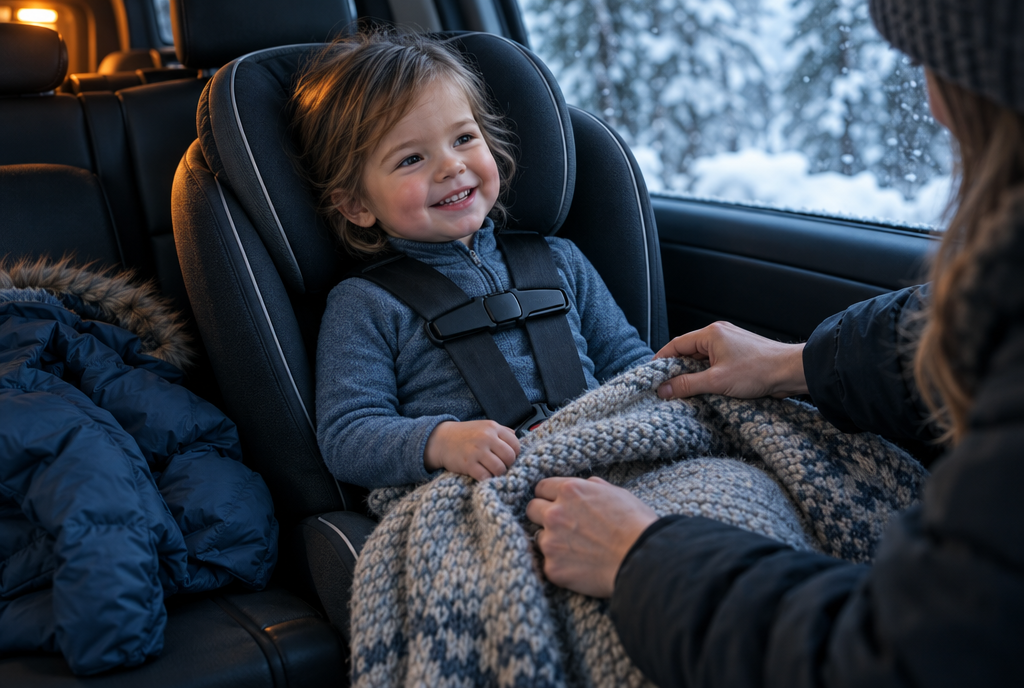
Bulky winter coats and snowsuits should not be worn under a car seat harness. In a crash, the padding flattens instantly and leaves slack, so a child can slip through the straps. The AAP and NHTSA recommend thin layers under a snug harness, then a blanket or the coat worn backwards over the buckled straps.
Why can't kids wear a winter coat in a car seat?
A harness only protects a child if it is snug against the body. HealthyChildren.org, the AAP's parent site, explains that in a crash the fluffy padding in a coat immediately flattens from the force, leaving extra space under the harness. A child can then slip through the straps and be thrown from the seat.
NHTSA makes the same point: too much bulk can create extra room in the harness and a loose fit. The problem is invisible in the driveway, because the strap feels tight against the puffy fabric. It only shows up when crash forces squeeze the air out of the coat.
The rule applies to any thick layer under the straps, including snowsuits and bulky fleece buntings. The AAP says nothing bulky should ever go underneath your child's body or between their body and the harness straps.
How do you do the car seat pinch test?
The pinch test checks whether the harness is snug. NHTSA says the harness is snug enough when you cannot pinch any extra material at the shoulder. The AAP puts it the other way around: if you can pinch the straps, tighten them until they fit snugly against your child's chest.
Consumer Reports describes a simple way to find out whether a particular coat is too bulky. It takes about a minute and settles the question for that coat.
Put the coat on your child, buckle the harness, and tighten it until you cannot pinch any webbing.
Without loosening the harness, unbuckle and take your child out.
Remove the coat, put your child back in, and buckle again.
If you can now pinch the webbing between thumb and forefinger, the coat is too bulky to wear under the harness.
| Check | What you want | Source |
|---|---|---|
| Shoulder pinch | No extra webbing can be pinched | NHTSA |
| Chest clip | At armpit level | NHTSA |
| Under the harness | Nothing bulky between child and straps | AAP |
| Coat test | No new slack after the coat comes off | Consumer Reports |
How do you keep a child warm in a car seat without a coat?
The fix is to move warmth from under the harness to on top of it. Both the AAP and NHTSA describe the same short list of options.
Dress in thin, snug layers. The AAP suggests starting with tights, leggings or a long-sleeved bodysuit, then pants and a warmer top such as a sweater or thermal-knit shirt. NHTSA suggests lightweight fleece instead of puffy materials.
Buckle and tighten the harness first, then lay a blanket over the top of the straps.
Put the child's coat on backwards over the buckled harness, arms through the sleeves, so it works like a blanket.
Add a hat, mittens, and socks or booties; the AAP notes these keep children warm without affecting the harness.
For babies, the AAP recommends storing the carrier portion of an infant seat inside the house so it starts out warm.
Are car seat covers and bunting bags safe?
Be careful with products sold separately from the seat. The AAP warns that if an item did not come with the car seat, it has not been crash tested and may interfere with the protection provided in a crash. That includes thick inserts and bunting bags that sit behind or under the child.
NHTSA gives similar advice for infant seats: never put thick padding under or behind the baby unless the car seat manufacturer recommends it. Check your seat's manual before using any accessory, and use only covers or inserts the manufacturer approves.
How do you warm up the car safely?
Starting the car a few minutes early makes the ride more comfortable and makes a thinner outfit easier to accept. Do it safely. The CDC warns never to run a car or truck inside a garage attached to a house, even with the garage door open, because carbon monoxide can build up. Pull the car fully outside before letting it idle.
Carbon monoxide poisoning causes headache, dizziness, weakness, upset stomach, vomiting, chest pain and confusion, according to the CDC. If anyone in the household has these symptoms after a car has been running nearby, get to fresh air and call 911.
What should be in a winter car kit for kids?
Winter roads can leave families stuck for hours. NHTSA recommends an emergency bag with blankets, a cell phone charger, food and water, and the AAP suggests packing blankets and extra dry clothing as well. Keep the bag in the passenger area so you can reach it without going outside.
If a child seems unusually cold, sleepy, or hard to wake during or after a winter drive, call your pediatrician or 911. Talk to a certified child passenger safety technician if you are unsure how your seat should fit, and to your pediatrician or another clinician about any symptoms.
Key takeaways
Puffy coats and snowsuits compress in a crash and leave slack under the harness.
Use the pinch test: no extra webbing at the shoulder, chest clip at armpit level.
Keep kids warm with thin layers under the harness and a blanket or backwards coat over it.
Avoid aftermarket padding that was not made by the seat's manufacturer.
Never let a car idle in an attached garage; pull it outside to warm it up.
Frequently asked questions
Can my child wear a fleece jacket in a car seat?
A thin fleece is usually fine, and NHTSA suggests lightweight fleece layers instead of puffy materials. Use the coat test to be sure: tighten the harness with the jacket on, remove the jacket, and rebuckle. If you can pinch slack, the jacket is too thick.
Is it safe to put a coat on backwards over a car seat harness?
Yes. Both the AAP and NHTSA describe putting the coat on backwards over the buckled, properly fitted harness. The coat acts like a blanket and does not change how the straps fit.
Where should the chest clip go on a car seat?
NHTSA says to place the chest clip at armpit level. This holds the harness straps in place on the child's chest and shoulders.
Do car seat coats and ponchos work?
Judge a car seat coat like any other layer. The AAP warns that items not made with the car seat have not been crash tested with it. Check your seat's manual and do the pinch test with anything your child wears.
Does my baby need a hat in the car?
A hat helps keep a baby warm on the way to and from the car, and the AAP lists hats, mittens and booties as good ways to add warmth. Once the car is warm, remove extra layers so your baby does not overheat.
From HEATJAC
We design low-profile thermal garments: a heat-reflective vest and a thermal harness with pockets for warmers or cold packs.
Choosing gear? What actually helps someone who is always cold · Warm, safe gifts for an older parent
Related reading
Sources
Winter Car Seat Safety Tips: Keeping Kids Safe and Warm, HealthyChildren.org (American Academy of Pediatrics)
Keep Your Little Ones Warm and Safe in Their Car Seats, National Highway Traffic Safety Administration
How to Install a Rear-Facing Only Infant Car Seat, National Highway Traffic Safety Administration
Winter Coats and Car Seats Don't Mix, Consumer Reports
Carbon Monoxide Poisoning Basics, Centers for Disease Control and Prevention
About HEATJAC. HEATJAC is a thermal architecture company founded by an anesthesiologist. We design patented garment systems that capture, conduct and broaden warmth across the body, and we publish this knowledge hub because the science of staying warm should be public. HEATJAC products are not medical devices and are not intended to diagnose, treat, cure or prevent any disease.