
How heat-reflective clothing linings work
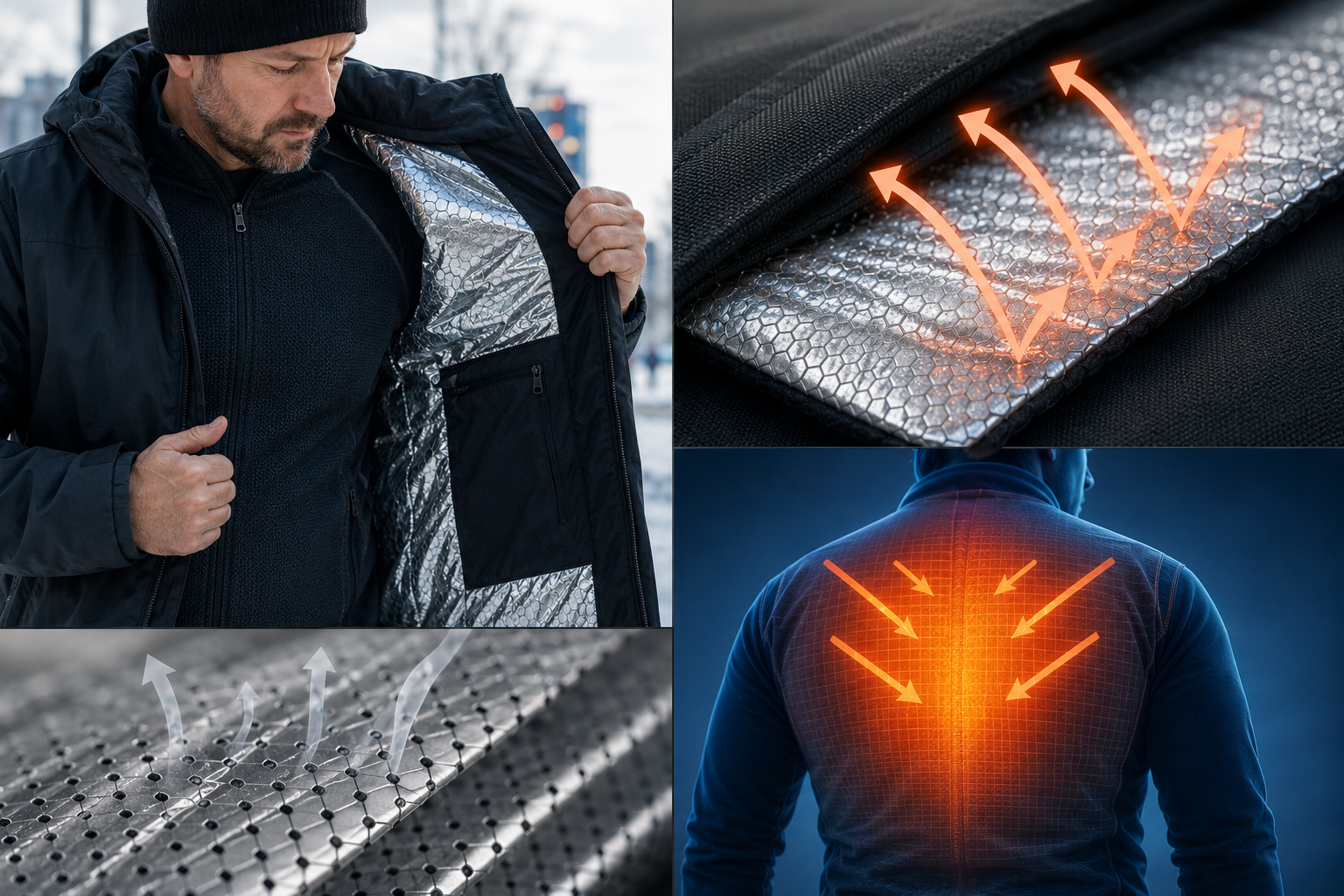
A heat-reflective lining is a thin metallized layer that returns infrared energy from your body instead of absorbing and re-emitting it outward. It works because skin is a strong infrared emitter and radiation is the largest route of heat loss at rest, about 60 percent. It conserves heat you already make; it cannot create heat, block wind or stop conduction.
What do emissivity and reflectance mean in plain language?
Every surface gives off infrared energy. Emissivity (or emittance) is a number from 0 to 1 that says how strongly a surface does this compared with a perfect emitter. For an opaque surface, whatever infrared energy is not absorbed is reflected, so a surface with low emittance is a strong reflector of infrared, and a surface with high emittance is a strong absorber and emitter.
Human skin sits near the top of the scale. A 2020 PLOS ONE study of 65 adults measured a mean skin emissivity of 0.972, with no meaningful difference by skin pigmentation. Ordinary fabrics are also good emitters. A polished or metallized surface is the opposite: it emits little and reflects most infrared energy back.
| Term | What it means | Example value |
|---|---|---|
| Emittance (emissivity) | How strongly a surface gives off infrared energy, 0 to 1 | Human skin about 0.97 (PLOS ONE, 2020) |
| Reflectance (infrared) | Share of incoming infrared a surface sends back; for opaque surfaces, roughly 1 minus emittance | Nickel coating up to 95 percent, emittance 0.05 (cited in Applied Sciences, 2023) |
| Metallized textile | Fabric coated with a thin metal layer | Copper-plated textile emittance 0.13 (Applied Sciences, 2023) |
| ASTM C1371 | Standard test for emittance of opaque, highly conductive materials near room temperature | Measures a flat material sample, not a garment |
Why does radiant heat loss matter when you are at rest?
At rest in a cool setting, radiation is the body's largest heat loss route. OpenStax Anatomy and Physiology puts it at about 60 percent of heat lost, ahead of evaporation, convection and conduction. Under clothing, skin radiates to the inner surface of the next layer, which absorbs that energy and passes it outward.
A heat-reflective lining interrupts that chain. Facing the body, its low-emittance surface sends much of the infrared back toward you and gives off little itself. The effect is largest when you are still, such as sitting, standing at a post or waiting, and smaller during hard exercise, when sweat evaporation takes over.
How is a lining's emittance tested?
The common standard is ASTM C1371. It uses a portable differential thermopile emissometer to compare a sample with calibration standards of known emittance, near room temperature. The scope covers opaque, highly thermally conductive materials, and the method is not meant for specimens that are transparent to infrared or have significant thermal resistance.
That tells you what a lining number means. An emittance of about 0.05, often described as about 95 percent radiant reflectance, describes the flat coated material under test. It is not a measurement of a finished jacket, which also depends on coverage, fit, layers and wind.
Why does a heat-reflective lining need an air gap?
Radiation crosses space; conduction needs contact. The US Department of Energy notes that a radiant barrier must face an air space to work, and that dust on the surface reduces its effect. Where a lining is pressed directly against skin or a damp base layer, heat simply conducts through it and the low emittance matters little.
Research on infrared textiles makes the same point. A 2023 Applied Sciences study of heat-reflective textiles for cold-protection garments found infrared reflection the more effective of the two methods it studied, but noted that the layers between body and lining must stay transparent to infrared and resist compression, which limits real-world performance.
Do heat-reflective linings breathe?
A continuous metal film blocks water vapor as well as infrared. In a garment that traps sweat, which then condenses and makes insulation damp, that is a problem. Manufacturers solve it with perforated films, printed dot patterns or metallized fibers that leave open area for vapor to escape.
Each approach trades coverage against breathability. More open area breathes better but reflects less, so two linings with the same material emittance can perform differently in a garment. Our comparison of dot, foil and film linings covers those designs.
What can a heat-reflective lining not do?
It does not create heat. It only slows the loss of heat your body already makes.
It does little against conduction, such as sitting on a cold bench or wearing a compressed, wet layer.
It does not stop wind. Convection through gaps and thin shells needs a windproof layer.
Its benefit is modest on its own. The Applied Sciences review cites earlier work reporting up to about a 10 percent gain in clothing insulation at 80 percent reflectivity.
Dirt, wear and folding can reduce surface performance over time.
When does a heat-reflective lining help most?
The best case is low activity in cold, dry air under a garment that already blocks wind and holds loft. Think of spectators, crossing guards, anesthesia providers in a cool operating room, or anyone waiting outdoors. In those settings the body makes little extra heat, radiation is a large share of the loss, and the lining has an intact air gap to work across.
The benefit shrinks during hard exercise, in rain or heavy sweat, and in thin or drafty garments. There, evaporation, convection and conduction dominate, and other layers matter more than the lining.
How do you judge a heat-reflective lining claim?
Separate the material from the garment. A material claim should name the test method, such as ASTM C1371, and give an emittance or reflectance value for that specific lining. A garment claim should come from whole-garment testing, such as thermal manikin measurements of insulation.
Then ask practical questions: how much of the garment the lining covers, whether it is perforated or patterned, what sits between it and your skin, and whether the shell blocks wind. A lining with excellent material numbers inside a drafty, thin jacket will not keep you warm.
Key takeaways
Heat-reflective linings use low-emittance metallized surfaces to return infrared energy to the body.
Radiation is about 60 percent of heat loss at rest, so these linings matter most when you are still.
ASTM C1371 measures a flat material sample, so a 95 percent figure is a material property, not a garment rating.
Linings need an air gap and need to breathe; contact, compression and moisture reduce their effect.
They conserve heat but cannot create it, block wind or stop conduction.
Frequently asked questions
Do heat-reflective jacket linings actually work?
Yes, within limits. They reduce radiant heat loss, which is the largest route at rest, but the gain in overall insulation is modest and depends on air gaps, coverage and the rest of the garment. Our evidence review covers the research in detail.
Is a heat-reflective lining the same as a space blanket?
They use the same principle, a low-emittance metallized surface. A space blanket is a continuous film with no breathability, while clothing linings are usually perforated or patterned so sweat vapor can escape.
Should the shiny side face in or out?
For keeping warm, the heat-reflective surface should face the body across a small air space. That is how clothing linings are built. Facing outward, it would mainly reflect radiant heat arriving from outside, such as sunlight.
Can heat-reflective linings make you sweat?
They can if the lining is a solid, non-breathable film or if you overdress during activity. Perforated and dot-pattern linings let vapor escape. Venting or removing a layer before you sweat helps.
Are heat-reflective linings safe for people with reduced sensation?
A lining adds no heat of its own, so it carries no burn risk by itself. Warmers or heated inserts worn with it can burn skin a person cannot feel, so keep them off bare skin and talk to a clinician if you have neuropathy or reduced sensation.
From HEATJAC
We design low-profile thermal garments: a heat-reflective vest and a thermal harness with pockets for warmers or cold packs.
Choosing gear? Heated vest vs heat-reflective vest · The thermal gear buying, safety and care guide
Related reading
Sources
Anatomy and Physiology 2e, 24.6 Energy and Heat Balance, OpenStax, Rice University
The effect of constitutive pigmentation on the measured emissivity of human skin, PLOS ONE (Charlton et al., 2020)
ASTM C1371-15(2022) Standard Test Method for Determination of Emittance of Materials Near Room Temperature Using Portable Emissometers, ASTM International
Radiant Barriers, US Department of Energy, Energy Saver
Development of Infrared Reflective Textiles and Simulation of Their Effect in Cold-Protection Garments, Applied Sciences (Cherunova et al., 2023)
About HEATJAC. HEATJAC is a thermal architecture company founded by an anesthesiologist. We design patented garment systems that capture, conduct and broaden warmth across the body, and we publish this knowledge hub because the science of staying warm should be public. HEATJAC products are not medical devices and are not intended to diagnose, treat, cure or prevent any disease.