
Heated vest vs heated jacket vs heated hoodie
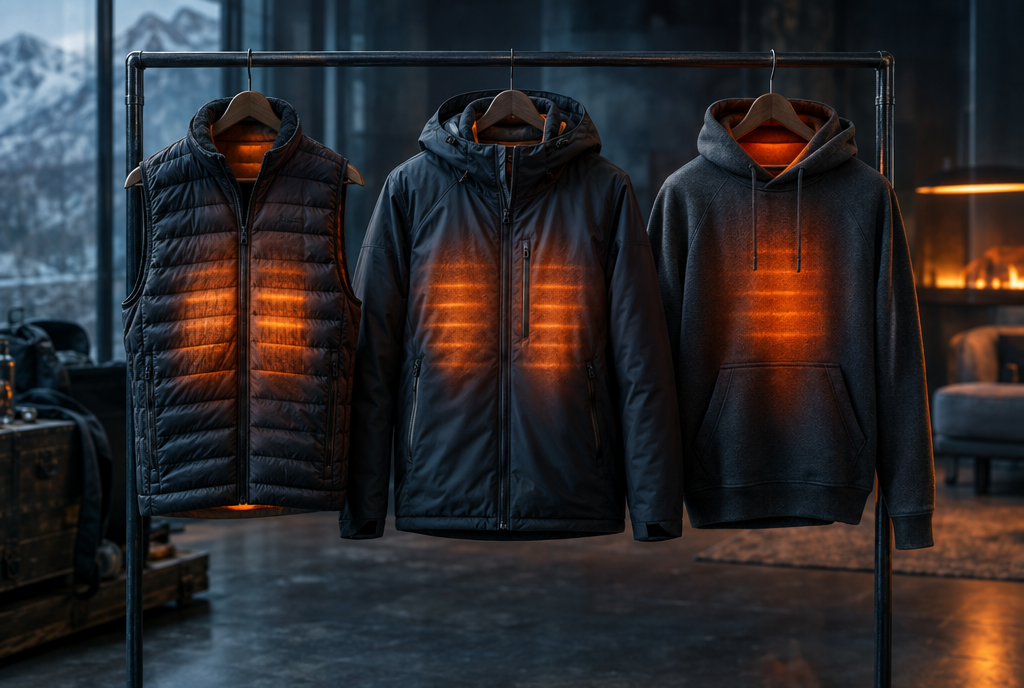
A heated vest warms your torso, layers under almost anything and leaves arms free, which makes it the most versatile choice. A heated jacket adds sleeves and an outer shell, so it suits people who want one garment for wind and weather. A heated hoodie is a casual mid layer for mild cold, commuting and time around home.
What is the core difference between a heated vest, jacket and hoodie?
All three use the same basic technology: thin heating elements sewn into panels, powered by a rechargeable battery, with a button to switch between heat levels. What differs is coverage, what the garment is designed to do on its own, and how it fits into a layering system.
A vest is a heat source you wear inside your clothing. A jacket is usually an outer layer with heat built in. A hoodie sits in between, as a knit mid layer that happens to be heated. Choosing well starts with asking which layer you actually need to replace.
| Factor | Heated vest | Heated jacket | Heated hoodie |
|---|---|---|---|
| Coverage | Torso only | Torso, often collar and pockets | Torso, sometimes hood area |
| Typical role | Mid layer under a coat or on its own in mild cold | Outer layer with wind and weather protection | Casual mid layer or light outer layer |
| Arm mobility | Best | Good, some bulk | Good |
| Layers under a work coat or scrubs top | Easily | Rarely | Sometimes |
| Weather protection | Depends on the coat over it | Built in, varies by shell | Low; knit fabric absorbs rain and wind passes through |
| Versatility across seasons | Highest | Winter focused | Shoulder seasons |
| Care | Usually simplest of the three | Shell and insulation add care steps | Usually washable once battery is removed |
Why does torso heating matter so much?
Your body protects its core first. When you get cold, blood flow to the skin of the hands and feet is reduced so that less heat escapes, which is why fingers and toes feel it before your chest does. Keeping the torso warm reduces that pressure on the extremities, which is the reasoning behind vest-first heating.
Heat also leaves the body in several ways at once. A StatPearls overview estimates that radiation accounts for about 60% of total body heat loss, with conduction, convection and evaporation making up the rest. A heated panel offsets some of that loss locally, but the layers around it decide how long the heat stays with you.
When is a heated vest the better choice?
Choose a vest if you already own a coat you like, if you work with your arms, or if you need warmth under something else, such as a uniform, a hi-vis jacket or a lab coat. OSHA recommends several loose layers for cold work, with a wicking inner layer, an insulating middle layer and a wind and water resistant outer layer. A thin heated vest slots into the middle position without changing the rest of your system.
A vest also makes the most of a battery, because it heats a smaller area close to the core. It is easy to take off indoors, which matters in settings that swing between cold and warm.
Layering under a work coat, shell or uniform
Driving, where sleeves and bulk are a nuisance
Jobs that need full arm movement
Commutes that alternate between outdoors and heated indoor spaces
When is a heated jacket the better choice?
Choose a jacket if you want one piece that handles wind, light precipitation and warmth, such as for spectating outdoor sports, dog walking or standing work outdoors. Jackets often add heated collar or hand-pocket zones, which many people value on still, cold days.
The trade-offs are bulk, less flexibility across seasons, and a garment that is harder to wash because shell fabrics, insulation and electronics each have their own needs. If the jacket's shell does not suit a given day, the heat comes with it or not at all.
When does a heated hoodie make sense?
A heated hoodie suits mild cold and casual use: an early commute, a cool office, working in a garage or sitting outside in the evening. It behaves like a sweatshirt, so it is comfortable and easy to wear, but knit fabric lets wind through and absorbs water.
In real cold, a hoodie needs a shell over it. At that point, many people find a vest under the same shell does the job with less bulk.
How should you decide?
Start from the conditions and the rest of your wardrobe, not from the heater.
If you already have a good outer layer, buy a vest
If you want a single outer garment for dry, cold days, consider a jacket
If your cold is mild and mostly indoors, a hoodie or a vest will both work
If you are often active, favor a vest you can switch off or remove quickly
If you need to wash it often, check the care label first; the FTC requires labels to give at least one safe cleaning method or a warning
Check the CPSC recall database for any model you are considering
Is a heated vest worth it compared with more layers?
Layers are cheaper and never run out of charge, and the CDC and OSHA both lead their cold weather advice with layered, loose clothing. A heated vest earns its place when you are sedentary in the cold for long periods, when bulk is a problem, or when your hands and feet struggle despite good layering.
Battery-free options, including reflective linings and pocketed garments that hold air-activated warmers, fill some of the same gap without charging. Compare approaches before assuming a battery is the answer.
Key takeaways
A heated vest is the most versatile format because it works as a mid layer under clothing you already own.
A heated jacket is best when you want one outer garment that combines weather protection and heat.
A heated hoodie suits mild cold and casual wear, and needs a shell in wind or rain.
Warming the torso helps the whole body, but surrounding layers decide how long that heat lasts.
Check care labels and CPSC recalls before you buy any heated garment.
Frequently asked questions
Is a heated vest or heated jacket warmer?
A jacket covers more area and adds an outer shell, so on its own it usually feels warmer outdoors. A vest under a good coat can be just as warm, and it lets you keep the coat you already trust.
Can you wear a heated vest under a coat?
Yes, that is how most heated vests are designed to be used. A snug but not tight fit keeps the panels close to your body while leaving room for circulation, consistent with OSHA advice to avoid tight layers in the cold.
Can you wear a heated hoodie in the rain?
Most heated hoodies are knit and absorb water, and wet clothing loses insulation quickly. Wear a waterproof shell over it and keep the battery and connectors dry.
Do heated jackets heat your arms?
Most heated jackets place heating zones on the chest, back and sometimes collar and hand pockets, not the sleeves. Check the product's zone map if arm warmth matters to you.
Which is best for driving or office use?
A vest is usually best, because it has no sleeves to bunch up, fits under a blazer or cardigan, and can be switched off once the car or room warms up.
From HEATJAC
We design low-profile thermal garments: a heat-reflective vest and a thermal harness with pockets for warmers or cold packs.
Choosing gear? Heated vest vs heat-reflective vest · What warmth costs per shift
Related reading
Sources
Physiology, Temperature Regulation (StatPearls), NCBI Bookshelf, National Library of Medicine
Cold Stress Guide, Occupational Safety and Health Administration
Preventing Hypothermia and Frostbite (Winter Weather), Centers for Disease Control and Prevention
Clothes Captioning: Complying with the Care Labeling Rule, Federal Trade Commission
Recalls and Product Safety Warnings, US Consumer Product Safety Commission
About HEATJAC. HEATJAC is a thermal architecture company founded by an anesthesiologist. We design patented garment systems that capture, conduct and broaden warmth across the body, and we publish this knowledge hub because the science of staying warm should be public. HEATJAC products are not medical devices and are not intended to diagnose, treat, cure or prevent any disease.