
Phase-change materials in clothing, explained
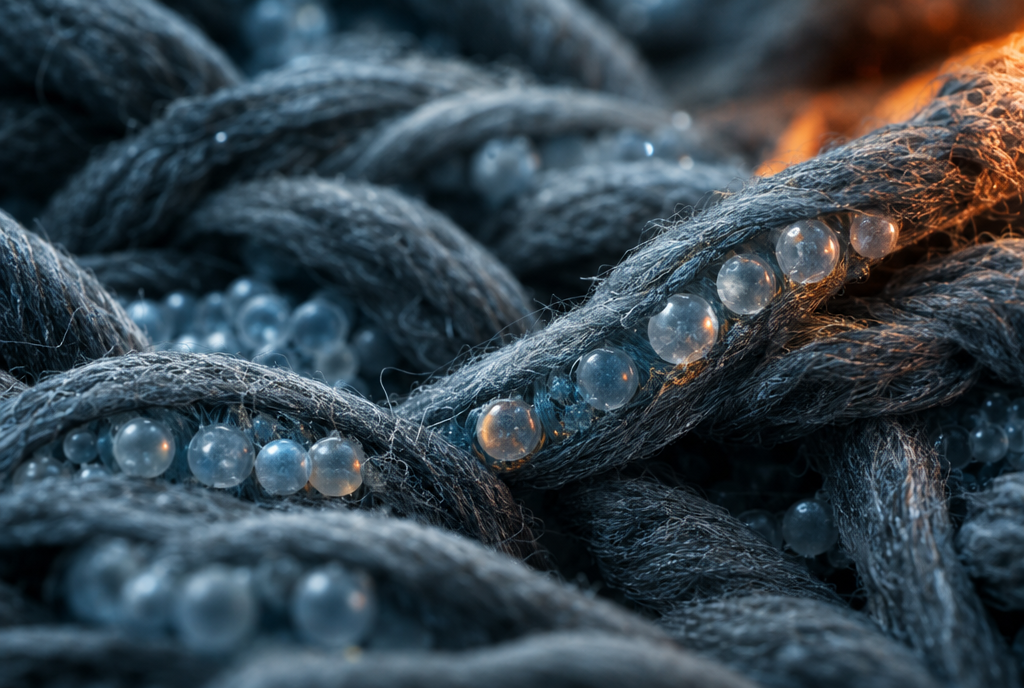
Phase-change materials (PCMs) are substances, often waxes, that melt and solidify near skin temperature. In clothing they are sealed in microcapsules or fibers. When you warm up, they absorb heat as they melt; when you cool down, they release it as they solidify. The effect is real but small and temporary, smoothing temperature swings rather than supplying lasting warmth.
How do phase-change materials work?
Every material needs extra energy to change phase. Ice at 0°C absorbs a large amount of heat as it melts, yet the meltwater is still at 0°C. That hidden energy is called latent heat.
PCMs used in textiles are chosen to change phase in a comfortable range near skin temperature. As the fabric warms, the material melts and soaks up heat without getting hotter. As it cools, the material solidifies and gives that heat back. Researchers describe the process as autonomous, reversible and bidirectional.
The key point is that a PCM stores heat; it does not produce it. Whatever it releases, it first had to absorb from your body or the environment.
Where did phase-change clothing come from?
NASA's Johnson Space Center began investigating passive temperature control in the 1980s, building on U.S. Air Force work. In 1987 it began seeking industry partners to develop PCMs for spacesuits, particularly astronaut gloves.
Triangle Research and Development Corporation completed two Small Business Innovation Research contracts with Johnson in 1987 and 1988. The patent rights later passed to a company renamed Outlast Technologies in 1997, whose microencapsulated PCMs now appear in bedding, apparel, footwear and seating, according to NASA Spinoff.
How are PCMs built into fabric?
Because PCMs turn liquid, they must be contained. The common approaches are microencapsulation, where tiny polymer shells hold the PCM and are coated onto or printed into fabric, and fibers with PCM cores spun directly into yarn.
Materials range from petroleum-derived paraffins to bio-based oils. A recent study of seamless knitted fabrics used fibers with phase-change cores derived from palm, palm kernel and coconut oils, blended with viscose and cotton.
How much heat can PCM clothing actually store?
Less than marketing sometimes implies. A frequently cited study by Shim, McCullough and Jones used a thermal manikin to measure PCM garments during temperature transitions. Heat released by the PCMs in a cold environment decreased body heat loss by an average of 6.5 watts for a one-layer suit and 13.2 watts for a two-layer suit, and the effects lasted approximately 15 minutes.
The authors concluded that PCMs provide a small, temporary heating or cooling effect during environmental transients. For scale, the heat released lasted about as long as a walk from a warm building to a parked car.
The amount of PCM matters. The knitted-fabric study measured enthalpy of about 4.1 joules per gram in its heating phase for a blended yarn, a modest figure because only part of each fiber is PCM. Its testing was conducted only at 22°C, and the authors note cold-climate performance remains unverified. They also report that bio-based PCMs tend to show more supercooling, meaning they can stay liquid below their nominal freezing point and release heat later than expected.
| Approach | Adds heat? | Duration of effect | Best use |
|---|---|---|---|
| Thin PCM fabric or coating | No, stores and returns heat | Minutes during transitions | Smoothing swings in and out of cold |
| Bulk PCM packs (cooling vests) | No, absorbs heat | Longer, due to much larger mass | Cooling in heat |
| Insulation | No, slows loss | Continuous while dry | Steady cold |
| Active heat (warmer or battery) | Yes | Hours | Sustained cold, low activity |
Do phase-change fabrics work?
They do what physics allows: they buffer short swings. People moving between a warm vehicle and cold air, or alternating hard effort with rest, may notice a smoother feel. In steady cold, a thin PCM layer melts or solidifies fully within minutes and then behaves like ordinary fabric.
Some PCM textiles also show measurable gains unrelated to phase change. In the knitted-fabric study, fabric structure and blend changed thermal resistance substantially, which is a reminder that knit, thickness and fit still do much of the work.
When reading product claims, look for specifics: how much PCM the garment contains, its transition temperature range, and whether testing reflects real wear. Phrases such as adapts to your body or regulates temperature all day describe the direction of the effect, not its size.
PCM for warming vs cooling
PCMs are far more useful for personal cooling than for thin warming layers. Cooling vests carry large packs of PCM chosen to melt at a cool temperature, so they can absorb body heat for a meaningful period. A shirt with a light PCM finish carries a small fraction of that mass.
For sustained warmth, pair insulation and a reflective layer with an active heat source. If you are unusually sensitive to cold or heat, a clinician can help identify the cause and what adjustments make sense.
Key takeaways
PCMs absorb heat as they melt and release it as they solidify, near skin temperature.
They store heat but do not generate it.
Manikin testing found a small effect, 6.5 to 13.2 watts, lasting about 15 minutes during transitions.
PCM textiles trace back to NASA-funded research in the late 1980s.
For lasting warmth, insulation and active heat matter more than a PCM finish.
Frequently asked questions
What is phase change material fabric?
It is fabric containing materials, often waxes or oils, that melt and solidify near skin temperature. They absorb heat as they melt and release it as they solidify, buffering temperature changes.
Does phase change clothing keep you warm?
Only briefly. Studies show PCM clothing releases a small amount of stored heat for roughly 15 minutes during a change to colder conditions. It does not replace insulation or a heat source.
What is Outlast fabric?
Outlast is a brand of microencapsulated phase-change technology descended from NASA-funded research for spacesuit gloves. It is used in bedding, apparel and other products.
Do PCM effects wear off after washing?
Durability depends on how the PCM is contained. Microcapsules in coatings can be lost over time, while PCM held in fiber cores is generally better protected. Follow the care label.
Are phase-change cooling vests the same technology?
Yes, the principle is the same, but cooling vests use far more PCM in packs, which is why they last much longer than a thin fabric finish.
From HEATJAC
We design low-profile thermal garments: a heat-reflective vest and a thermal harness with pockets for warmers or cold packs.
Choosing gear? Heated vest vs heat-reflective vest · The thermal gear buying, safety and care guide
Related reading
Sources
Phase Change Fabrics Control Temperature, NASA Spinoff
Using Phase Change Materials in Clothing (Shim, McCullough and Jones, 2001), Textile Research Journal (SAGE)
Thermoregulatory Performance and Thermal Comfort Analysis of Phase-Change Fiber Seamless Knitted Fabrics, PMC (National Library of Medicine)
An overview of phase change materials, their production, and applications in textiles, ScienceDirect (Results in Engineering)
About HEATJAC. HEATJAC is a thermal architecture company founded by an anesthesiologist. We design patented garment systems that capture, conduct and broaden warmth across the body, and we publish this knowledge hub because the science of staying warm should be public. HEATJAC products are not medical devices and are not intended to diagnose, treat, cure or prevent any disease.