
How cooling vests work: evaporative, ice, phase-change and active
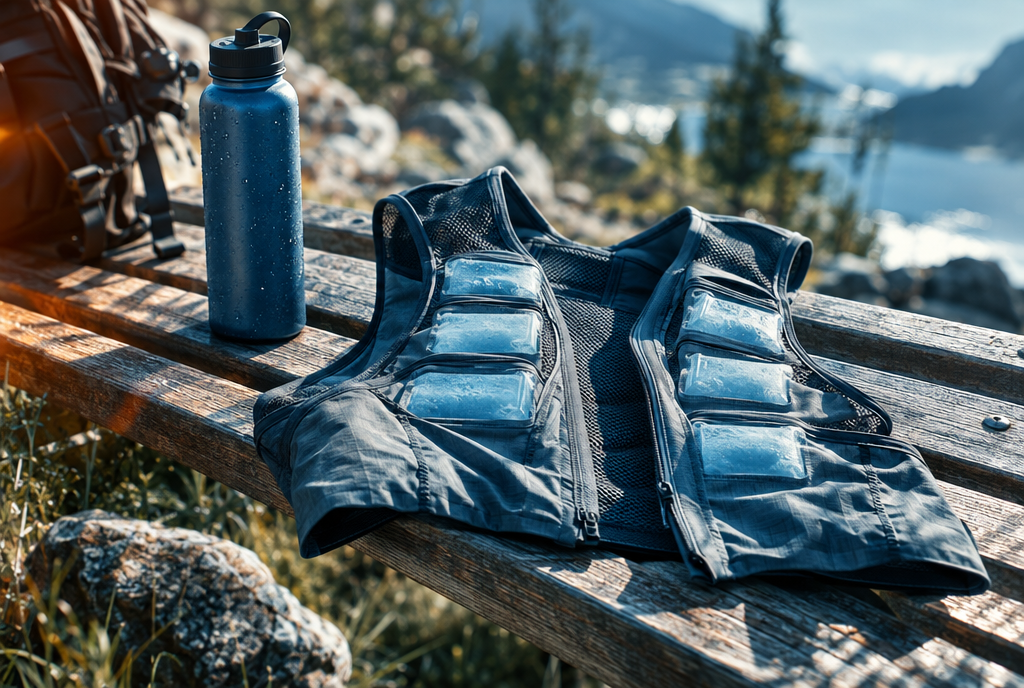
Cooling vests move heat out of the torso in one of four ways. Evaporative vests cool as soaked fabric dries. Ice and gel vests pull heat into frozen packs. Phase-change vests use packs that absorb heat while melting at a set temperature. Active vests pump chilled liquid or air through the garment. Each type trades cooling power against runtime, weight and humidity tolerance.
What does a cooling vest actually do?
Your body is always producing heat, and during hard work or in hot weather it must shed that heat to keep core temperature stable. It does so mainly by moving warm blood to the skin and by sweating. Sweat cools only when it evaporates.
A cooling vest adds a heat sink next to the torso, a large area with plenty of blood flow. Heat moves from warm skin into something cooler, by conduction into a cold pack or by evaporation from wet fabric. The result is lower skin temperature and, depending on the load, less heat stored in the body.
In a 2023 randomized crossover trial of 30 surgeons, an ice-pack vest lowered mean skin temperature by 0.23°C and reduced thermal discomfort by 2.1 points on a 10-point scale, with no significant change in core temperature. That pattern, clear comfort gains with modest core effects, is typical of the research.
How do evaporative cooling vests work?
An evaporative vest is made from an absorbent fabric or polymer layer that you soak in water. As the water evaporates, it takes heat with it, the same physics that makes sweat work. These vests are light, inexpensive and can be recharged with a tap.
Their weakness is humidity. Evaporation depends on dry air to absorb water vapor, so in muggy weather the vest cools far less. It also cools poorly under raincoats, chemical suits or other impermeable layers, which trap moisture. Evaporative vests suit dry heat, open-air work and light activity.
How do ice and gel pack vests work?
Ice vests hold frozen packs in pockets across the chest and back. Heat flows by conduction from skin into the packs, and melting ice absorbs a large amount of heat before it warms above freezing. Cooling is strong and immediate.
The tradeoffs are runtime and comfort. Once the ice melts, cooling fades, and very cold packs can feel harsh against skin, so a fabric layer between pack and body is sensible. The vest used in the surgeon trial was designed to cool for about 2.5 hours in an operating room, a relatively mild setting.
How do phase-change cooling vests work?
Phase-change materials (PCMs) absorb heat as they melt. Designers choose a material that melts at a comfortable temperature, so the pack stays at that temperature while it absorbs heat. Published vest designs have used melting points of 24 to 28°C, well above ice, which makes them feel cool rather than cold.
Melting point matters. In a 2011 study of subjects in firefighting gear at 55°C, a vest with packs melting at 24°C cooled the torso more than one melting at 28°C. Because the melting point sits above freezing, a PCM pack can resolidify anywhere colder than that point; in one military study the packs were simply chilled in a refrigerator. The dedicated phase-change article covers runtime and recharging in more detail.
How do active liquid and air cooling vests work?
Active vests circulate a cooled fluid through tubing or channels in the garment. Liquid systems use a pump and a reservoir of ice water or a chiller; air systems blow cooled or ambient air across the skin. Because the fluid is continuously refreshed, cooling can be adjusted and sustained for long periods.
The cost is equipment. Researchers note that air and liquid cooling systems can be heavy and can restrict movement. Some need a tether to a cooling unit, which suits vehicles, cockpits and stationary work better than walking jobs. Hybrid vests combine PCM packs with small battery fans to add airflow without the weight of a full liquid system.
Which cooling vest type is best?
There is no universal winner. The right choice depends on humidity, work rate, what you wear over the vest and how often you can recharge.
| Condition | Best fit | Why |
|---|---|---|
| Dry heat, light work | Evaporative | Cheap, light, easy to recharge with water |
| Humid heat | Phase-change, ice or active | Does not depend on evaporation |
| Under impermeable PPE | Phase-change or ice | Works without airflow to the skin |
| Long stationary shifts | Liquid or air circulating | Sustained, adjustable cooling with a power source |
| Frequent breaks available | Any pack-based vest with spares | Packs can be swapped during rest |
What are the limits of cooling vests?
Cooling vests cover the torso, not the whole body, and they add some weight. A vest whose packs have fully melted stops cooling and simply insulates, which can add to heat strain; a 2020 study of bomb disposal suits found a PCM vest stayed effective for about 50 minutes at 40°C and recommended swapping it during rest.
OSHA lists cooling vests among protective options but places engineering controls, rest, water and shade first. A vest is a supplement to a heat safety plan, and anyone with symptoms of heat illness should stop, cool down and seek care.
Key takeaways
Cooling vests work by evaporation, conduction into cold packs, or circulating chilled liquid or air.
Evaporative vests lose much of their effect in humid air and under impermeable layers.
Phase-change vests hold a steady, comfortable temperature while melting; ice cools harder but can feel harsh.
Active systems cool longest but add weight, power needs and sometimes tethers.
Spent packs insulate rather than cool, so plan to swap or recharge them.
Frequently asked questions
Do cooling vests work in high humidity?
Pack-based and active vests do, because they cool by conduction or circulating fluid. Evaporative vests work poorly in humid air, since moist air cannot absorb much more water vapor.
Is a phase-change vest better than an ice vest?
It depends on the job. Ice delivers stronger cooling but can feel very cold and must be frozen; phase-change packs feel gentler and can recharge at any temperature below their melting point, such as in a refrigerator. Lower melting points cool more strongly than higher ones.
How long does an evaporative cooling vest last?
Until the fabric dries, which can be quick in hot, dry, windy conditions and slow in humid ones. Re-soaking restores cooling, but in humid weather the vest cools only weakly even when wet.
Can you wear a cooling vest under clothes?
Pack-based vests are designed to be worn under shirts, gowns or protective gear. Evaporative vests need open air to work, so they are usually worn as an outer layer.
Are cooling vests safe?
For most people they are low risk when used as directed. Keep a layer between frozen packs and skin, stop if you feel pain or numbness, and talk to a clinician if you have circulation problems, cold sensitivity or other health concerns.
From HEATJAC
We design low-profile thermal garments, including a thermal harness with pockets that hold cold packs in summer and warmers in winter.
Choosing gear? One garment, two seasons: modular heating and cooling · The thermal gear buying, safety and care guide
Related reading
Sources
Cooling vest improves surgeons' thermal comfort without affecting cognitive performance: a randomised cross-over trial, Occupational and Environmental Medicine (via PubMed Central)
Cooling vests with phase change materials: the effects of melting temperature on heat strain alleviation in an extremely hot environment, European Journal of Applied Physiology (via PubMed)
Experimental Study on the Efficacy of a Novel Personal Cooling Vest Incorporated with Phase Change Materials and Fans, Materials (via PubMed Central)
Optimizing the Use of Phase Change Material Vests Worn During Explosives Ordnance Disposal Operations in Hot Conditions, Frontiers in Physiology
Heat: Protecting Workers (Controls), Occupational Safety and Health Administration
Criteria for a Recommended Standard: Occupational Exposure to Heat and Hot Environments (DHHS/NIOSH Publication 2016-106), CDC, National Institute for Occupational Safety and Health
About HEATJAC. HEATJAC is a thermal architecture company founded by an anesthesiologist. We design patented garment systems that capture, conduct and broaden warmth across the body, and we publish this knowledge hub because the science of staying warm should be public. HEATJAC products are not medical devices and are not intended to diagnose, treat, cure or prevent any disease.