
Phase-change cooling vests: how they work and how long they last
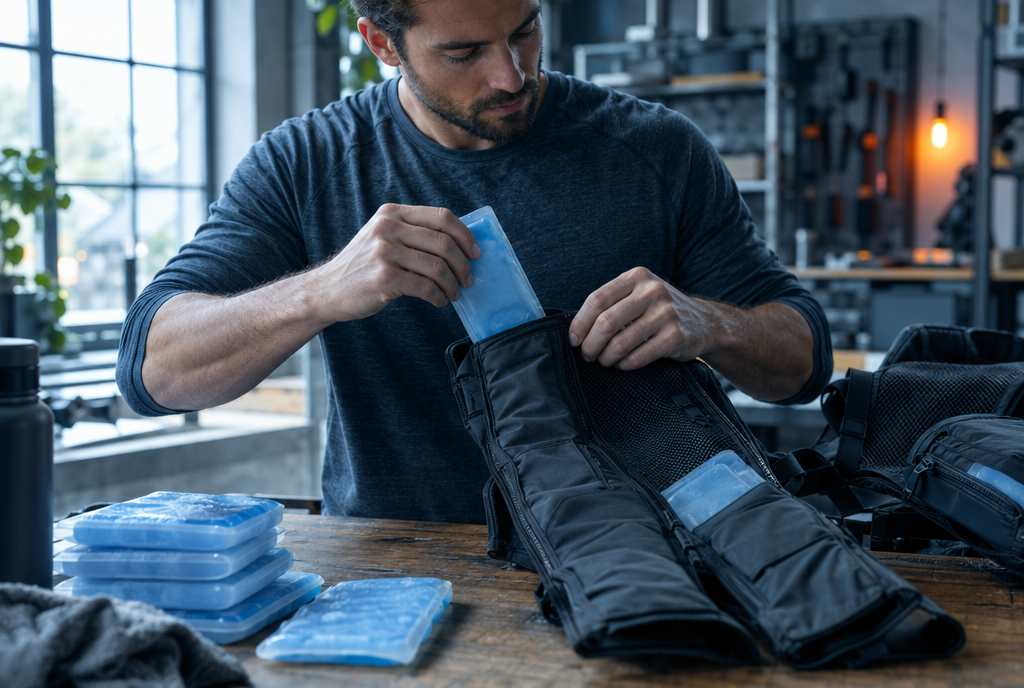
A phase-change cooling vest holds packs of a material that absorbs heat as it melts, staying at a fixed temperature, often in the 20s Celsius, until it has fully liquefied. That gives steady, comfortable cooling instead of the harsh cold of ice. Runtime depends on pack mass and heat load: in one study under a heavy protective suit at 40°C, packs lasted about 50 minutes.
What is a phase-change material?
A phase-change material (PCM) is any substance that absorbs or releases a large amount of heat as it changes between solid and liquid. Ice is the most familiar example: it soaks up heat while melting and stays at 0°C until it is all water. The heat absorbed during melting is called latent heat.
Cooling vests use PCMs engineered to melt at higher temperatures, specially formulated compounds sealed in flexible packs. In a 2020 study of a hybrid vest, the packs melted at 28°C and had a latent heat of 131 kJ/kg. While a pack is melting, its surface stays near that set temperature, which is what makes the cooling feel even.
How does a phase-change cooling vest cool you?
Skin under clothing in the heat is usually warmer than a pack melting in the 20s Celsius, so heat flows from skin into the pack by conduction. The pack absorbs that heat without warming up until it has melted through, then it warms like any other object and cooling fades.
Because the pack is only moderately cool, the temperature gradient against skin is smaller than with ice. That feels more comfortable and is gentler on skin, but it also means less heat moves per minute. Researchers have studied how temperature gradient, pack mass and covering area each change a vest's cooling, and all three matter.
Does the melting point matter?
Yes. In a 2011 study, subjects wearing firefighting gear walked on a treadmill in a 55°C chamber. A vest with packs melting at 24°C cooled the torso and lowered mean skin temperature more than one melting at 28°C. Both vests reduced peak core temperature during recovery but not during exercise, and the authors suggested testing lower melting points, such as 15°C, and larger coverage.
The takeaway for buyers: a lower melting point cools harder and a higher one feels gentler. Products are often sold with packs rated to a specific temperature, and that number is worth checking against your conditions.
Some designs add small battery fans to move air across the skin. In a 2020 study of such a hybrid vest, 12 men recovering in a 37°C chamber at 60% relative humidity reported much cooler thermal sensation and showed lower physiological strain with the vest, and they ran longer in the next exercise bout.
How long do phase-change cooling vests last?
Runtime is not a fixed number. It depends on how much PCM the vest holds, the melting point, the outside temperature, how hard you are working and what you wear on top. Manufacturer claims assume particular conditions that may not match yours.
Field-style research gives a sense of the range under severe load. In a 2020 study of explosive ordnance disposal operators wearing suits of about 38 kg at 40°C, a 1.12 kg PCM vest with a 25°C melting point stayed effective for about 50 minutes. Replacing it with a fresh vest during a 10-minute rest reduced heat storage and lowered rectal temperature by 0.57°C compared with no cooling.
In lighter work or milder heat, the same packs last longer. The practical rule is to carry spare packs for long shifts and swap them before they are fully melted.
How do you recharge phase-change packs?
A PCM pack resolidifies whenever it is held below its melting point. For packs rated in the 20s Celsius, that can mean a refrigerator, a cooler of ice water or, for some, a cool air-conditioned room; the ordnance disposal study simply chilled its packs in a refrigerator. Colder settings recharge faster.
Follow the manufacturer's instructions, since some packs are designed for freezers and some can become harder or change texture if chilled far below their rating.
Phase-change vs ice vs evaporative: how do they compare?
| Feature | Phase-change | Ice or gel | Evaporative |
|---|---|---|---|
| Pack temperature | Set melting point, often 20s Celsius | At or below 0°C | Depends on air humidity |
| Comfort on skin | Cool, not icy | Can feel harsh | Mild |
| Works in humidity | Yes | Yes | Poorly |
| Works under impermeable PPE | Yes | Yes | Poorly |
| Recharge | Below melting point, often refrigerator | Freezer | Re-soak in water |
| Weight | Moderate | Moderate to heavy | Light |
What mistakes should you avoid?
Wearing a spent vest: once packs have melted, they add insulation without cooling, which the ordnance disposal study linked to higher heat strain.
Assuming the label runtime: heavy work and high heat shorten it sharply.
Relying on the vest alone: water, rest, shade and acclimatization remain the core of heat safety.
Ignoring symptoms: stop and cool down if you feel dizzy, confused or nauseated, and talk to a clinician about any recurring heat symptoms.
Key takeaways
PCM packs absorb heat while melting at a set temperature, giving steady cooling that feels cool rather than icy.
Lower melting points cool more strongly; higher ones feel gentler.
Under a heavy suit at 40°C, one PCM vest lasted about 50 minutes, so spare packs matter for long shifts.
Packs recharge anywhere colder than their melting point, often a refrigerator.
Swap packs before they are spent, since a melted vest only insulates.
Frequently asked questions
Do phase-change cooling vests need a freezer?
Not usually. A pack only needs to be held below its melting point to resolidify, so packs rated in the 20s Celsius can recharge in a refrigerator or ice water. Check the product's instructions.
Are phase-change cooling vests better than ice vests?
They are gentler and easier to recharge, while ice removes heat faster. For long wear against skin many people prefer PCM; for short, intense heat exposure ice can deliver more cooling per minute.
Can phase-change cooling vests be worn under body armor or PPE?
Yes. Because they cool by conduction rather than evaporation, they keep working under impermeable layers. Slim packs fit best under armor and harnesses.
Are phase-change neck wraps the same technology?
Yes, they use the same melting-pack principle on a smaller area. They can improve comfort, but a neck wrap removes far less heat than a vest covering the torso.
How long do PCM ice packs last?
Anywhere from under an hour to a few hours, depending on the pack's melting temperature, its mass and how much heat it has to absorb. One maker rates its 64 °F (18 °C) packs at up to 4 hours, while a 2020 study found a vest with 77 °F (25 °C) packs stayed effective for about 50 minutes under a heavy bomb disposal suit at 104 °F (40 °C). Read label runtimes as best-case figures and carry spares for long shifts.
What melting temperature is best for a cooling vest?
Lower melting points cool harder and higher ones feel gentler on skin. In a 2011 study of people in firefighting gear in a 131 °F (55 °C) chamber, packs melting at 75 °F (24 °C) lowered torso and mean skin temperature more than packs melting at 82 °F (28 °C). Check the rated temperature printed on the packs and match it to your heat load and to how cold you can comfortably tolerate against your body.
How long does it take to recharge PCM cooling packs?
It depends on how cold the recharge spot is compared with the pack's melting point. One maker of 64 °F (18 °C) packs gives about 10 minutes in a cooler of ice, 1 to 2 hours in a freezer and 2 to 3 hours in a refrigerator. Follow your own pack's instructions, since recharge temperatures differ by product.
From HEATJAC
We design low-profile thermal garments, including a thermal harness with pockets that hold cold packs in summer and warmers in winter.
Choosing gear? One garment, two seasons: modular heating and cooling · The thermal gear buying, safety and care guide
Related reading
Sources
Cooling vests with phase change materials: the effects of melting temperature on heat strain alleviation in an extremely hot environment, European Journal of Applied Physiology (via PubMed)
Optimizing the Use of Phase Change Material Vests Worn During Explosives Ordnance Disposal Operations in Hot Conditions, Frontiers in Physiology
Experimental Study on the Efficacy of a Novel Personal Cooling Vest Incorporated with Phase Change Materials and Fans, Materials (via PubMed Central)
Cooling vests with phase change material packs: the effects of temperature gradient, mass and covering area, Ergonomics
Criteria for a Recommended Standard: Occupational Exposure to Heat and Hot Environments (DHHS/NIOSH Publication 2016-106), CDC, National Institute for Occupational Safety and Health
Chill-Its 6220 Rechargeable Phase Change Ice Packs for Cooling Vest (product specifications), Ergodyne
About HEATJAC. HEATJAC is a thermal architecture company founded by an anesthesiologist. We design patented garment systems that capture, conduct and broaden warmth across the body, and we publish this knowledge hub because the science of staying warm should be public. HEATJAC products are not medical devices and are not intended to diagnose, treat, cure or prevent any disease.